

What Increases a Brand’s AI Citation Share?
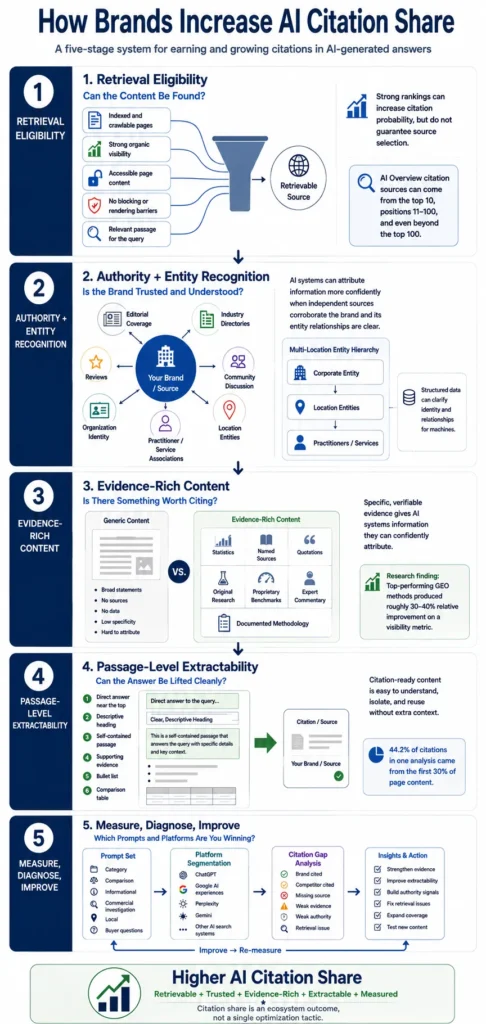
AI citation share increases when a brand becomes consistently retrievable, credible, corroborated by outside sources, and structured for easy extraction across the prompts buyers actually ask. As one industry synthesis puts it, “ranking in the organic top 10 is still the single best predictor of being cited… but roughly half or more of AI Overview citations now come from outside the top 10, and that share has been growing” — CapstonAI.
That gap is where most marketing teams lose visibility: they optimize for rank and assume citations follow automatically. Content Ops Lab builds citation-verified content programs for regulated, multi-location brands, and the pattern holds across every engagement — retrieval alone doesn’t win citations.
Related: How Does ChatGPT SEO Help Brands Get Cited?
What Does AI Citation Share Actually Measure?
AI citation share measures the percentage of attributed source citations a domain captures across a defined set of prompts and a fixed time window, rather than whether a brand is merely mentioned in an AI-generated answer. It requires an explicit internal definition, because commercial platforms calculate citations differently and inconsistent tracking produces numbers that can’t be compared over time.
How Is AI Citation Share Calculated?
The calculation is a simple ratio, but the tracking discipline behind it determines whether the number means anything over time.
- Count citations your domain receives within a tracked prompt set
- Divide by total citations issued across that same prompt set
- Track the result by engine, not as one blended number
- Recalculate on a fixed schedule to catch drift
- Treat the metric as directional, not a certified industry standard
How Is Citation Share Different From AI Share of Voice?
Citation share and share of voice answer different questions, and conflating them leads teams to chase the wrong signal. One definition frames citation share as “the percentage of total citations a query produces that come to your domain” — Frase. Share of voice, by contrast, measures whether a brand is named or discussed in an answer at all, with or without a clickable source link.
| Metric | What It Measures | What It Requires |
| AI Citation Share | Attributed source links captured across a prompt set | Retrievable, extractable, evidence-backed content |
| AI Share of Voice | Brand mentions inside generated answers | Broad topical presence and entity recognition |
A brand can appear frequently in AI share-of-voice tracking through mentions and comparisons, yet still capture a low citation share because competitors’ pages are the ones linked as sources.
Why Does the Measurement Definition Matter?
Denominator choice changes the number a team reports internally, so a citation share pulled from ten prompts and one platform tells a narrower story than the same metric pulled from a hundred prompts across five platforms. Prompt scope, platform scope, and which competitors are included in the comparison set all affect the results, which is why teams need a documented methodology before they start benchmarking month over month.
How Do Rankings and Retrieval Affect AI Citation Share?
Search visibility, indexing, crawlability, and retrievability are baseline conditions for AI citation share — a page has to be findable before it can be cited — but strong rankings increase the probability of citation without guaranteeing which source is selected. AI systems frequently retrieve content well outside the primary organic top 10 when subqueries, passage-level relevance, or specific evidence needs diverge from what ranks for the head term.
Why Does Organic Visibility Still Matter?
Ranking strength remains the strongest single predictor available for citation likelihood, because indexed, well-ranked pages are the ones AI retrieval systems encounter first when assembling an answer. Weak organic visibility caps a brand’s citation ceiling before evidence quality or structure ever get evaluated.
Why Doesn’t a Top Google Ranking Guarantee a Citation?
Source selection happens after retrieval, and a growing share of citations now comes from outside the conventional top 10. A March 2026 study found: “38% of citations from top-10 pages; 31.2% from positions 11–100; 31.0% from beyond top 100” — Ahrefs.
That distribution should not be generalized to all AI platforms; Google’s AI Overview citation behavior does not necessarily reflect how ChatGPT, Perplexity, or Gemini select sources for the same query.
What Can Prevent an Eligible Page From Being Retrieved?
Even well-ranked, well-written content can fall out of the retrieval pool entirely when technical access issues get in the way.
- Crawl restrictions that block AI retrieval bots entirely
- Indexing problems that keep pages out of the search corpus
- JavaScript rendering issues that hide key content from crawlers
- Content locked behind logins, paywalls, or interactive elements
- Thin technical infrastructure that slows or interrupts crawling
Why Do Authority and Entity Recognition Increase Citation Share?
AI citation share rises when independent sources corroborate what a brand publishes about itself, because AI systems weigh third-party validation heavily when selecting which source to attribute. Research shows a “systematic and overwhelming bias towards Earned media (third-party, authoritative sources) over Brand-owned and Social content” — arXiv.
Multi-location organizations face an added layer: the corporate entity, individual locations, and named practitioners are distinct entities that each need recognizable, consistent signals.
Why Does Third-Party Authority Matter?
AI systems treat independent validation as evidence a brand’s claims hold up outside its own marketing, which is why these surfaces carry disproportionate weight in source selection.
- Independent editorial coverage in trade or local publications
- Verified reviews on recognized third-party platforms
- Listings in trusted industry directories and associations
- Community discussion on forums AI systems already crawl
- Citations from other authoritative sites in the same category
How Does Entity Recognition Affect Attribution?
Entity recognition affects whether retrieved information gets correctly attributed to a brand, separate from whether the underlying content gets retrieved at all. Research on Gemini’s search behavior found that “Content not ranking in Google is unlikely to be cited by Gemini. Entities absent from Google’s Knowledge Graph will have their content retrieved without the brand being named” — Gemini SEO research.
Schema markup can support machine-readable signals for identity, authorship, and provenance, but it serves as clarifying infrastructure rather than a proven universal citation-ranking lever on its own.
What Changes for Multi-Location Brands?
Multi-location organizations have three distinct entity layers, and AI systems need consistent signals at each level to correctly attribute retrieved information.
- Corporate entity: central brand name, domain authority, and organization-level credibility signals
- Location entity: individual facility names, addresses, and location-specific service pages
- Practitioner/service associations: named staff, credentials, and the services tied to each location
Consistency across these three layers — not a single flagship page — determines whether AI systems attribute retrieved information to the right part of the organization.
Ready to build content infrastructure that scales without the compliance risk? Contact us to discuss your content production requirements.
How Does Evidence Quality Make Content More Citable?
Evidence density is one of the best-supported, most controllable levers a brand has over citation performance, ahead of sheer content volume. Statistics, named sources, direct quotations, first-party research, and documented methodology give AI systems concrete material to extract and attribute, rather than generic category summaries that offer nothing distinct to cite.
Why Do Statistics, Citations, and Quotations Matter?
Princeton GEO research found that “Including citations, quotations from relevant sources, and statistics can significantly boost source visibility, with an increase of over 40% across various queries… top-performing methods… achieved a relative improvement of 30-40% on the Position-Adjusted Word Count metric” — Princeton GEO research.
That result reflects visibility gains in Princeton’s own GEO metrics, not a guaranteed citation-rate lift that applies uniformly across all AI engines.
What Makes Original Information More Valuable?
Original information gives AI systems something no other source can provide, making it a stronger citation lever than a well-written but generic explanation.
- Proprietary benchmarks pulled from a brand’s own operations
- Original surveys of customers, patients, or industry peers
- Aggregated operational data not published anywhere else
- Case-study findings tied to specific, verifiable outcomes
- Named expert commentary with attributable credentials
When Does More Content Fail to Add More Evidence?
Adding word count without adding information gain does not improve citation odds; duplicated summaries, unsupported claims, and keyword-stuffed sections read as filler to both readers and retrieval systems. A shorter section built around original evidence can be more useful for citation than a longer section that simply restates widely available information.
Related: Google Rankings vs AI Citations – What Is the Difference?
Why Does Extractable Content Structure Affect AI Citations?
Citation selection depends heavily on passage-level usability — whether a specific answer can be lifted cleanly from a page without additional context. Front-loaded answers, descriptive headings, self-contained sections, lists, and tables all improve extractability, which is a distinct concern from simply adding more formatting for its own sake.
Why Should Important Answers Appear Early?
Citations concentrate disproportionately in the earlier portion of a page. One analysis found that “44.2% of citations come from the first 30% of content; 31.1% from the middle third; 24.7% from the final third” — Wix. Answer-first section openings put the extractable claim ahead of the supporting explanation, which aligns directly with that concentration pattern.
- Lead each section with a direct, standalone answer
- Place the strongest evidence in the first two sentences
- Push background and caveats after the core claim
- Avoid preambles that delay the actual answer
What Makes a Passage Easy to Extract?
A passage becomes easy to extract when it is semantically complete on its own, addresses one focused subquestion, and pairs a clear claim with visible evidence. Passages that require the reader to jump between paragraphs to understand a single point are far less likely to be lifted cleanly into a generated answer.
When Are Tables and Structured Formats Useful?
Tables and structured formats earn their place when the underlying information is genuinely comparative — multiple options evaluated against the same criteria, or enumerable steps where order matters. Structure should clarify existing complexity, not decorate simple prose that reads fine as sentences. Do not claim that a specific word count, table count, or heading ratio guarantees citation on its own.
How Should Brands Measure and Improve AI Citation Share?
Turning these factors into a measurement discipline means tracking citation performance against a defined set of buyer-relevant prompts, broken out by engine, intent, and competitor. Month-over-month movement should be read as an operational signal to investigate, not as a fixed, universal ranking.
Which Prompts Should a Brand Track?
An effective prompt set should mirror real buyer research rather than a single head-term keyword, covering the full range of questions a prospect might ask along the way.
- Category prompts describing the broad service or product area
- Comparison prompts pitting the brand against named competitors
- Informational prompts covering how-to and educational questions
- Commercial-investigation prompts signaling active buying research
- Local prompts tied to specific markets or service areas
- Buyer-question prompts drawn from real sales and support conversations
Why Should Citation Share Be Segmented by Platform?
Source behavior differs meaningfully across AI systems, so a single blended citation number obscures where the real gaps are. One index reported that “Reddit is the #1 source across every major AI engine, cited at roughly 40% frequency across LLMs… Wikipedia dominates ChatGPT, accounting for 26% to 48% of ChatGPT’s top-10 citation share” — 5W Public Relations. Segmenting by platform surfaces those differences instead of averaging them away.
What Should Marketing Teams Do With the Data?
Once citation gaps are visible by prompt and platform, teams can act on specific findings.
- Identify prompts where a named competitor is cited and the brand is not
- Audit which source types competitors rely on for those prompts
- Flag pages with retrieval eligibility but weak evidence density
- Pursue off-site authority opportunities in the source types AI systems favor
- Re-measure on a fixed cadence to confirm gaps are closing
Repeated citation may coincide with stronger authority and entity signals over time, but the available research does not establish that a single citation independently causes the next.
How Does Content Ops Lab Build Content for AI Citation Visibility?
Content Ops Lab treats AI citation visibility as a byproduct of repeatable content operations, not a one-time optimization project. Across a 23-month engagement with a 12-location regulated healthcare client, that operational discipline delivered 1,000+ articles and pages with verified citations and zero compliance issues along the way.
- 1,000+ articles and pages delivered with verified citations across the full 23-month engagement
- Zero compliance issues over the engagement
- 5x increase in monthly output, from 10 to 50+ articles per month
- 278 blog articles published within the tracked measurement window
- Research-first methodology using verified sources before generation begins
- Line-by-line citation verification built into every production cycle
- Multi-platform optimization across Google, ChatGPT, Perplexity, Claude, and Gemini
- Systematic production architecture built to scale without linear headcount growth
Traffic originating from AI search also converted at 21.4% on average, compared with a 3.32% site-wide average — a 6.4x difference. That gap doesn’t mean AI citation share caused the conversion lift, and it isn’t a guarantee for every industry, but it does establish that AI-originated traffic can carry real commercial value worth measuring alongside traditional search performance.
The Content Ops Lab Production System
Every article moves through the same four-stage system regardless of client size or industry, which makes citation-worthy output repeatable at scale.
- Research — verified sourcing before any drafting begins
- Verification — line-by-line citation and fact cross-checking
- Optimization — structural and platform-level extractability review
- Delivery — final QA against assignment and compliance standards
That system is what turns citation visibility from a one-off tactic into an operating discipline — which is exactly where measurement and improvement have to start.
If your operation needs to produce 20–50+ articles per month without sacrificing compliance or quality, Content Ops Lab builds the infrastructure to make that possible. Get in touch — we’ll assess your current content operation and outline what a systematic approach would look like for your organization.
FAQs About AI Citation Share
Is AI Citation Share Just Another Name for AI Share of Voice?
No. AI citation share measures attributed source links captured across a defined prompt set, while AI share of voice measures whether a brand is mentioned inside a generated answer at all. A brand can score well on share of voice through comparisons and mentions while still capturing a low AI citation share if competitors hold the linked source positions.
How Long Does It Take to Improve a Brand’s AI Citation Share?
Timelines vary by the starting authority, current retrieval eligibility, and the amount of evidence-rich content already in place. Brands with strong organic visibility and thin evidence density often see measurable movement faster than brands starting from weak retrieval, because structural and content fixes compound on top of an existing ranking base rather than starting from zero.
Can Brands Increase AI Citation Share Without Making Unsupported Claims?
Yes, and it’s the more durable approach. Improving retrieval, adding verifiable evidence, earning third-party corroboration, and structuring content for extraction all raise citation probability without relying on inflated claims, manipulation tactics, or promises no single team can guarantee across every AI platform.
Why Can a Lower-Ranking Competitor Have a Higher AI Citation Share?
Because citation selection happens after retrieval and depends on evidence quality, third-party corroboration, and extractability — not rank alone. A competitor ranking below a brand in Google can still win more citations if its content offers denser evidence, clearer structure, or stronger independent validation.
How Can Content Ops Lab Help Multi-Location Brands Improve AI Citation Visibility?
Content Ops Lab builds research-first, citation-verified content programs that address corporate-, location-, and practitioner-level entity signals collectively rather than treating each location as a separate content problem. The production system scales output volume while maintaining the evidence density, structural extractability, and compliance controls that multi-location and regulated brands require at every stage.
Key Takeaways
- AI citation share measures attributed source citations across a prompt set, not simple brand mentions
- Retrieval eligibility and strong organic rankings raise citation probability but don’t guarantee which source ultimately gets selected
- Third-party corroboration and consistent entity recognition matter just as much as the quality of owned content
- Evidence density — original statistics, quotations, and first-party research — is a stronger citation lever than raw content volume
- AI-originated traffic converted at 21.4% versus a 3.32% site average, a 6.4x gap worth measuring alongside search performance
- Citation share must be measured by prompt and platform, since source behavior varies across AI engines
- Marketing teams should audit competitor citation gaps by prompt and platform, then re-measure on a fixed cadence
Treat AI Citation Share as an Ongoing Operational Discipline
AI citation share rises when retrieval, authority, evidence quality, entity recognition, and extractable structure improve together — not when any single tactic is optimized in isolation. Rankings still matter, but they set a ceiling rather than a guarantee; what happens after retrieval determines which source actually gets cited.
Brands that wait for a single fix, whether schema, word count, or backlinks, will keep losing source attribution to competitors already treating this as measurable, ongoing work. Content Ops Lab builds that operational discipline into every engagement, turning citation visibility into something teams can track and improve rather than hope for.
Related: How AI Search Engines Evaluate Source Trust and Credibility