

What Are the Most Important AI Overview Ranking Factors?
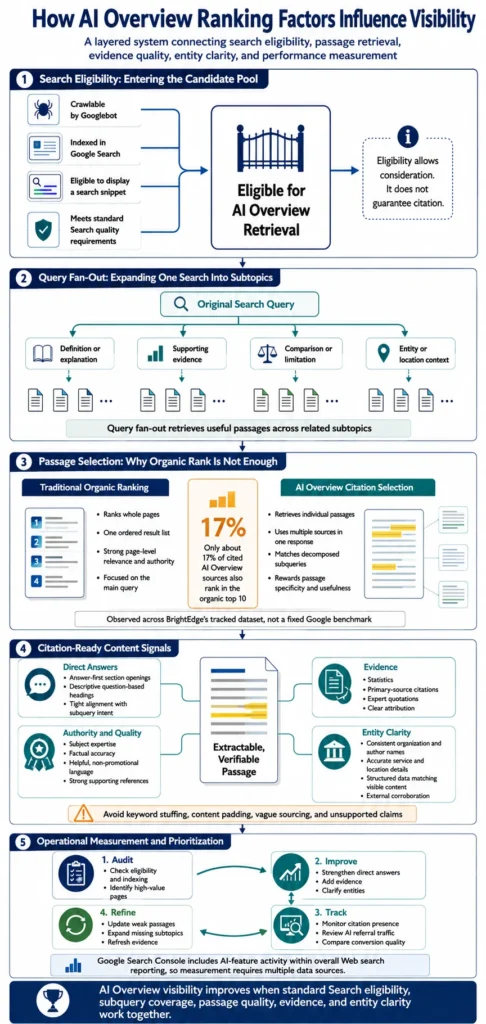
AI Overview ranking factors are not a separate, disclosed formula — they are an interconnected set of eligibility, retrieval, content, authority, and entity signals that determine whether a page can be found, retrieved, and cited. Google has confirmed that “AI Overviews use a customized Gemini model, which works in tandem with our existing Search systems – like our quality and ranking systems and the Google Knowledge Graph” — Google.
For marketing teams, that overlap creates a real problem: chasing a ranking-factor list that doesn’t exist wastes the budget better spent on documented signals. Content Ops Lab builds citation-verified content systems around those signals rather than speculative tactics.
Related: How Can Multi-Location Businesses Appear in Google AI Overviews?
What Do AI Overview Ranking Factors Actually Measure?
AI Overview ranking factors measure whether a page is eligible for retrieval, whether a passage matches a decomposed subquery, and whether the source is useful enough to support a generated answer — not a single weighted score. Google has not published a ranked list of AI Overview factors.
How Does Google Build an AI Overview?
Google starts with the user’s query, then may issue related searches to cover implied subtopics. Both AI Mode and AI Overviews “may use a ‘query fan-out’ technique — issuing multiple related searches across subtopics and data sources — to develop a response” —Google Search Central.
- Candidate sources are retrieved for each subquery
- Retrieved passages are synthesized into one response
- Supporting links are attached to the generated answer
- The process repeats independently for each new query
Fan-out explains why one well-ranked page rarely covers an entire AI Overview response alone.
Which Signals Belong to Eligibility and Retrieval?
Eligibility signals determine whether a page can be considered at all; retrieval signals determine whether a passage gets used. Google does not rank these layers against each other, and neither should marketing teams.
| Signal Layer | What It Controls | What It Does Not Guarantee |
| Technical eligibility | Indexing and snippet display | Citation or ranking position |
| Search quality systems | General helpfulness and trust | A specific AI Overview placement |
| Query relevance | Match to subquery intent | Inclusion in every related subquery |
| Passage usefulness | Answering a decomposed question | Selection over a more specific passage |
These signals do not all carry the same level of evidence. They fall into three practical categories:
- Documented: indexing, snippet eligibility, quality systems, query fan-out
- Observed: passage specificity, evidence density, entity clarity
- Emerging: generative-engine optimization studies, citation-overlap tracking
Why Is There No Universal Ranking-Factor Formula?
Several variables change which sources are useful for a given AI Overview, which is why a fixed, universal formula does not hold up across queries:
- Query type
- Industry vertical
- Available evidence
- User intent
- The specific claims the generated answer needs to support
A financial-services query and a healthcare query decompose differently and reward different passage structures. Treating optimization as a fixed checklist ignores that variability.
How Do Traditional Google Search Signals Affect AI Overview Visibility?
Crawlability, indexing, snippet eligibility, quality systems, and the Knowledge Graph form the technical foundation every AI Overview citation depends on. Traditional SEO remains necessary — a page that fails standard Search requirements never enters the candidate pool — but meeting those requirements does not control whether retrieval systems select that page.
Why Must a Page Be Crawled and Indexed First?
A page must be indexed and eligible to show in Google Search with a snippet before it can support an AI Overview response. Google states plainly: “To be eligible to be shown as a supporting link in AI Overviews or AI Mode, a page must be indexed and eligible to be shown in Google Search with a snippet, fulfilling the Search technical requirements. There are no additional technical requirements” — Google Search Central.
Technical eligibility checklist:
- Page is crawlable by Googlebot without blocks
- Page is indexed in Google Search
- Page is eligible to display a standard snippet
- Content is visible text, not hidden behind scripts
- No manual actions or quality penalties are active
How Do Quality and Authority Signals Carry Over?
Helpful-content standards, source reputation, link signals, expertise, and factual reliability carry over from traditional Search because AI Overviews draw on the same quality systems. Authority here is not a single domain score or backlink count.
- Demonstrated subject-matter expertise on the page itself
- Consistent factual accuracy across related content
- Reasonable link and reference patterns supporting claims
- A track record of helpful, non-manipulative content
- Trust signals that hold up sitewide, not just on one page
Which Technical Fixes Do Not Create AI Overview Rankings?
Several tactics marketed as AI Overview optimization are not documented Google requirements, and treating them as such misallocates effort.
| Misconception | Approved Treatment |
| Special AI schema improves citation odds | No special AI schema exists; ordinary structured data supports entity clarity |
| An llms.txt file controls AI retrieval | Not a documented ranking or admission requirement |
| Hidden content reaches AI systems | Only visible, crawlable text supports eligibility |
| More structured data always helps | Accuracy and consistency matter more than volume |
Eligibility opens the door to consideration. It does not guarantee retrieval, citation, prominence, or resulting traffic.
Why Do Organic Rankings and AI Overview Citations Differ?
Organic ranking and AI Overview citation selection share infrastructure but perform different jobs: organic results rank whole pages for a query, while AI Overviews retrieve individual passages supporting specific claims or subtopics. That distinction explains why a narrower, lower-ranking page can supply a more useful passage than a broader page ranking above it.
What Does the Top-10 Citation Overlap Reveal?
BrightEdge’s tracking found that “only about 17% of sources cited in AIOs also rank in the organic top 10 — and that number has been remarkably flat — barely moving over the entire tracking period” — BrightEdge. That figure describes BrightEdge’s tracked dataset, not a fixed Google benchmark, but the gap is directionally significant.
| Organic Ranking Objective | AI Overview Citation Objective |
| Rank the best whole page | Surface the best passage |
| Page-level authority | Passage-level usefulness |
| One position per query | Multiple sources per answer |
| Single keyword target | Decomposed subtopics |
Why Can Lower-Ranking Pages Earn Citations?
A page ranking outside the top 10 can still earn an AI Overview citation when its supporting passage does its job better than a broader competitor’s section. BrightEdge’s related tracking noted that “Most overlap growth comes from pages ranking 21-100, not top 10. Only 16.7% of citations come from top 10 results, suggesting Google seeks diversity within ranked content” — BrightEdge.
A handful of factors tend to separate a citable lower-ranking passage from a broad top-ranked page that gets passed over:
- Passage specificity — a narrow, direct answer to one subquery
- Evidence density — statistics, citations, or quotations that back the claim
- Subquery alignment — a tight match to the exact question decomposed from the query
- Narrower topical coverage — depth on one subtopic rather than breadth across many
This describes where citations concentrated in BrightEdge’s data, not a recommendation to target a lower position — Google has not indicated that ranking lower causes inclusion.
What Should Marketing Teams Optimize Beyond Position?
Marketing teams get more return from optimizing for citation coverage and passage quality than from chasing incremental ranking gains alone.
- Cover every subtopic a target query is likely to decompose into
- Own direct, extractable answers for each subtopic
- Keep entity references consistent across pages
- Strengthen passage-level evidence, not just page authority
- Track which subqueries the brand is retrieved for
If your operation needs to produce 20–50+ articles per month without sacrificing compliance or quality, Content Ops Lab builds the infrastructure to make that possible. Contact us to discuss your content production requirements.
Which Content Signals Improve AI Overview Citation Potential?
Answer-first structure, verifiable statistics, primary-source citations, expert quotations, descriptive headings, and complete subtopic coverage make a passage easier to retrieve, verify, and cite. These are extraction and evidence improvements that strengthen a page’s usefulness to Google’s retrieval systems — not standalone ranking hacks that work independently of everything else covered so far.
How Does Answer-First Structure Improve Extractability?
A section that opens with a direct, self-contained answer gives Google’s retrieval systems a clean passage to lift. Descriptive H3 headings that mirror likely subqueries, followed by supporting detail beneath the direct answer, make that passage easier to isolate.
- Lead each section with the direct answer, not a preview
- Match headings to language a user would actually search
- Keep supporting detail directly beneath the answer
- Avoid burying the answer inside a longer narrative
Why Do Statistics, Citations, and Quotations Matter?
Academic testing found that “including citations, quotations from relevant sources, and statistics can significantly boost source visibility, with an increase of over 40% across various queries” — Aggarwal et al. That study tested generative engines broadly; it did not disclose Google’s ranking weights or promise a matching lift in Google specifically. The mechanism is still instructive: explicit evidence helps a passage support a claim without requiring the model to infer accuracy.
| Evidence Type | Editorial Function | Misuse to Avoid |
| Original statistics | Anchors a claim to a measurable fact | Outdated or unsourced numbers |
| Direct quotations | Attributes a claim to an authority | Quoting out of context |
| Primary-source citations | Lets Google verify the claim | Citing secondary summaries |
| Expert commentary | Adds domain credibility | Commentary with no real expertise |
Which Content Practices Reduce Citation Value?
Some common production habits work against extractability even when a page looks complete.
- Keyword stuffing — adds noise without usable evidence
- Content padding — dilutes the passage a model would lift
- Persuasive sales language — reduces the neutral tone retrieval favors
- Unsupported claims — cannot be verified against a source
- Vague sourcing — leaves a claim without a citable origin
- Excessive simplification — strips terminology a query may require
Related: Google Rankings vs AI Citations – What Is the Difference?
How Do Entity Signals Affect AI Overview Rankings?
AI Overview source selection can depend on whether Google understands who or what a page represents, how that entity relates to the query, and whether business or location information stays consistent across relevant surfaces. Structured data supports that understanding — it is not a separate AI ranking mechanism.
How Does Google Connect Content to an Entity?
Google connects a page to an entity through organization names, named authors, described services and products, location details, internal relationships between pages, and external corroboration — all evaluated against Knowledge Graph alignment.
- Consistent organization and author naming across the site
- Clear service and product descriptions tied to the entity
- Accurate location and contact details where relevant
- Internal links reinforcing entity relationships
- External mentions corroborating the same entity details
Why Do Local and Multi-Location Signals Require Separate Attention?
Corporate-level authority and location-level accuracy are not the same thing, and multi-location organizations need both addressed deliberately.
| Brand-Level Signals | Location-Level Signals |
| Corporate site authority and depth | Individual location page accuracy |
| Brand-wide expertise and trust | Business Profile completeness |
| Company-level entity recognition | NAP consistency |
| Enterprise reputation | Location-specific reviews |
What Role Does Structured Data Actually Play?
Structured data should match visible page content and correctly identify real entities and relationships — it clarifies what is already true rather than manufacturing ranking credit.
Useful applications:
- Confirming organization, author, and location details already visible on the page
- Disambiguating entities that share similar names
- Reinforcing relationships between a brand and its locations
Unsupported expectations:
- Adding more schema fields will not, alone, improve AI Overview inclusion
- Schema cannot compensate for thin or inaccurate content
- Structured data is not a substitute for documented eligibility
Google’s own guidance confirms this framing: “You don’t need to create new machine readable files, AI text files, or markup to appear in these features. There’s also no special schema.org structured data that you need to add” — Google Search Central. That does not make structured data useless — it clarifies schema is not a separate AI Overview admission requirement.
How Should Marketing Teams Prioritize AI Overview Ranking Factors?
Prioritizing AI Overview ranking factors is a governance problem: technical eligibility, subtopic analysis, evidence-backed content, entity consistency, and citation measurement need clear ownership and a repeatable cadence. The goal is disciplined decision-making applied consistently across the portfolio, not a new named framework or numbered methodology layered on top of existing SEO work.
Which Pages Should Be Reviewed First?
Review order should follow business value and improvement opportunity, not publication date.
| Business Value | Improvement Opportunity |
| High-value informational pages | Ranking pages not yet cited |
| Pages losing AI Overview clicks | Strong evidence, poorly surfaced |
| Core commercial-topic pages | Missing answer-first structure |
| Named entity or location pages | Lacking passage specificity |
How Should Teams Divide Ownership?
AI Overview visibility cannot sit with one writer; it requires defined handoffs across functions.
| Function | Primary Responsibility | Required Handoff |
| SEO | Technical eligibility, indexing health | Flags issues to content |
| Content | Answer-first structure, evidence | Sends drafts to SMEs |
| Subject-matter experts | Accuracy, claim verification | Returns content to content team |
| Marketing operations | Entity and location consistency | Confirms with SEO and content |
| Digital PR | External corroboration | Shares placements with content |
| Analytics | Citation and performance tracking | Reports findings to all functions |
How Should AI Overview Performance Be Measured?
Measurement needs several combined signals; no single report captures performance end to end.
Dashboard checklist:
- Visibility — Citation presence and subtopic coverage over time
- Traffic — AI referral traffic and source-page changes tied to visibility shifts
- Conversion — Conversion quality from AI-attributed traffic versus other channels
- Content Quality — Passage extractability audits and citation freshness checks
Google Search Console does not isolate AI Overview traffic: “Sites appearing in AI features, such as AI Overviews and AI Mode, will be included in the overall search traffic in the Performance report in Search Console” — Google Search Central. Third-party citation tracking and referral analysis add visibility, but each carries coverage limitations and should be treated as directional.
How Does Content Ops Lab Build Content for AI Overview Visibility?
A 12-location regulated healthcare client’s content, produced under Content Ops Lab’s system, converts AI search traffic at 21.4% on average against a 3.32% site average — 6.4x higher. That figure reflects this client’s observed performance; it does not mean AI Overview citations produced the conversion rate, that all AI-attributed traffic originated from Google, or that another organization should expect the same result. It shows AI search traffic can carry real commercial value when content is built for accuracy and extraction.
Content Ops Lab operates as a production-system partner for organizations applying AI Overview optimization across a large content portfolio without sacrificing accuracy, brand consistency, or compliance:
- Research-first content development from credible sources
- Citation verification against original research
- Question-based architecture for conversational search
- Answer-first section openings built for extraction
- Multi-platform optimization across Google and AI search
- Knowledge-base integration for client expertise and context
- Multi-stage quality control before publication
- Scalable workflows for multi-location portfolios
The Content Ops Lab Production System
Every article moves through four fixed stages that keep evidence and compliance consistent at scale.
- Research — Source credible evidence and confirm claims against documentation
- Verification — Check every citation, statistic, and quote before drafting
- Optimization — Structure content for answer-first extraction and entity clarity
- Delivery — Apply final QA against assignment and compliance standards
That system makes AI Overview optimization repeatable at 20-plus articles a month, not a one-off project. For a VP of Marketing managing a large content footprint, the alternative is a portfolio where every article becomes a custom rescue job — inconsistent evidence standards, uneven extractability, and compliance risk that scales with volume instead of shrinking. Applying the same research, verification, and extraction standards across every asset is what keeps that risk flat as the portfolio grows.
Ready to build content infrastructure that scales without the compliance risk? Get in touch — we’ll assess your current content operation and outline what a systematic approach would look like for your organization.
FAQs About AI Overview Ranking Factors
Are AI Overview Ranking Factors Separate from Traditional SEO Ranking Factors?
No. AI Overview visibility builds on the same technical eligibility, quality systems, and Knowledge Graph foundation as traditional Search. Google requires standard indexing and snippet eligibility, with no additional technical admission system. What differs is retrieval: AI Overviews select individual passages for decomposed subqueries, while organic results rank whole pages for one query.
How Long Does It Take to Improve Visibility in Google AI Overviews?
Timelines vary by starting technical health, content gaps, and query competitiveness — there is no fixed number of weeks that applies universally. Because Search Console does not isolate AI Overview traffic natively, teams should expect a measurement lag before citation and referral patterns become clear enough to evaluate progress across a large content portfolio.
Can AI-Generated Content Rank or Get Cited in an AI Overview?
Content origin is not the deciding factor — accuracy, verification, and extractability are. Google’s documented requirements center on indexing, quality, and snippet eligibility rather than how content was produced. That is why citation verification remains a required production step regardless of drafting method, since an unverified claim carries the same risk either way.
Is Ranking in the Organic Top 10 Enough to Appear in an AI Overview?
Not reliably. BrightEdge’s tracked data found roughly 17% overlap between organic top-10 rankings and AI Overview citations, with much of the observed citation growth coming from pages ranking outside the top 10. Organic strength remains foundational to eligibility, but it does not directly control which passages retrieval systems ultimately select for citation.
Do Companies Need a Dedicated AI Search Team to Improve AI Overview Visibility?
No dedicated team is required, but clear ownership is. Responsibility typically spans SEO, content, subject-matter experts, marketing operations, digital PR, and analytics, with defined handoffs between them rather than one person owning the entire workflow. What matters most is a repeatable review process, not a new department.
Key Takeaways
- AI Overview visibility depends on layered eligibility, retrieval, content, authority, and entity signals — not a disclosed Google formula.
- Traditional SEO eligibility is necessary but does not determine which passages Google ultimately cites.
- BrightEdge found only about 17% organic top-10 overlap with AI Overview citations, showing the systems diverge in practice.
- A 12-location regulated healthcare client saw a 21.4% AI search conversion rate versus a 3.32% site average under Content Ops Lab.
- Answer-first structure, verifiable evidence, and entity consistency improve extractability more reliably than isolated tactics.
- Marketing teams that build repeatable AI Overview processes now can establish citation visibility before adoption becomes more competitive.
- Start by auditing high-value pages for eligibility and evidence density, then build measurement around citation tracking.
Why Defensible AI Overview Optimization Beats Chasing a Formula
AI Overview visibility begins with standard Search eligibility, then improves as content answers decomposed subqueries clearly, backs claims with verifiable evidence, establishes entity authority, and gives Google extractable passages that do specific work inside a generated response. No documented Google formula rewards a single tactic in isolation.
Organizations waiting for an official ranking-factor list will keep waiting; organizations that build repeatable research, verification, optimization, and measurement into their content operation are already positioned for whatever Google’s retrieval systems reward next. That operational discipline — not a shortcut — is what Content Ops Lab builds for organizations that need it applied consistently across their content portfolio.
Related: How AI Search Engines Evaluate Source Trust and Credibility