

How Does ChatGPT SEO Help Brands Get Cited?
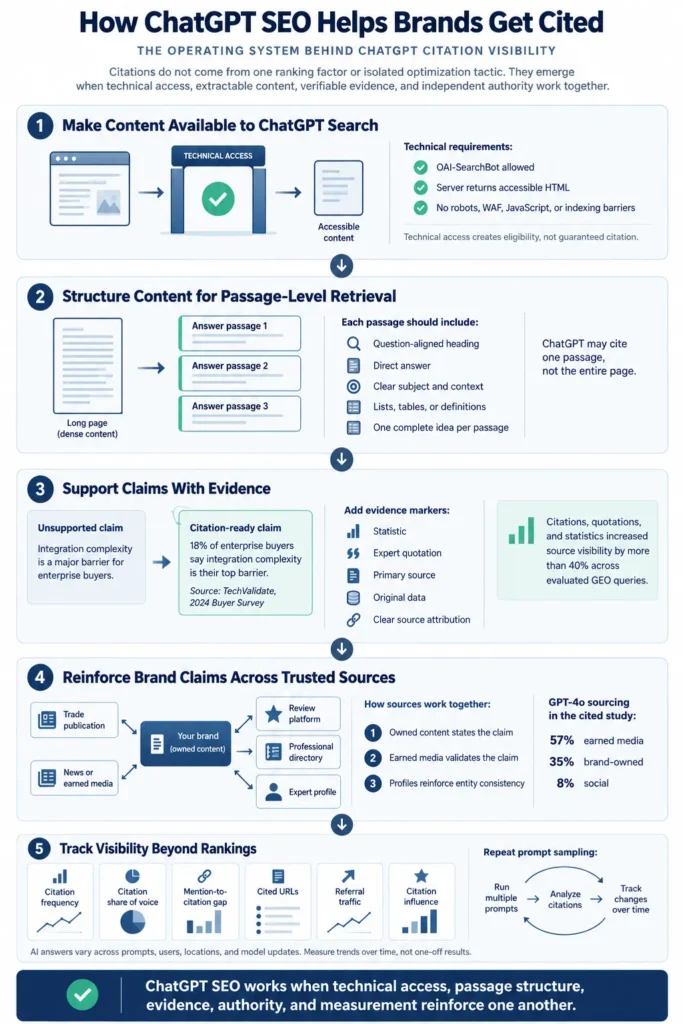
ChatGPT SEO helps brands earn citations by making brand information accessible to crawlers, extractable as self-contained passages, verifiable through evidence, and corroborated by independent sources. Ranking placement inside ChatGPT search “is based on a number of factors designed to help users find reliable, relevant information,” and there is “no way to guarantee top placement” — OpenAI.
That frustrates marketing teams who assume a high Google position or aggressive keyword optimization will automatically translate into ChatGPT citations — it does not. Content Ops Lab builds the citation-ready content infrastructure that closes this gap, coordinating research, verification, and technical publishing into one production system built for regulated and multi-location brands.
Related: How AI Search Engines Decide Which Sources to Cite
What Is ChatGPT SEO, and How Is It Different From Traditional SEO?
ChatGPT SEO coordinates technical access, content structure, evidence, entity clarity, and external authority so ChatGPT can retrieve and cite brand information inside a synthesized answer. Traditional SEO seeks document visibility and clicks from a ranked results page. ChatGPT SEO seeks source participation inside the answer itself, where a single passage — not the whole page — determines credit.
How Traditional SEO Competes for Ranked Visibility
Traditional SEO competes at the document level, optimizing an entire page for relevance, technical accessibility, and authority, measuring success by impressions and clicks.
- Targets document-level relevance signals
- Requires technical crawlability and clean indexation
- Builds authority through backlinks and domain trust
- Converts through user clicks on a ranked listing
- Reports success via rankings, impressions, and CTR
The click remains a central traditional SEO success metric, but it does not transfer cleanly to answer engines.
How ChatGPT SEO Competes for Answer Participation
ChatGPT SEO competes at the passage level. The system retrieves candidate content, evaluates extractable claims and supporting context, and selects sources for inline citation.
- Retrieves candidate passages, not full documents
- Extracts factual claims for direct reuse
- Evaluates claims alongside supporting context
- Selects sources for citation, not ranking
- Converts through referral traffic from a citation link
A page can rank well on Google and still fail every one of these passage-level tests.
Why Google Rankings and ChatGPT Citations Diverge
Google rankings and ChatGPT citations rest on different retrieval systems, and the gap is measurable. GPT-4o “shows the lowest mean overlap at 4.0%, followed by Gemini (11.1%), Claude (12.6%), and Perplexity (15.2%),” with its cited domains diverging the most from Google’s top-ranked domains — arXiv. Teams tracking only conventional rankings are measuring a system that predicts ChatGPT citation behavior poorly.
This does not make traditional SEO irrelevant: technical SEO, indexability, and useful content remain valuable foundations, even though they don’t proxy for ChatGPT source selection.
| Dimension | Traditional SEO | ChatGPT SEO |
| Primary outcome | Ranked position on a results page | Inline citation inside a generated answer |
| Retrieval unit | Full document or page | Extractable passage |
| Authority signals | Backlinks, domain trust | Verifiable evidence, corroboration |
| Typical user action | Click through to the page | Read or click the citation link |
| Measurement method | Rankings, impressions, CTR | Citation frequency, share of voice |
| Relationship to citations | Foundational, not predictive | Direct, outcome-defining |
How Does ChatGPT Find and Cite Brand Content?
ChatGPT draws on two information sources: static knowledge from pre-training and live retrieval at query time. Citation eligibility depends on the second pathway, which relies on dedicated web crawlers rather than training data. OAI-SearchBot, GPTBot, and ChatGPT-User serve different functions, and treating them as interchangeable creates avoidable visibility gaps.
What OAI-SearchBot Does
OAI-SearchBot is the crawler responsible for surfacing websites inside ChatGPT’s search features. Its access status determines whether a domain is even eligible to appear as a cited source.
- Surfaces indexed pages in ChatGPT search results
- Determines citation eligibility, not citation selection
- Requires normal crawl access to function
- Operates separately from training-data crawlers
- Can still allow navigational links if blocked
Sites that opt out “will not be shown in ChatGPT search answers, though can still appear as navigational links” — OpenAI. Blocking it removes a brand from consideration before any content-quality factor comes into play.
How GPTBot and ChatGPT-User Differ
GPTBot and ChatGPT-User serve different purposes than OAI-SearchBot, and the three should never be presented as interchangeable in an audit or a technical brief.
| OpenAI user agent | Primary function | Relevance to citation visibility |
| OAI-SearchBot | Crawls and indexes content for ChatGPT search | Determines search-citation eligibility |
| GPTBot | Collects data for foundation-model training | Shapes model knowledge, not live citations |
| ChatGPT-User | Fetches a page for an active user request | Enables browsing, not indexing |
Blocking GPTBot affects future training, not today’s citation eligibility — confusing the two leads teams to over-restrict access or leave the wrong crawler unmanaged.
Which Technical Barriers Prevent Retrieval
Technical access is necessary but insufficient. Crawlable content can still fail retrieval when infrastructure quietly blocks it. Audit checklist for retrieval barriers:
- Confirm OAI-SearchBot is not disallowed in robots.txt
- Verify server response codes return 200, not 403 or 429
- Check whether a WAF rule is silently blocking crawler traffic
- Render the page as a bot would to confirm content is not JavaScript-only
- Review meta robots and X-Robots-Tag directives for unintended noindex flags
- Confirm canonical tags point to the intended, crawlable URL
A page can pass every item on this checklist and still go uncited if the content is generic or difficult to extract — technical access opens the door, it does not walk the brand through it.
If your operation needs to produce 20–50+ articles per month without sacrificing compliance or quality, Content Ops Lab builds the infrastructure to make that possible. Contact us to discuss your content production requirements.
What Makes Content Easier for ChatGPT to Extract and Cite?
ChatGPT needs self-contained passages that directly answer a recognizable question and can be verified without reconstructing meaning from disconnected sections of a page. Passages that require surrounding context are less likely to be lifted cleanly into an answer.
Build Self-Contained Answer Passages
A citation-ready passage should function correctly even when it is pulled out of the article and placed inside someone else’s answer.
Passage-level requirements:
- Open with a direct answer to a specific, recognizable question
- Name the subject explicitly instead of relying on pronouns
- Include enough context to stand alone outside the article
- Avoid burying the answer under throat-clearing setup
- Use explicit, question-aligned headings above each passage
Passages built this way survive extraction intact; passages needing three prior paragraphs of context typically don’t.
Add Verifiable Evidence to Important Claims
Evidence density changes extraction outcomes. Research on generative engine optimization found that “including citations, quotations from relevant sources, and statistics can significantly boost source visibility, with an increase of over 40% across various queries” — Pranjal Aggarwal et al. That figure reflects the evaluated GEO methods and query set rather than a universal guarantee, but the underlying pattern — evidence outperforms assertion — holds directionally.
- Unsupported: vague adjectives with no backing
- Citation-ready: a statistic tied to a named source
- Citation-ready: an attributed expert quotation
- Citation-ready: a verifiable primary-source reference
Unsupported marketing copy asserts a claim without support: “our platform delivers industry-leading results.” Citation-ready evidence backs the same claim with a checkable source ChatGPT can verify.
Use Structure That Preserves Meaning
Structural elements act as extraction aids, not decoration. Semantic heading hierarchy, lists, tables, and concise definitions all signal where one discrete idea ends and another begins.
| Structural element | Extraction function |
| Semantic H2/H3 headings | Signals the question a passage answers |
| Bulleted lists | Separates parallel points into units |
| Comparison tables | Preserves attribute relationships |
| Concise definitions | Anchors a term to one citable meaning |
| Source-attributed statistics | Connects a quantitative claim to verifiable evidence |
A page loaded with decorative formatting but no structural logic offers little extraction benefit — the goal is meaning preservation, not visual variety.
Why Does Third-Party Authority Influence ChatGPT Citations?
Brand-owned pages define claims, services, data, and expertise. External sources provide independent corroboration that owned content cannot. ChatGPT weighs both, and skipping third-party authority leaves owned claims without the validation that often determines whether they support an answer.
What Brand-Owned Content Should Establish
Owned content is the foundation, but only a foundation.
- First-party facts about products and services
- Original research or proprietary data
- Named expert credentials and author identity
- Specific service and location details
- Clear, unambiguous source ownership
None of these claims corroborate themselves.
How Earned Media Corroborates Brand Claims
Independent repetition of a brand’s facts by outlets it does not control is what turns an assertion into something ChatGPT can treat as verified. Sourcing patterns show why this matters: “Google shows balanced sourcing (41% earned, 34% social, 26% brand), while AI engines favor earned over social content,” with GPT-4o citing “57% earned, 8% social” content — arXiv.
| Authority type | Editorial control | Verification role |
| Owned (brand website) | Full brand control | States the claim, doesn’t corroborate it |
| Earned (press, trade publications) | Independent editorial judgment | Provides outside validation |
| Profile-based (directories, review platforms) | Low editorial scrutiny | Reinforces entity facts |
Earned coverage, analyst references, and trade interviews supply the evidence layer owned pages can’t provide alone.
Why Entity Consistency Supports Verification
ChatGPT needs to resolve who a brand is, what it does, and where it operates before it can trust corroborating sources as referring to the same entity.
Entity-consistency checklist:
- Brand name spelled and formatted identically everywhere
- Executive names and titles consistent across sources
- Services described the same way across owned and earned content
- Location and NAP details matching across every listing
- Parent-to-location entity relationships clearly documented
Unlinked mentions and schema markup can support consistency, but neither directly causes a citation — OpenAI hasn’t disclosed a quantified weighting for either.
Related: Structured Content for AI Search: How It Gets You Cited by AI
Why Can ChatGPT Mention a Brand Without Citing Its Website?
A brand can be well known, mentioned, or actively recommended by ChatGPT while a different domain — a publisher, directory, review platform, or competitor — receives the citation. Recognition, mentions, recommendations, and citations are four separate outcomes, and conflating them leads teams to celebrate visibility that never converts.
What a Brand Mention Indicates
A mention shows that the model recognizes a brand and associates it with a category, often from pre-training exposure rather than live retrieval.
- Name appears without a link
- Reflects category association, not live evidence
- Often sourced from pre-training exposure
- Carries no referral or attribution opportunity
What a Recommendation Indicates
A recommendation shows that ChatGPT evaluated the brand against a user’s stated criteria — location, reputation, or service fit. It does not guarantee that the recommended company also receives the citation.
- Weighed against explicit user criteria
- Draws on reputation and external evidence
- Named as a suggestion within the answer
- Doesn’t require the brand’s page as source
What a Direct Citation Indicates
A direct citation shows live retrieval and visible source attribution — the strongest evidentiary threshold, and the only outcome that creates a referral opportunity back to the brand’s own domain.
| Outcome | Definition | Likely source | Visible output | Marketing value |
| Recognized | Model associates a brand with a category | Pre-training exposure | Brand name in generated text | Awareness signal only |
| Mentioned | Brand named without attribution | Pre-training exposure | Inline text, no link | Limited, unmeasurable |
| Recommended | Brand evaluated against user criteria | External evidence | Named suggestion | Reputation reinforcement |
| Cited | Brand page used as a live source | Direct retrieval | Attributed source with link | Referral opportunity |
Semrush research found “fewer than 30% of AI responses mention and cite the same brand,” and “fewer than one in five brands are frequently mentioned and consistently cited as a source” — Search Engine Land / Semrush Data. That gap isn’t universal across every query or model, but it’s wide enough that mentioning volume alone is a poor citation proxy.
How Should Marketing Teams Build and Measure a ChatGPT SEO Program?
ChatGPT SEO is a coordinated operating responsibility, not a single team’s task list. It spans content, technical SEO, digital PR, analytics, and brand governance, requiring a measurement system built for an environment where outputs vary across prompts, users, and model updates.
Assign Ownership Across Marketing Functions
Citation visibility breaks down when one function assumes another owns a requirement no one is managing.
| Function | Core responsibility |
| Web / technical SEO | Maintains crawl access and page performance |
| Content | Produces self-contained, evidence-backed passages |
| Marketing operations | Coordinates the production system across teams |
| Digital PR | Secures earned media for third-party corroboration |
| Analytics | Tracks referral traffic and conversions |
| Brand or location operations | Maintains entity and NAP consistency |
Measure Visibility Beyond Referral Clicks
Referral traffic alone understates citation performance because it misses mentions that never converted into clicks and citations that shaped a decision without a tracked visit.
| Metric | Definition | Calculation | Business use |
| Citation frequency | How often a domain is cited across sampled prompts | Citations ÷ prompts sampled | Tracks visibility over time |
| Citation share of voice | Brand’s citation volume vs. competitors | Brand citations ÷ category citations | Benchmarks competitive standing |
| Mention-to-citation gap | Difference between mention rate and citation rate | Mention rate minus citation rate | Flags awareness not converting |
| Referral traffic | Sessions arriving via ChatGPT’s UTM parameter | Sessions tagged utm_source=chatgpt.com | Confirms citation-driven clicks |
| Citation influence | Qualitative weight of a citation in the answer | Manual review of answer context | Assesses response impact |
ChatGPT referral traffic can be isolated directly in standard analytics: “ChatGPT automatically includes the UTM parameter utm_source=chatgpt.com in referral URLs, enabling clear tracking and analysis of inbound traffic from ChatGPT search results” for publishers that allow OAI-SearchBot access — OpenAI.
Interpret Prompt Tracking as a Variable Signal
Prompt-tracking output should never be treated as a static rank report, because the underlying system is noisier than a search-engine results page. As one industry guide puts it, “you’re measuring against systems that can change the answer format, cited sources, wording, and even brand recommendations from one run to the next” — the tools are not flawed, the environment is simply less stable Search Engine Land.
Repeatable prompt-sampling checklist:
- Run a stable, documented prompt set on a consistent schedule
- Repeat each prompt multiple times to capture output variance
- Control for geography and user context where possible
- Record the model version used for each sampling run
- Track directional trends across weeks, not single-run snapshots
Treat individual runs as samples and longitudinal patterns as the meaningful signal.
How Does Content Ops Lab Build Citation-Ready Content Systems?
ChatGPT SEO is a content-operations problem, not a single-tactic checklist, requiring coordination among research, evidence verification, article structure, technical publishing, and measurement. Content Ops Lab built its production system for organizations that need to meet these requirements repeatedly, at volume, across regulated subject matter and multiple locations.
- 1,000+ articles and pages delivered with verified citations across a 23-month engagement
- Zero compliance issues over the entire engagement
- 5x increase in monthly output, from 10 to 50+ articles per month
- 278 blog articles published in the tracked window
- 21.4% average AI search CVR vs. 3.32% site average (6.4x better)
- 95+ confirmed AI search conversions
- 887% ChatGPT traffic growth in seven months
That conversion gap matters: AI-referred visitors can carry substantial commercial value, and citation visibility deserves operational attention beyond impression reporting.
The Content Ops Lab Production System
Content Ops Lab organizes production through four consistent stages:
- Research — build the evidence base and source the claims an article will make
- Verification — confirm every citation, statistic, and quotation against its source
- Optimization — structure content for extractability and answer participation
- Delivery — publish with technical access, tracking, and formatting confirmed
Coordinating these stages consistently is what separates a citation-ready operation from a one-off optimization effort.
Ready to build content infrastructure that scales without the compliance risk? Get in touch — we’ll assess your current content operation and outline what a systematic approach would look like for your organization.
FAQs About ChatGPT SEO
Does ranking first on Google make a brand more likely to be cited by ChatGPT?
Not directly. Traditional search strength supports discovery and authority, but ChatGPT’s cited domains can differ substantially from Google’s top organic results. High rankings help brands get found, not automatically get cited.
How long does it take to improve ChatGPT citation visibility?
There’s no fixed timeline — citation selection depends on an ongoing combination of crawl access, extractable content, and third-party corroboration, not a one-time change. Teams treating citation visibility as a continuous system, tracked through longitudinal prompt sampling, see clearer progress than teams expecting a single ranking event.
Can ChatGPT SEO create compliance or misinformation risks?
It can, if evidence goes unverified or claims are overstated. A process built around cited, source-verified passages and explicit claim controls reduces this risk, which is why verification is a distinct production stage rather than folded into drafting.
Is ChatGPT SEO different from traditional SEO and digital PR?
Yes, though it depends on both as foundations. Traditional SEO establishes crawlability and document-level authority, and digital PR builds the earned-media corroboration ChatGPT weighs heavily; ChatGPT SEO adds passage-level extractability and citation-specific measurement on top.
Should a company build ChatGPT SEO capabilities internally or use a managed content system?
That depends on publishing volume and cross-functional bandwidth. Programs spanning content, technical SEO, digital PR, analytics, and entity governance at meaningful volume — particularly in regulated or multi-location environments — often adopt a managed production system to keep verification and structure consistent.
Key Takeaways
- ChatGPT citations come from a coordinated system — crawl access, extractable content, entity clarity, verified evidence, and independent authority reinforcing each other.
- Traditional rankings remain useful foundations, but they do not reliably predict which sources ChatGPT will cite.
- Content Ops Lab delivered 21.4% average AI search CVR vs. 3.32% site average (6.4x better).
- Brand mentions, recommendations, and direct citations are separate outcomes that require different measurement and optimization strategies.
- Citation visibility requires an ongoing operating system, not a one-time optimization pass.
- Brands that establish ownership and citation measurement now can build visibility before ChatGPT SEO becomes a standard competitive requirement.
How Should Brands Move Forward With ChatGPT SEO
ChatGPT citations reward brands that treat visibility as a coordinated system rather than a single tactic: accessible to crawlers, extractable at the passage level, backed by verifiable evidence, and corroborated by independent sources. Google rankings and keyword density alone do not produce this outcome, and brands optimizing only for traditional search will keep losing citation share to competitors building for both retrieval environments at once.
Most brands have not yet operationalized citation measurement the way they operationalized rank tracking a decade ago, and that window for deliberate action is still open. Content Ops Lab has run this exact production system at scale, in a regulated industry, with zero compliance issues — evidence that scalable, citation-ready content production and operational discipline can coexist.
Related: Ranking vs Being Cited – What Actually Drives Visibility in AI Search?