

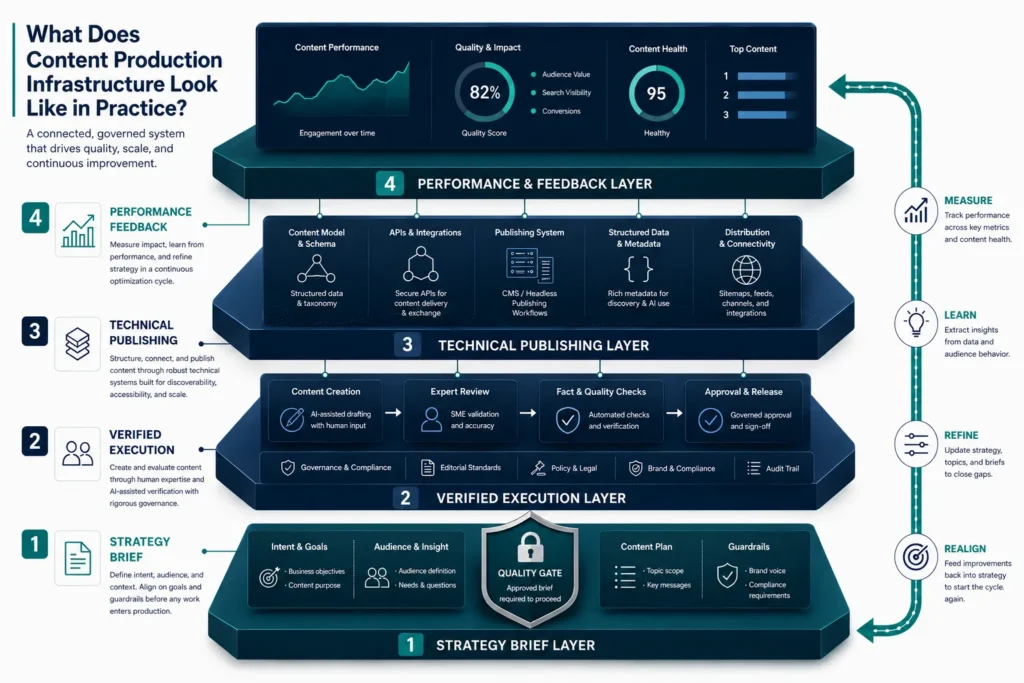
What Does Content Production Infrastructure Look Like in Practice?
Content production infrastructure is the operational system that converts marketing strategy into published output at scale — not a tool stack, not a content calendar, not a team of writers. “Content operations sits between content management and content marketing, connecting strategy to execution. It is inherently cross-functional—marketing and IT must collaborate for it to work. Most enterprises have invested in the first two while ignoring the third, which explains why content bottlenecks persist despite better tools,” — Dotfusion.
For multi-location operators running 5, 10, or 20+ properties, the gap in that third layer is where production ceilings come from. Workflows tell people what to do. Infrastructure ensures the work is done consistently, regardless of who does it.
Content Ops Lab built this infrastructure inside a 12-location regulated healthcare organization — 1,000+ citation-verified articles delivered across 23 months with zero compliance violations.
Related: Content Systems vs Content Teams – Why Structure Wins at Scale
Why Do Most Multi-Location Content Operations Break Before They Scale?
Most content operations break at scale because the approach was built for low volume — individual writers, ad hoc research, email-based approvals — and was never designed to carry high-velocity publishing without quality degradation. The gap isn’t talent. It’s architecture.
The Strategy-Execution Gap
Most organizations have invested in content management platforms and content marketing strategies while ignoring the operational layer that connects the two.
Most organizations have invested in content management platforms and content marketing strategies while leaving the operational layer connecting the two undefined. The result is a production pipeline that can’t fulfill the strategy it was built to serve — content calendars that fill up, bottlenecks that persist despite better tools, and publishing volume that plateaus well below what the business needs.
- Strategy exists, but production can’t execute it at scale
- Marketing and IT operate in separate lanes with no handoff clarity
- Content calendars fill up; the system to fulfill them never gets built
The symptom is a production ceiling. The cause is a missing operational layer.
Workflow Fragmentation Points
Many organizations hit a ceiling because they’ve accumulated tools without aligning their processes underneath them. The result is duplicated effort, missed deadlines, and low tool adoption — what operations researchers call “shiny tool syndrome.”
- No single defined content owner at each production stage
- Approval cycles run through email with no audit trail
- Research, drafting, review, and publishing are handled in separate systems with no handoff logic
Fragmented workflows don’t just slow output — they create compliance exposure whenever a step is skipped under deadline pressure.
What a Production Ceiling Looks Like
Internal teams typically top out at 4-8 articles per month before quality starts degrading or the team burns out. At that ceiling, multi-location operators face a specific problem. Each location needs unique, locally optimized content, but the system can’t produce it without proportionally scaling headcount.
- Location-specific content collapses into templated copy-paste
- Brand voice consistency becomes personality-dependent
- Compliance review becomes the bottleneck that limits everything else
Hitting the ceiling isn’t a resourcing problem — it’s confirmation that the system was never designed for the volume the business actually needs.
What Is Content Debt and Why Does It Compound Faster Than Most Operators Expect?
Content debt accumulates when organizations prioritize publishing velocity without building the maintenance infrastructure to keep what they’ve published accurate, consistent, and AI-visible. In the short term, it looks like productivity. In the long term, it actively undermines search performance.
How Content Debt Accumulates
“Content debt is the implied cost of future reworking required when choosing an easy but limited solution instead of a better approach that could take more time. Like financial debt, content debt allows you to create something quickly instead of doing it exactly right” — Scriptorium.
- Teams create faster than they maintain — outdated claims accumulate across hundreds of pages
- Ownership changes without documentation create narrative inconsistency across locations
- Tech migrations leave orphaned content and broken links that suppress crawl performance
The compounding effect is the real danger: each new article published without a maintenance system adds to the debt load.
The AI Visibility Penalty
Content debt doesn’t just affect traditional SEO rankings — it now directly affects AI search visibility. Outdated content that still appears in crawl data sends conflicting signals to AI systems that are attempting to understand your brand’s authority and positioning.
- Different location pages making incompatible claims confuse AI interpretation
- Outdated statistics cited across old articles influence AI’s perception of current claims
- Narrative inconsistency across a content library erodes the cross-source corroboration AI systems require
The content published without a verification infrastructure two years ago is still actively read by AI systems today.
Debt vs. Infrastructure Investment
The framing most operators resist: content debt is a balance sheet problem, not a content problem. Every article produced without citation verification, maintenance triggers, or structural standards for AI extraction is a liability being added to the ledger.
- Infrastructure investment front-loads the quality work that debt requires you to repeat later
- A governed system reduces rework by embedding quality standards into the production process
- The operator who builds infrastructure at 20 articles/month doesn’t inherit the debt load at 50
The cost of doing it right now is always lower than the cost of fixing it at scale.
What Are the Real Options for Content Production at Scale?
Multi-location operators evaluating content production have three realistic options: build internal team capacity, hire a traditional agency, or deploy generic AI content tools. Each has genuine trade-offs worth understanding before choosing a path — or deciding that systematic infrastructure is the right answer.
Internal Team Constraints
An internal content team offers brand knowledge, editorial control, and direct SME access. These are real advantages. The constraint is structural: internal teams produce 4-8 quality articles per month at maximum sustainable velocity before burnout or quality degradation sets in.
- Deep brand familiarity doesn’t translate into production scale
- Location-specific content needs multiply the workload without adding headcount
- Research, drafting, compliance review, and publishing compete for the same bandwidth
Internal teams are well-suited to editorial oversight and quality control. They’re not designed to be the primary production engine at 20-50+ articles per month.
Traditional Agency Trade-offs
Traditional content agencies offer scale—but their production model is volume-oriented by design. More output requires more writers, which means higher cost and greater inconsistency in brand voice, research quality, and citation accuracy.
- Template-driven structures don’t accommodate the local optimization that multi-location operators require
- Citation verification is rarely built into agency workflows (the economics don’t support it)
- Most agencies optimize for 2019-era Google signals, not AI platform citation criteria
Agencies solve the volume problem. They rarely solve the compliance problem, the local optimization problem, or the AI search problem simultaneously.
Generic AI Content Risks
AI content tools accelerate output dramatically. They do not, by default, verify what they produce. The result is content that sounds authoritative while citing nonexistent sources, using fabricated statistics, and making claims that fail compliance reviews in regulated industries.
- AI writes from training data, not from verified source research
- Hallucinated citations and fabricated statistics are a documented production risk
- Without a verification layer, AI-generated content at scale multiplies compliance exposure proportionally
Generic AI tools are a production accelerator. Without a systematic verification infrastructure underneath them, they’re also a liability accelerator.
If your operation needs to produce 20-50+ articles per month without sacrificing compliance or quality, Content Ops Lab builds the infrastructure to make that possible. Contact us to discuss your content production requirements.
What Does Production-Grade Content Infrastructure Actually Include?
Production-grade content infrastructure is a layered system — not a tool, not a workflow, not a single platform. It’s the coordination of people, processes, and verification mechanisms that uphold quality standards at every stage of publishing, regardless of who executes any given step.
Semantic Scaffolding for AI Retrieval
AI search systems don’t retrieve content the way traditional search engines do. “AI engines reward organizations whose content is built on structure, clarity, and conceptual hierarchy. Structured content architecture has become the new currency of visibility because AI engines do not retrieve content the way traditional search engines do. They do not ‘crawl’ for keywords; they interpret meaning.” — Webolutions.
- Hierarchical heading structure (H1 → H2 → H3) signals conceptual priority to AI systems
- Answer-first paragraph formatting (40-60 words) increases the citation worthiness of individual passages
- Consistent entity naming across all location pages supports cross-source corroboration
Infrastructure that isn’t built for AI extraction is invisible to the channel that converts at 6x the rate of traditional organic traffic.
Citation Verification and Compliance Layers
In regulated industries, the compliance layer isn’t a final review step — it’s built into the production process from brief to publication. Pre-publish governance requires verification before content ever reaches human review, allowing compliance specialists to focus on clinical or legal judgment rather than repeating basic checklist work.
- Every statistic is cross-checked against the source material with line-number documentation
- STAT vs. CLAIM labeling distinguishes data citations from sourced assertions
- Audit trail created at every verification step — required for healthcare and legal GxP validation
Citation verification is what separates AI-assisted content production from AI content that creates compliance exposure.
Multi-Location Governance Architecture
For franchise operators and multi-location practice groups, the central infrastructure challenge is maintaining brand consistency while allowing for the local variation that drives location-specific search performance. The solution isn’t standardization — it’s controlled variation built on a governance architecture.
- Centralized style and compliance standards applied across all location content
- Location-specific profiles that pull structured data into locally optimized article variants
- NAP consistency verification across all properties as a publishing checkpoint, not an afterthought
Governance architecture is what makes the system replicable across 5, 10, or 20 locations without degrading quality at the edges.
Related: What Are Multi-Location Content Systems?
What Does Systematic Content Infrastructure Deliver in Production?
The question operators should be asking isn’t whether content infrastructure is worth building — it’s what the production data shows in live deployment. The answer, from 23 months of regulated-industry operation, is consistent across three dimensions: search performance, AI search conversion, and the content maintenance ratio.
Search Performance at Scale
A 12-location regulated healthcare client deployed a unified content production infrastructure across dual-brand operations, scaling from 10 articles per month to 50+ without adding a proportional headcount. The production data across 23 months (April 2024–March 2026):
- 186,000 clicks, 27.4M impressions for the primary brand in a 4-month snapshot (Oct 2024–Jan 2025)
- 2.3M monthly impressions and 13.2K monthly organic clicks across the network (February 2026)
- 188 question-based keywords ranking with 83% in positions 1-10
- Organic search delivering 45% of all leads — outperforming paid search nearly 2:1 across both brands
For the emerging brand launched with near-zero organic presence, the same infrastructure produced 653% growth in impressions and 1,700% growth in clicks over 14 months. Infrastructure, not creative talent, was the consistent variable.
AI Search Conversion Rates
AI search referrals are the highest-converting traffic source in the network — and the most direct validation that content structured for AI extraction performs differently than content optimized only for traditional search.
- 21.4% average AI search CVR vs. 3.32% site average — a 6.4x performance multiplier
- 887% ChatGPT traffic growth in 7 months (8 sessions in July 2025 → 79 in February 2026)
- Peak ChatGPT CVR: 40% in January 2026 with 52 sessions
- 95+ confirmed conversions from AI search platforms in 8 months (July 2025–February 2026)
A channel representing less than 0.3% of total traffic is delivering a disproportionate share of conversions — because the content was built to be cited, not just indexed.
The Maintenance-to-Creation Ratio
Research shows that just 7% of content published in the last three years qualifies as evergreen. “Just 7% of the content created in the last 3 years is ‘evergreen.’ The vast majority is ‘current’ but that is all content which, without maintenance, will eventually devolve into outdated content” — Demand Genius.
The implication for multi-location operators: the infrastructure that governs what gets created also needs to govern what gets maintained. Organizations that build production systems without maintenance triggers accumulate debt in proportion to their publishing velocity—and that debt actively degrades AI search visibility, as outdated content signals conflicting narratives to AI systems.
Is Your Organization Ready to Build Content Infrastructure or Still Running on Workflows?
The difference between a workflow and a content production infrastructure is accountability. A workflow depends on individuals following the steps. Infrastructure ensures quality standards throughout the system, regardless of who executes any given step. Most organizations running content at a multi-location scale have the former when they need the latter.
Signs Your Current Approach Has Reached Its Ceiling
The indicators aren’t always obvious — they present as content-quality complaints, location-specific performance gaps, or compliance incidents that are attributed to individual error rather than system failure.
- Publishing velocity has plateaued despite adding tools or personnel
- Content quality varies significantly by location, writer, or month
- Citation errors or outdated claims surface during review rather than being caught in production
- AI search traffic is unmeasured or attributed to “other” in GA4 without a tracking strategy
These are infrastructure problems, not execution problems. Fixing them requires building systems, not retraining individuals.
Done-For-You vs. System Build
Content Ops Lab delivers content production infrastructure through two engagement models, both producing the same outcome — systematic, AI-optimized, compliance-verified content — differing only in who operates the system after delivery.
- Done-For-You: Full production and delivery managed service — research, generation, verification, optimization, and publishing-ready output handled entirely by Content Ops Lab
- System Build: Complete infrastructure design, documentation, and team training — the organization owns and operates the system after a 12-week implementation
The right model depends on internal capacity, not preference. Organizations that want to own the infrastructure in the long term choose System Build. Organizations that want the output without the operational overhead choose Done-For-You.
The First-Mover Window
The competitive window for AI search citation dominance is measured in quarters, not years. Most multi-location healthcare, legal, and home services operators have not built content infrastructure optimized for AI extraction — which means early movers capture a larger share of citations before competitors enter the channel.
- Implementation takes 3-6 months from knowledge documentation to production scaling
- Early citation patterns compound: AI systems reinforce existing citation sources
- Competitive intensity is rising as mainstream agencies begin packaging AI search services
The organizations that move now inherit defensible positions in a channel that’s still in an early-growth phase. The ones that wait inherit a more contested market with less available citation share.
How Content Ops Lab Builds Content Production Infrastructure
Content Ops Lab deployed this methodology inside a 12-location regulated healthcare organization for 23 months — producing 1,000+ citation-verified articles with zero compliance violations while scaling output 5x without adding headcount. The system didn’t start as infrastructure. It was built over time through iteration, version control, and live production testing.
- 23-month production test inside a 12-location regulated healthcare organization
- 1,000+ citation-verified articles and pages delivered with zero compliance violations
- 5x production scale achieved: 10 articles/month to 50+ without proportional headcount increase
- 45% of all leads from organic search — outperforming paid search nearly 2:1 across both brands
- 21.4% average AI search CVR vs. 3.32% site average — 6.4x performance multiplier
- 887% ChatGPT traffic growth in 7 months (July 2025–February 2026)
- 653% impression growth, 1,700% click growth for an emerging brand over 14 months
- Dual-brand methodology validated across both mature brand maintenance and emerging brand growth
The Content Ops Lab Production System
The same four-stage production system governs every engagement — whether Done-For-You delivery or System Build handoff. The system, not the individual, carries quality.
- Research: Verified sources and client knowledge base before any generation begins — no AI writing from memory
- Verification: Line-by-line citation cross-check, STAT vs. CLAIM labeling, full audit trail at every stage
- Optimization: Structured for Google, ChatGPT, Perplexity, Claude, and Gemini simultaneously — not just traditional SEO
- Delivery: WordPress staging or Google Docs packaging — publish-ready, Grammarly-reviewed, compliance-cleared
The infrastructure is transferable. The outcomes are documented. The production data is from a live regulated-industry deployment, not a pilot.
Ready to build a content infrastructure that scales without the compliance risk? Get in touch today — we’ll assess your current content operation and outline what a systematic approach would look like for your organization.
FAQs About Content Production Infrastructure
Can’t We Hire More Writers to Scale Content Production?
Hiring more writers scales headcount — it doesn’t scale the system. Internal teams top out at 4-8 quality articles per month, regardless of how many writers are added, because the bottleneck is research, verification, and review — not drafting. Infrastructure removes the bottleneck by integrating quality standards into the workflow itself, enabling replicable output without linear increases in cost.
How Long Does It Take to Build Functional Content Production Infrastructure from Scratch?
A full System Build engagement runs 12 weeks from discovery to team handoff, followed by 90 days of post-launch support. Organizations typically see production scale increases within the first 60-90 days of operation. The ramp from initial implementation to 50+ articles per month generally takes 3-6 months, depending on team capacity and existing knowledge documentation.
How Does a Content Production System Handle Compliance Requirements in Healthcare or Legal?
Compliance is built into the production process as a pre-publish governance layer — not applied as a final review. Citation verification with line-number documentation, STAT vs. CLAIM labeling, and audit trail creation at every stage ensure that compliance specialists review clinical or legal judgment, not basic checklist items. The result across 23 months of healthcare deployment: 1,000+ articles with zero compliance violations.
How Is Content Production Infrastructure Different from What a Content Agency Delivers?
Traditional agencies deliver articles. Content production infrastructure provides a system for producing articles. The distinction is repeatability and accountability: agencies depend on individual writer quality, which varies. Infrastructure ensures quality standards throughout the production process, regardless of who executes any given step. The other key difference is verification — most agency models don’t include citation cross-checking, which is a compliance liability in regulated industries.
What’s the Difference Between Done-For-You and System Build for Content Infrastructure?
Done-For-You is a managed service — Content Ops Lab operates the complete production system and delivers publish-ready content. System Build is an infrastructure implementation — Content Ops Lab designs, documents, and trains your team to operate the system internally. Both produce the same outcome: systematic, citation-verified, AI-optimized content at scale. The choice depends on whether your organization wants to own the operational infrastructure or the output.
Key Takeaways
- Content production infrastructure is the operational layer between content strategy and published output — workflows tell people what to do; infrastructure ensures it gets done consistently, regardless of who does it
- Most multi-location content operations hit a ceiling at 4-8 articles per month because they were built for low volume without governance architecture to carry quality at scale
- Content debt accumulates proportionally to publishing velocity without maintenance infrastructure — and it actively degrades AI search visibility as outdated content signals conflicting narratives to AI systems
- Content structured with answer-first formatting, hierarchical headings, and citation verification converts AI search traffic at 21.4% average vs. 3.32% site baseline — a 6.4x performance multiplier documented across 8 months of live deployment
- The first-mover window for AI search citation dominance is measured in quarters — organizations that build infrastructure now capture citation share before competitors enter the channel
- Content Ops Lab delivers this infrastructure through Done-For-You (managed production) and System Build (team handoff) — both grounded in 23 months of regulated-industry production data
Build Content Infrastructure That Compounds: Content Production Infrastructure
Content production infrastructure is the difference between a content strategy that describes what to publish and a production system that actually publishes it — at volume, with verified citations, across every location, month after month.
“Content creation is a skill, content production is an operational discipline” — Oliver Munro. The operators who build the discipline now capture compounding advantages in organic search and AI citation share before the competitive window closes.
Content Ops Lab has built, operated, and iterated on this infrastructure in a live, regulated-industry environment for 23 months. The production data is documented. The methodology is transferable. The question is whether your organization builds the infrastructure now or inherits the debt load of running without it.