

Why Does Cheap Content at Scale Fail?
Cheap content at scale fails because the cost structure inverts. What looks efficient at 10 articles per month becomes a liability at 50 — rework cycles multiply, compliance exposure compounds across locations, and unverified content gets structurally excluded from AI citations before it ever generates a lead.
Google has already updated its spam policies to explicitly target “producing content at scale to boost search ranking — whether automation, humans, or a combination are involved” —Google.
For multi-location operators in regulated industries, the downstream cost of cheap content consistently exceeds any upfront savings — and the window to fix it before competitors capture AI citations is narrowing.
Related: Content at Scale – Why Volume Without Verification Fails in AI Search
Why Does Cheap Content at Scale Cost More Than You Think It Does?
Cheap content at scale appears efficient at the point of purchase. The hidden costs accumulate downstream — in rework cycles, compliance reviews, labor for republishing, and the compounding performance gap between content that gets cited and content that doesn’t.
For multi-location operators managing 20-50+ articles per month, those downstream costs aren’t marginal line items. They become structural.
The Hidden Rework Tax
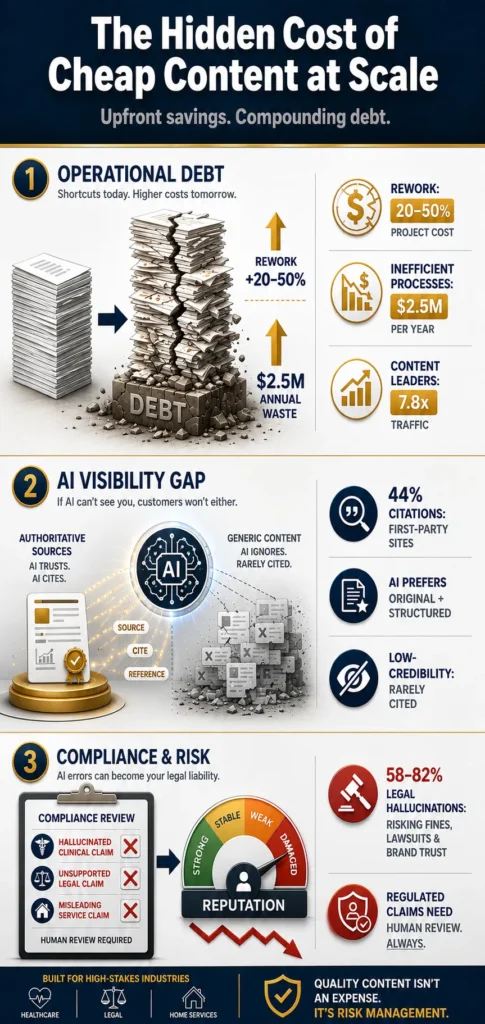
Every article that fails a compliance review, misattributes a statistic, or gets flagged during an audit requires editor time, legal review, and often republishing. Research shows that “on average, rework can add 20% to 50% to the total cost of a project, with some estimates suggesting that rework can add up to 200% of the original project cost” — BeamUp.
At scale, rework isn’t an exception — it’s a recurring line item that never appears in the per-article cost estimate.
- Compliance flagging adds legal review time per article
- Citation errors require source verification and correction
- Brand voice inconsistency triggers editorial rewrites
- Outdated or fabricated statistics require post-publish corrections
- Multi-location duplication creates version management overhead
An article that costs $150 to produce can cost $800-$1,200 when total revision cycles are factored in. Multiply that across 50 articles per month, and the math on “cheap” inverts quickly.
Production Speed vs. Total Operational Cost
Most operators evaluate content cost using the wrong metric: cost per article delivered. The accurate metric is cost per article that performs — that ranks, earns citations, generates leads, and doesn’t require correction.
Aprimo’s analysis reports that large organizations waste an average of $2.5 million annually on inefficient content processes, with rework and duplication as the primary drivers — Dotfusion.
- Editorial team time diverted from strategy to corrections
- Compliance team reviews that weren’t budgeted
- CMS cleanup labor when templated pages fail quality audits
- Republishing costs when bad content gets indexed, then corrected
Fragmented workflows turn content into a cost center before it ever generates a lead.
Content Debt Across Locations
The multi-location context makes cheap content at scale uniquely dangerous. A single templated article duplicated across 15 location pages isn’t 15 articles — it’s one article with 15 compliance exposure points. Content debt compounds with location count.
- Template-based pages with minimal local differentiation trigger Google’s lowest-quality classification
- Outdated statistics in a base template propagate instantly across the entire location network
- NAP inconsistencies in bulk-produced content require manual audits per location
The cost of fixing content debt at 15 locations is categorically different from that at 1 location.
What Breaks When Unverified Content Hits a Regulated Industry?
In healthcare and legal contexts, unverified AI-generated content isn’t a performance problem — it’s a liability problem. The failure modes are specific, documented, and increasingly difficult to attribute to “AI error” when your organization published the content. Any claim produced through an AI workflow is treated as if your organization wrote it, regardless of how it was generated.
Hallucination Risk in Healthcare and Legal Content
General-purpose AI tools hallucinate at rates that make unreviewed output structurally unsafe for regulated industries. Stanford HAI’s legal benchmark found that general-purpose chatbots “hallucinated between 58% and 82% of the time on legal queries, highlighting the risks of incorporating AI into legal practice” — Stanford HAI.
The problem isn’t that AI generates hallucinations — it’s that cheap content production has no step between AI output and publication to catch them.
- Fabricated clinical statistics create FTC liability for unsupported health claims
- Invented study citations are indistinguishable from real ones to non-specialist reviewers
- Hallucinated URLs produce dead-link audit failures in compliance reviews
Citation Fabrication as Compliance Liability
OpenAI acknowledges that GPT-4 “has the tendency to ‘hallucinate,’ i.e., ‘produce content that is nonsensical or untruthful in relation to certain sources,'” and warns that this becomes more dangerous as models become more convincing.
The FTC requirement that all health-related claims be supported by competent and reliable scientific evidence doesn’t include an exception for AI-generated content.
- Fabricated statistics in published content = your organization’s legal exposure
- Hallucinated citations referencing non-existent studies = audit failure documentation
- Medical claims without credible sourcing = potential regulatory action
Low-content workflows lack a systematic citation-verification step. That gap is the liability.
The Cascade Problem in Multi-Location Publishing
When an unverified claim publishes in a templated article distributed across 12 location pages, the compliance exposure multiplies by location. Correcting a base template doesn’t retroactively fix indexed pages.
- One fabricated statistic × 12 location pages = 12 correction events
- Each correction requires republishing, re-indexing, and compliance sign-off
- Audit trail documentation must account for every published instance
Regulated operators can’t assess the risk of cheap content at the article level. They have to evaluate it at the network level.
What Are the Real Options for Content Production at Scale?
Multi-location operators have three legitimate options before reaching systematic infrastructure: build internal capacity, hire a traditional agency, or use generic AI tools. Each approach addresses part of the problem. None addresses the full stack of scale + verification + multi-platform optimization — and operators making budget decisions deserve a clear-eyed view of what each delivers.
Internal Team Capacity Limits
Internal teams know the brand, understand compliance requirements, and can produce high-quality output. The ceiling is velocity. Most internal teams max out at 4-8 articles per month before quality degrades or burnout sets in.
- Brand voice consistency is highest — but only at low volume
- Compliance awareness is built in — but verification is informal
- Scalability hits a headcount ceiling before it hits a quality ceiling
Internal teams are the right answer for content requiring deep institutional knowledge at low volume. They’re not the right answer for 50+ articles per month across 12 locations.
Traditional Agency Trade-offs
Traditional agencies solve the volume problem — not the verification problem. Most agency workflows prioritize delivery speed over citation accuracy, producing template-driven output that passes editorial review but fails compliance audits in regulated industries.
- Volume is achievable — quality and compliance are inconsistent
- Generic research produces generic output
- One-draft delivery models skip systematic optimization
The agency model works when volume is the only constraint. When compliance, AI citation, and multi-platform optimization are also constraints, the agency model delivers on one of four requirements.
Generic AI Tools Without Verification
Generic AI tools accelerate production without solving the verification problem. Output is fast. Accuracy is unverified. Compliance is unaddressed. Google’s scaled content abuse policy explicitly targets this production model, regardless of whether a human or an AI generated the content.
- Production speed is high — verification is zero
- Citation accuracy depends entirely on the model’s training data
- Multi-platform optimization requires a structured methodology, not just AI generation
None of these three options is wrong in the right context. The gap they all share is in systematic verification infrastructure — and that’s where performance and compliance risk live.
If your operation needs to produce 20-50+ articles per month without sacrificing compliance or quality, Content Ops Lab builds the infrastructure to make that possible. Contact us today to discuss your content production requirements.
What Does Content Infrastructure That Actually Scales Look Like?
Systematic content infrastructure isn’t a writing process — it’s a production system. Writing processes are personality-dependent and don’t scale. Production systems are documented, replicable, and consistent across volume. For multi-location operators, the question isn’t whether to use AI — it’s whether the AI workflow includes the verification layer that makes output defensible.
Research-First Foundation Before Generation
The verification failure in most cheap content workflows happens before the first word is written. AI tools write from training data by default — pulling from memory rather than verified, current sources. A research-first methodology inverts this: verified source material is assembled and documented before AI generation begins.
- Perplexity Pro research workflows pull current citations before content is drafted
- Source material is logged with exact quotes and line references before generation
- SME interview documentation ensures content reflects actual institutional knowledge
Verification can’t happen at the review stage if the source material was never assembled.
Citation Verification as a Production Stage
Citation verification isn’t a proofreading step — it’s a production stage with its own workflow. Every statistic and sourced claim is cross-checked against the source document, labeled as STAT or CLAIM based on evidence type, and documented with an audit trail before publication.
- STAT labels require numerical data traceable to the source
- CLAIM labels require sourced assertions with direct citation
- Line-number documentation creates audit trails reviewable by compliance teams
This stage is structurally absent from cheap content workflows — and that absence is what makes unverified AI content a compliance risk rather than just a quality risk.
Multi-Platform Optimization Architecture
Traditional SEO optimization targets one platform. Systematic content infrastructure targets five simultaneously: Google, ChatGPT, Perplexity, Claude, and Gemini. Content that isn’t built for both traditional and AI search fails one or the other.
- Question-based H2 structure optimized for voice search and AI query patterns
- Answer-first formatting (40-60 words) provides citation-ready snippets for AI extraction
- 40-60% bullet-heavy content enables AI parsing and featured snippet capture
Cheap, keyword-optimized content isn’t competing in AI search. It’s invisible to it.
What Separates Citation-Worthy Content from Content That Gets Ignored?
AI search systems don’t distribute citations democratically. They concentrate citations in a small pool of sources that meet specific structural and credibility criteria. For multi-location operators, this creates a direct connection between content quality infrastructure and whether AI systems refer patients, clients, or customers to your locations.
How AI Systems Select Sources
A cross-platform analysis of 6.8 million AI citations found that “44% of citations came from first-party sites. Listings close behind: 42%. Reviews and social: 8%. Forums: Just 2%” — Search Engine Land. AI systems lean heavily on brand-controlled, structured properties — not on generic content or social noise.
What AI systems reward structurally:
- Answer-first formatting with direct responses extractable in 1-3 sentences
- Statistical backing with traceable citations
- Question-based architecture that mirrors how users query AI
- Structured formatting that enables clean passage extraction
What AI systems ignore:
- Generic keyword-dense content without substance
- Unsourced claims and marketing language
- Dense paragraph blocks without structural formatting
Brand-Controlled Properties vs. Generic Pages
AI citation data confirms that owned web properties with strong trust signals earn citations at dramatically higher rates than generic, templated, or thin content. For multi-location operators, the quality of your location and service pages directly determines whether AI systems can safely cite you.
- Location pages with unique, verified, location-specific content earn citations
- Templated pages with duplicated content across locations don’t differentiate
- Generic pages without evidence or specificity get passed over for better-structured alternatives
This creates a direct line between content infrastructure investment and AI search performance.
Why Structured, Verified Content Earns Citations
AI systems have strong structural incentives to cite sources they can verify — content with traceable statistics, credible sourcing, and clear organizational authority. Content that hallucinates its citations, duplicates its structure across locations, or produces generic output fails every credibility signal these systems rely on.
- Verified statistics with named sources signal citation safety to AI systems
- Consistent NAP data across locations establishes geographic authority
- Evidence-backed claims reduce the hallucination risk AI systems are managing against
The citation economy rewards the same infrastructure that compliance requires: research-first, verification-first, structure-first production.
Related: Why Generic Content Fails in AI Search Even If It Ranks in Google
Is Cheap Content at Scale Worth the Compounding Risk for Your Organization?
The correct evaluation frame for cheap content at scale isn’t cost per article. It’s the total cost of content ownership across the production lifecycle — including rework, compliance review, AI invisibility, and the compounding performance gap between operators who built infrastructure early and those who didn’t.
When Volume Becomes Liability
Volume without verification isn’t neutral. At scale, unverified content creates active liabilities — compliance exposure that compounds with location count, content debt requiring ongoing management, and AI search invisibility that cedes citations to competitors.
Edelman and LinkedIn research finds that “71% of hidden decision-makers…trust high-quality thought leadership more than marketing materials or product sheets,” and that executives make significant spending decisions based on the thought leadership they consume. —Edelman / LinkedIn via Ysobelle Edwards.
- 50 articles/month with 20% rework rate = 10 articles requiring correction every month
- At $800-$1,200 in fully loaded correction cost per article: $8,000-$12,000 in monthly rework
- AI citation share lost to competitors with better-structured content doesn’t recover without systematic infrastructure investment
Volume amplifies both performance and liability. The question is: which of your current content models is amplifying?
The Cost-per-Lead Frame vs. Cost-per-Article
VPs of Marketing who evaluate content on a cost-per-article basis are measuring the wrong unit. The relevant unit is cost per qualified lead generated, and cheap content at scale that doesn’t rank, doesn’t earn AI citations, and requires rework delivers a cost-per-lead that often exceeds premium content by a significant margin.
- Cheap content that generates zero leads has an infinite cost per lead
- Content that earns AI citations converts at 3-6x the rate of standard organic traffic
- Organic leads carry $0 media cost — the content investment is the total acquisition cost
Content marketing leaders generate 7.8 times more site traffic than non-leaders. The performance gap between systematic and cheap content production isn’t marginal — it’s structural.
Evaluating Build vs. Buy for Content Infrastructure
Operators evaluating content infrastructure have two paths: build internal capability or engage a Done-For-You production system. The evaluation criteria should be operational fit, not per-article cost comparison.
- Internal build is right when the team has the capacity for a 12-week implementation and ongoing system management
- Done-For-You is right when: growth timeline doesn’t accommodate a build phase, or internal team capacity is fully allocated
- Wrong criterion: which option has the lower per-article cost in the first 90 days
The operator who builds infrastructure in Q1 captures AI citations in Q2. Delaying for cost reasons starts that clock 6 months later — in a competitive environment where early citation patterns compound.
How Content Ops Lab Builds Content Infrastructure
Content Ops Lab’s production methodology was built and tested within a 12-location, regulated healthcare organization over 23 months, with 1,000+ articles and zero compliance violations. That production record wasn’t achieved by writing faster. It was achieved by building a systematic infrastructure that separated research, verification, and optimization into distinct production stages before content generation began.
- 23-month production test inside a 12-location regulated healthcare organization
- 1,000+ citation-verified articles and pages delivered with zero compliance violations
- 45% of all leads from organic search — outperforming paid search nearly 2:1
- AI search converting at 21.4% average vs. 3.32% site baseline — 6.4x performance multiplier
- 653% impression growth and 1,700% click growth for an emerging brand over 14 months
- 5x production scale achieved: 10 articles/month to 50+ without adding headcount
- 887% ChatGPT traffic growth in 7 months across the client network
- Dual-brand methodology validated on both mature brand maintenance and emerging brand growth
The Content Ops Lab Production System
Every engagement follows the same four-stage workflow, tailored to the client’s industry, number of locations, and compliance requirements.
- Research: Verified sources assembled before generation — no AI writing from memory
- Verification: Line-by-line citation cross-check, STAT vs. CLAIM labeling, full audit trail
- Optimization: Simultaneous multi-platform build for Google, ChatGPT, Perplexity, Claude, and Gemini
- Delivery: WordPress staging or Google Docs — publish-ready, Grammarly-reviewed, compliance-cleared
The system produces content that performs in traditional search and earns citations in AI search — without the rework tax that makes cheap content expensive in the long run.
Ready to build a content infrastructure that scales without the compliance risk? Get in touch — we’ll assess your current content operation and outline what a systematic approach would look like for your organization.
FAQs About Cheap Content at Scale
Can’t we just produce more content and let Google sort out what’s good?
Google’s March 2024 spam update eliminated this assumption. The policy now explicitly targets “producing content at scale to boost search ranking — whether automation, humans, or a combination are involved.” Volume without verified quality doesn’t get rewarded — it gets downgraded. Templated pages with minimal local differentiation fall directly into the pattern Google’s quality raters classify as Lowest, generating more compliance exposure and AI invisibility, not better rankings.
How long does it take a systematic content infrastructure to outperform a cheap content approach?
Infrastructure build takes 8-12 weeks for a System Build engagement. Performance gaps between systematic and cheap approaches typically appear within 90-120 days, when structured, citation-verified content begins earning AI citations and featured snippet placements that unverified content doesn’t capture. Operators who build infrastructure in Q1 establish citation authority before competitors enter the channel, and that advantage compounds.
How does a verification-first content system handle compliance requirements in healthcare or legal?
Verification infrastructure is built around compliance requirements from the start. Every statistic is traced to its source with line-number documentation. Every claim is labeled STAT or CLAIM based on the evidence type. No paraphrasing is permitted — exact quotes eliminate interpretation errors that create liability. The audit trail produced is reviewable by compliance teams before publication, not after.
How is a content production system different from hiring a content agency to write at volume?
Traditional agencies solve the output problem — not the verification, multi-platform optimization, or compliance problems. A content production system treats research, verification, and multi-platform optimization as distinct production stages with their own quality controls, not tasks a writer completes alongside drafting. The result is content defensible in a compliance audit and structured for AI citation, not just deliverable on a deadline.
Should a multi-location operator build a content system in-house or use a Done-For-You service?
System Build is right when your team has bandwidth for a 12-week implementation and the operational appetite to own production in the long term. Done-For-You is right when growth timelines don’t allow for a build phase, or when internal teams are fully allocated elsewhere. Both models deliver the same outcome — systematic, citation-verified, multi-platform-optimized content. The difference is who operates the system.
Key Takeaways
- Cheap content at scale is a cost-deferral strategy — rework alone can add 20-200% to total project cost when unverified output requires correction
- Google’s March 2024 spam update explicitly targets producing content at scale to boost rankings, regardless of whether humans or AI generated it
- General-purpose AI tools hallucinated between 58% and 82% of the time on legal queries — unreviewed output is structurally unsafe in regulated industries
- AI search systems concentrate 44% of citations in first-party brand-controlled sources — structured, verified content earns citations; generic templated content doesn’t
- A 12-location regulated healthcare client achieved 45% organic lead share and 21.4% AI search conversion rate through a systematic, verification-first production infrastructure
- The correct evaluation frame isn’t cost per article — it’s the total cost of content ownership across the production lifecycle, including rework and compliance review
- Operators who build content infrastructure before competitors capture AI citation authority establish compounding advantages that volume-based approaches can’t close after the fact
Build Content Infrastructure That Compounds: Cheap Content at Scale
The operators who win in AI search aren’t producing the most content — they’re producing the most citable content. Cheap content at scale produces operational debt: rework costs, compliance exposure, AI invisibility, and a performance gap that compounds with every month a competitor builds citation authority instead.
The first-mover window in AI search is measured in quarters, not years. Early citation patterns compound — AI systems reinforce existing sources, and operators who establish citation authority before competitors enter the channel build advantages that volume-based approaches can’t close after the fact.
Content Ops Lab builds that infrastructure for multi-location operators who’ve decided the cost of cheap content is higher than the cost of building it right.