

What Is Content Infrastructure for Multi-Location Brands?
Content infrastructure for multi-location brands is the governed system of models, workflows, templates, and verification protocols that allows multi-location businesses to produce consistent, compliant, AI-optimized content at scale — across traditional search, answer engines, and generative AI platforms simultaneously. Most operators don’t have it.
Research from GenesysGrowth finds that only one in five marketers feels their organization manages content well, contributing to an estimated $958 million in wasted spend annually across mid-to-large B2B organizations. For growth-stage businesses managing five or more locations, the gap between ad-hoc production and systematic content infrastructure is the gap between capturing AI citations and going unnoticed by them.
Content Ops Lab built its production methodology within a live, multi-location deployment — delivering 1,000+ citation-verified articles with zero compliance violations over 23 months — and the results validate the research predictions.
Related: Answer Engine Optimization: What Multi-Location Operators Need to Know
Why Can’t Most Multi-Location Marketing Teams Scale Content Without Losing Quality or Consistency?
Most multi-location marketing teams can’t scale content because their production model was built for small volumes. Article-by-article workflows, freelancer networks, and unverified AI tools create content chaos at scale — inconsistent messaging, compliance exposure, and diminishing returns on production investment.
Content Science finds that 61% of organizations operate at content maturity levels 2–3, where fragmented processes and limited governance prevent consistent output. The problem isn’t effort. It’s infrastructure.
The Volume-Velocity Gap
Every location needs content. Every service line needs coverage. Every market requires local relevance. The math breaks traditional production models fast.
- Internal teams cap out at 4–8 articles per month before quality degrades
- Freelancer networks introduce inconsistent tone, voice, and research standards
- Brief-to-publish cycles stretch across weeks, not days
- New locations multiply the workload without multiplying the team
The volume problem requires a system designed for it, not a team stretched around it.
Franchise and Multi-Location Complexity
Multi-location brands face a unique operational burden: each location must express the same brand while adapting to local realities. Without centralized infrastructure, that balance fails in both directions.
- Corporate messaging doesn’t adapt to local markets
- Local teams improvise, creating off-brand content and conflicting offers
- Outdated location pages persist because update workflows don’t exist
- Campaign rollouts stall because there’s no replicable execution model
Inconsistent content isn’t just a brand problem. As AI answer engines pull from location pages to generate responses, outdated or contradictory information can propagate across markets at scale — compounding the damage.
The Generic AI Trap
AI writing tools accelerate production. They don’t solve the infrastructure problem — and in regulated industries, they create new ones.
- Generic AI output optimizes for keywords, producing repetitive copy that signals low quality to search engines
- Hallucination rates in AI content range from 8–20%, depending on model and data quality
- In 2025, the Chicago Sun-Times published a summer reading list where 10 of 15 AI-generated book recommendations were for non-existent titles — an editorial failure with direct credibility consequences
- 77% of organizations using AI report hallucination concerns, but most have no systematic verification protocol
What Are the Real Options for Multi-Location Content Production?
Multi-location operators have four realistic options for content production: internal teams, traditional agencies, generic AI tooling, and structured content infrastructure. Each solves part of the problem. Only one solves it at scale with the compliance and AI-optimization requirements modern search demands.
Internal Team Production
Internal teams understand the brand, the market, and the compliance requirements. They’re also the first thing to break when content demands scale.
- Quality is high, but volume is capped — typically 4–8 articles per month
- Knowledge is tribal, not documented — output depends on who’s writing
- No systematic workflow means inconsistent quality across locations
- Adding headcount to scale is a linear cost model with no efficiency ceiling
Traditional Agency Models
Agencies offer scale. The trade-off is quality, compliance, and AI-optimization — the three things that matter most in the current search environment.
- Traditional agencies charge $300–500 per article for generic, template-driven content
- Citation verification is rarely systematic — fake stats and hallucinated URLs are common outputs
- Optimization targets 2019-era Google, ignoring AI search platforms entirely
- Scaling production means hiring more writers — costs rise linearly with volume
Traditional agencies handle scale, but citation verification rarely survives the production process.
Generic AI Tooling
Generic AI tools — ChatGPT, basic writing assistants, unverified AI workflows — bring speed to production. They bring risk alongside it.
- Fast output with no research foundation means hallucinations reach publication
- No compliance infrastructure for healthcare, legal, or financial content
- No multi-platform optimization — content is written for text output, not AI citation
- Brand voice consistency depends entirely on prompt quality, not systematic standards
Structured Content Infrastructure
Structured content infrastructure combines AI efficiency with systematic verification, governance, and multi-platform optimization. Teams using defined content operations frameworks produce three to five times more content without corresponding increases in headcount.
- Centralized knowledge models feed consistent messaging across every location
- Verified research and citation protocols eliminate hallucination risk before publication
- Repeatable templates and workflows scale production without scaling headcount
- Content is built simultaneously for SEO, AEO, and GEO — not retrofitted after the fact
If your operation needs to produce 20–50+ articles per month without sacrificing compliance or quality, Content Ops Lab builds the infrastructure to make that possible. Contact us today to discuss your content production requirements.
What Does Content Infrastructure Actually Include — and Why Does It Take More Than a CMS?
Content infrastructure is not a content management system. A CMS stores and publishes content. Infrastructure governs how that content is researched, verified, structured, optimized, and delivered across every channel and location simultaneously — solving the problems that break multi-location content at scale: inconsistent knowledge sources, unverified claims, and content that doesn’t meet AI extraction requirements.
Knowledge Modeling and Centralized Governance
The foundation of content infrastructure is a centralized knowledge system — a documented, versioned source of truth for services, locations, personas, compliance language, and approved claims.
- Without centralized knowledge, different writers make conflicting statements about the same service
- Outdated information on one location page can propagate into AI-generated answers across entire markets
- Regulated industries require a central repository of vetted claims and disclaimers — not ad-hoc writer research
- Knowledge documentation from SME interviews converts tribal expertise into reusable, audit-ready content assets
Repeatable Workflows and Templates
Systematic workflows and templates are the operational layer that translates knowledge into consistent output at scale.
- Standardized article templates enforce research, verification, and optimization steps before publication
- Editorial checklists create governance checkpoints: citation accuracy, compliance review, keyword density, readability
- Location-page templates pull from shared components — service descriptions, disclaimers, CTAs — while exposing controlled fields for local customization
- Workflow documentation makes the system transferable: a new team member follows the same process as the original builder
The workflow is what makes infrastructure scalable. Without it, quality depends on who’s producing — not on the system itself.
Verification and Citation Standards
In a landscape where AI systems amplify and redistribute content, verification is a strategic asset. GEO frameworks consistently identify evidence-backed authority — original data, verifiable statistics, explicit source attribution — as a primary signal that generative engines use to evaluate and cite content.
- Every statistic requires cross-checking against source research before publication
- STAT vs. CLAIM labeling applies different verification standards to different evidence types
- Line-number documentation creates an audit trail for every data point
- Compliance-ready content requires no fabricated medical, legal, or financial claims — ever
Verification isn’t a bolt-on. It’s embedded into the workflow at the research stage, before AI generation begins.
Related: SEO vs AEO vs GEO – How Multi-Location Businesses Should Think About Modern Search
How Does a Structured Content System Serve SEO, AEO, and GEO Simultaneously?
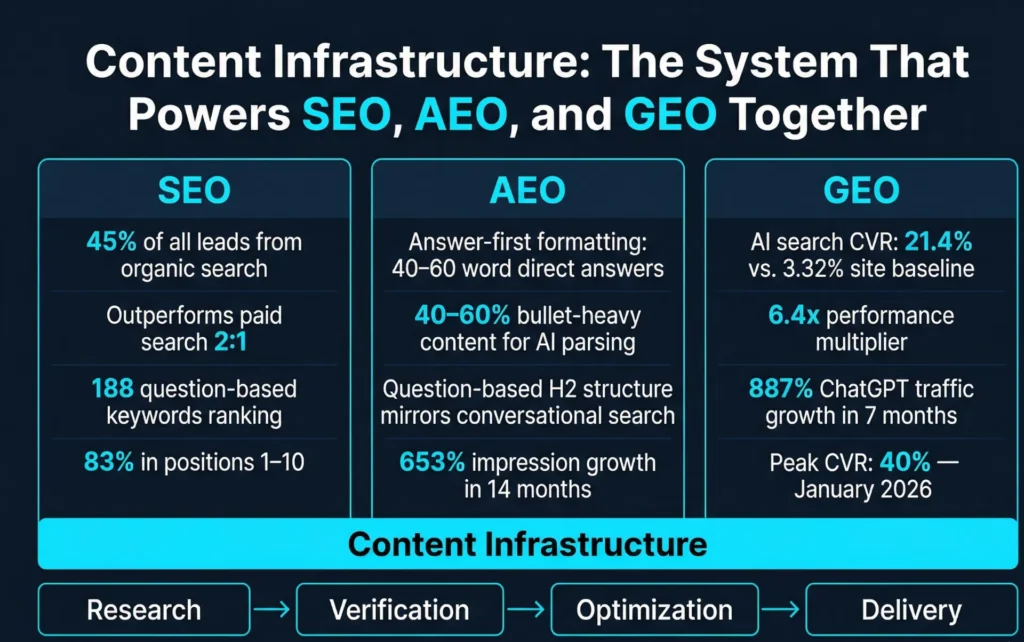
A structured content system serves SEO, AEO, and GEO simultaneously because the structural requirements of all three platforms converge. Answer-first formatting, question-based headings, verified citations, and schema markup aren’t separate optimization strategies — they’re the same underlying architecture, applied across different output channels.
SEO: Structure as a Ranking Signal
Traditional SEO is evolving toward richer, more structured content representations. Clear H1/H2 hierarchies, scannable sections, and FAQ blocks improve crawlability and engagement — both of which correlate with better rankings.
- Structured content gives search engines a clear topical hierarchy and entity relationships
- Schema markup enables rich results: featured snippets, FAQ boxes, enhanced click-through
- Google’s own case study of publisher Vidio shows that implementing correct structured data nearly doubled clicks from search, while video production grew only 30%
- Consistent internal linking, optimized meta tags, and location-specific content feed local SEO performance across every location simultaneously
AEO: Answer-First Architecture
Answer Engine Optimization targets AI-powered answer boxes — Google AI Overviews, Bing Copilot, Perplexity’s instant answers. The content architecture that earns these placements is specific and reproducible.
- Answer-first formatting: 40–60-word direct answers open every section, giving answer engines an extractable response
- Question-based H2 structure mirrors how users ask queries in conversational AI interfaces
- FAQ blocks with the FAQPage schema create structured question-and-answer pairs that answer engines can parse directly
- Bullet-heavy content (40–60% of the article) enables AI systems to identify key points without processing dense paragraph blocks
GEO: Citation-Worthy Content at Scale
Generative Engine Optimization focuses on being cited inside full AI-generated answers — not just surfaced in search results. Research indicates that specific GEO optimization strategies can improve AI citation visibility by up to 115%.
- Original data and verified statistics signal credibility to AI systems evaluating content quality
- Transparent sourcing — explicit citations, publication dates, named authors — increases AI confidence in the material
- Consistent structured formatting across all location pages creates a coherent “source of truth” that generative engines pull from
- High citation density in one authoritative piece outperforms dozens of loosely written posts without clear structural signals
Organic traffic growth is measurable — but AI search citation data is where the real operator ROI story lives.
What Does Content Infrastructure Actually Deliver in Production?
Organizations with mature content operations generate approximately 3 times as many qualified leads as those with ad hoc processes — a gap driven by infrastructure quality, not content volume.
Lead Generation and Organic Channel Performance
Organic search is consistently the highest-ROI channel in structured content deployments.
- 45% of all leads from organic search in a verified multi-location deployment — outperforming paid search nearly 2:1
- 12,487 total leads generated in 6 months (H2 2025) across a dual-brand operation
- Organic delivering 40–45% of total leads consistently across both a mature brand and an emerging brand, built from a near-zero presence
- 653% impression growth and 1,700% click growth for the emerging brand over 14 months
AI Search Conversion Data
AI-referred traffic converts at a fundamentally different rate than traditional organic — users arriving from AI citations have already completed much of their research and qualification before clicking through.
- AI search converting at 21.4% average vs. 3.32% site baseline — 6.4x performance multiplier — over an 8-month measurement period
- 887% ChatGPT traffic growth in 7 months (July 2025–February 2026)
- Peak CVR: 40% in January 2026 — from a channel that represented less than 0.3% of total traffic
- 95+ confirmed conversions from AI search platforms in 8 months, with AI-referred traffic growing month-over-month
AI-referred traffic surged approximately 1,200% across platforms between mid-2024 and early 2025. The operators that captured that traffic built the infrastructure for it. The majority didn’t.
Efficiency Gains at Scale
The infrastructure model produces compounding efficiency gains that agency and internal-team models don’t.
- 5x production scale: 10 articles/month to 50+ without adding headcount
- Three to five times more content output from teams using structured content operations frameworks, without proportional cost increases
- A single unified production system eliminates version conflicts, simplifies onboarding, and makes the workflow transferable across new markets
- Dual-brand methodology proven simultaneously across a mature brand, maintaining market position, and an emerging brand scaling from scratch
Is Building Content Infrastructure Right for Your Organization — and Where Do You Start?
Building content infrastructure is the right move for multi-location operators who have outgrown ad-hoc production — whether the gap shows up as compliance exposure, inconsistent brand voice, or AI search platforms that aren’t converting.
Signals You’ve Outgrown Ad-Hoc Production
Most organizations underestimate their content operations maturity by about one level. The real signals that you’ve hit the infrastructure ceiling are operational, not strategic.
- Content quality varies significantly by writer or location — no consistent output standard
- Citation errors, compliance concerns, or brand inconsistencies appearing in published content
- AI search platforms not appearing in your traffic data — or appearing but not converting
- New location launches require building content from scratch rather than deploying from a template
- Production velocity has plateaued despite team effort
Done-For-You vs. System Build
Content Ops Lab operates two engagement models, differing in who operates the infrastructure after implementation.
- Done-For-You: COL runs the complete production system. You provide strategic direction and approve deliverables. Research, generation, verification, and optimization are fully managed.
- System Build: COL builds the complete content production infrastructure and trains your team to operate it. You gain full ownership of the system, templates, and workflows. 90-day post-launch support included.
The right model depends on your team’s capacity and long-term ownership preference. Done-For-You is the faster path to production volume. System Build is the path to internal ownership and full control of infrastructure.
Implementation Timeline and What to Expect
Full implementation runs 10–12 weeks. The timeline covers the systematic work required — SME interviews, knowledge-base documentation, workflow design, template development, and quality-control buildout.
- Weeks 1–3: Discovery, content audit, strategy, workflow design
- Weeks 4–6: Knowledge documentation, style guide integration, research source library
- Weeks 7–9: Template development, citation verification workflows, quality control checklists
- Weeks 10–12: Training, live article production, quality review, and refinement
- Weeks 13+: Full production cadence, 90-day post-launch support
The first-mover window for AI search citation is measured in quarters. Early citation dominance compounds — AI systems reinforce existing citation patterns. Operators who build infrastructure in 2026 will be defending a position by 2027. Operators who wait will find themselves building in a more competitive environment.
How Content Ops Lab Builds Content Infrastructure
Verified production, not theoretical positioning. Over a 23-month engagement, Content Ops Lab’s methodology delivered 1,000+ citation-verified articles with zero compliance violations — scaling a multi-location operation from 10 articles per month to 50+ across a dual-brand deployment.
- 23-month production test in a regulated, multi-location environment — iterated through multiple system versions to a single unified source of truth
- 1,000+ citation-verified articles and pages delivered with zero compliance violations across the full engagement
- 45% of all leads from organic search — outperforming paid search nearly 2:1 in a 6-month measurement period
- AI search converting at 21.4% average vs. 3.32% site baseline — 6.4x performance multiplier over 8 months
- 653% impression growth and 1,700% click growth for an emerging brand scaled from near-zero organic presence over 14 months
- 5x production scale — 10 articles/month to 50+ without adding headcount
- 887% ChatGPT traffic growth in 7 months, with peak CVR reaching 40% in January 2026
- Dual-brand methodology — proven simultaneously on mature brand maintenance and aggressive emerging brand growth
The Content Ops Lab Production System
Every engagement runs on the same four-stage production system — adapted to your knowledge base, your compliance requirements, and your location footprint:
- Research: Verified sources before generation — no AI writing from memory or without citation backing
- Verification: Line-by-line citation cross-check, STAT vs. CLAIM labeling, full audit trail for every data point
- Optimization: Simultaneous multi-platform build — Google, ChatGPT, Perplexity, Claude, Gemini
- Delivery: WordPress staging or Google Docs — publish-ready, compliance-reviewed, Grammarly-verified
Ready to build a content infrastructure that scales without the compliance risk? Get in touch with us—we’ll assess your current content operations and outline what a systematic approach would look like for your organization.
FAQs About Content Infrastructure
What’s the difference between content infrastructure and a content management system?
A CMS stores, organizes, and publishes content. Content infrastructure governs how that content is researched, verified, structured, and optimized before it reaches the CMS — including knowledge documentation, citation verification protocols, repeatable workflows, and multi-platform optimization standards. Most CMSs are tools. Infrastructure is the operating system that runs around them.
How long does it take to build a content infrastructure system for a multi-location business?
Full implementation runs 10–12 weeks, followed by a 90-day post-launch support period. That timeline covers discovery and strategy, knowledge documentation, SME interviews, template development, workflow design, and team training. Production scaling begins in weeks 10–12 and reaches full velocity within the first 90 days post-launch.
How does content infrastructure reduce compliance risk in regulated industries like healthcare and legal?
Infrastructure embeds verification at the research stage — before AI generation begins. Centralized knowledge repositories store vetted claims, approved disclaimers, and sourced statistics that every piece of content draws from. Citation verification protocols cross-check every statistic against source documents, with line-number audit trails, eliminating the risk of hallucination at the source.
Can content infrastructure work for both mature brands and emerging brands building from scratch?
Yes — the same system architecture works in both contexts. A mature brand uses infrastructure to maintain a consistent search presence, defend AI citation positioning, and optimize existing authority. An emerging brand uses the same workflow to scale from near-zero organic presence to primary lead channel — both achieving 40–45% organic lead contribution in production.
What does Content Ops Lab’s content infrastructure actually deliver — and how is it different from a content agency?
Content Ops Lab delivers a governed production system with verified research, citation-checked content, and simultaneous optimization for Google, ChatGPT, Perplexity, Claude, and Gemini. The difference from a content agency: agencies produce articles. COL produces infrastructure — the repeatable system, documented workflows, and quality control protocols that generate consistent, compliant output at scale without linear cost increases.
Key Takeaways
- Content infrastructure is the governed system of knowledge, workflows, templates, and verification protocols that enables multi-location businesses to produce consistent, AI-optimized content at scale — a CMS alone doesn’t provide it
- Operators running ad-hoc production face compounding risk: generic AI output introduces hallucinations, while fragmented workflows create brand inconsistency that AI answer engines amplify across markets
- SEO, AEO, and GEO share the same underlying structural requirements — answer-first formatting, question-based architecture, verified citations, and schema markup — making a single content infrastructure the foundation for all three platforms simultaneously
- AI search converting at 21.4% average vs. 3.32% site baseline is the emerging channel most operators aren’t capturing — because capturing it requires content built for AI citation from the start
- The first-mover window for AI search citations is measured in quarters: early citation dominance compounds as AI systems reinforce existing patterns
- Content Ops Lab offers two engagement models — Done-For-You and System Build — both delivering systematic, scalable, compliance-ready content production without linear cost increases
Related: Generative Engine Optimization: How Brands Get Recommended by AI
Build Content Infrastructure That Compounds: Content Infrastructure for Multi-Location Growth
Content infrastructure is the competitive differentiator that separates operators that capture AI citations from those that remain invisible to them. The research is unambiguous: organizations with mature content operations generate 3x more qualified leads, AI-referred traffic has grown 1,200% in under a year, and traditional search traffic is projected to decline by 25% by 2026.
The operators who wait for this shift to become obvious will be building infrastructure into a far more competitive environment. Content Ops Lab’s methodology was built and validated in a live, multi-location production environment — 23 months, 1,000+ verified articles, zero compliance violations, and AI search converting at 6.4x the site baseline. The infrastructure exists. The question is whether you build it now or after your competitors do.