

Zero-Click Search: Why Informational Queries No Longer Drive Website Traffic
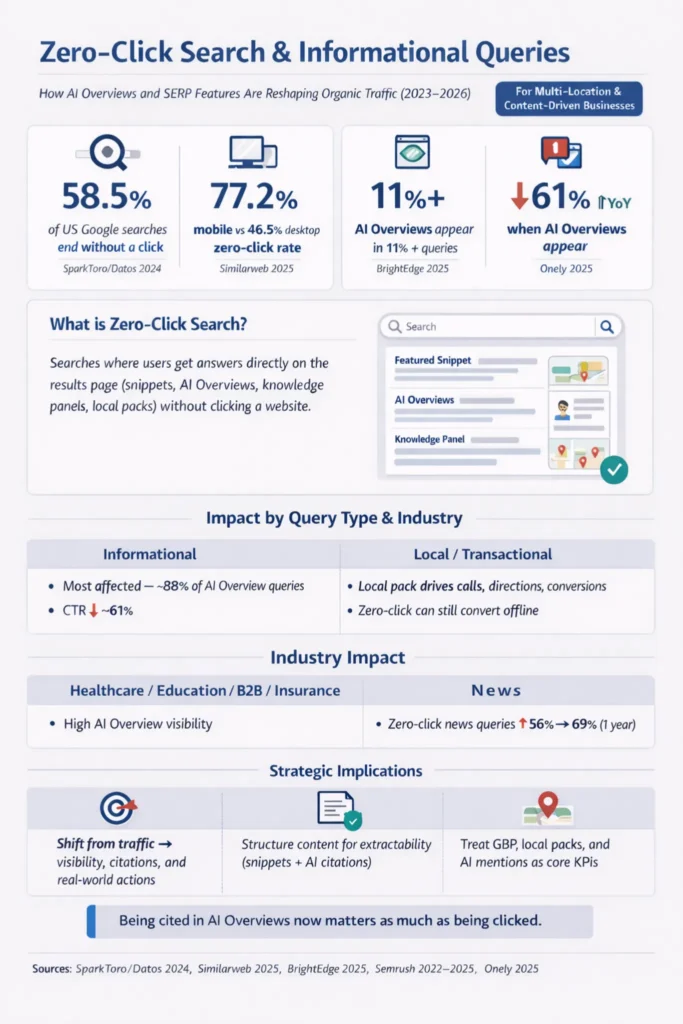
Zero-click search now accounts for the majority of Google queries — meaning most of the content you publish to educate, attract, and convert prospects is being read by Google’s systems, not by your prospects. According to the SparkToro/Datos 2024 Zero-Click Search Study, summarized by Search Engine Land, “a majority of Google searches – 58.5% in the U.S. and 59.7% in the EU – result in zero clicks.”
For multi-location businesses running content at scale, this isn’t a traffic problem. It’s a strategy problem. The operators who understand that zero-click shifts the success metric from clicks to citations will build durable visibility. Content Ops Lab built its production methodology inside a regulated multi-location organization for this environment — 1,000+ citation-verified articles, structured for AI extraction from day one.
Related: SEO vs AEO vs GEO – How Multi-Location Businesses Should Think About Modern Search
What Is Zero-Click Search and Why Is It Eroding Your Organic Traffic?
Zero-click search describes queries that end on the search results page — no outbound click, no site visit, no session in your analytics. Google answers the question directly through featured snippets, knowledge panels, People Also Ask boxes, AI Overviews, and local packs. For operators managing large content libraries across multiple locations, this changes what content investment is actually buying you.
How Google Answers Queries Before the Click
Google’s SERP has evolved from a list of blue links into a direct-answer engine. Featured snippets extract short answers above organic results. Knowledge panels surface entity data. PAA boxes let users chain related questions inline — all without leaving Google.
- Featured snippets depress the #1 organic result’s CTR from ~26% to ~19.6%
- Snippets capture ~8.6% of clicks while reducing total SERP click volume
- Knowledge panels satisfy local and entity queries entirely within Google’s interface
- PAA boxes appear on roughly half of all mobile and desktop searches
Even when you rank, your traffic isn’t guaranteed.
The Featured Snippet and PAA Traffic Drain
Featured snippets reward well-structured content with visibility — but visibility and traffic are no longer the same thing. For informational content, the better your content answers the question, the less likely users are to click through to read it.
- Informational “how-to” and “what is” queries see the highest snippet prevalence
- Single-sentence factoid pages are citation assets, not traffic assets
- Structured content earns citations; unstructured content earns neither
PAA compounds the issue. Users resolving multiple questions through PAA chains complete a research journey inside Google’s interface rather than entering your content funnel.
Mobile Search and the 77% Zero-Click Reality
Mobile amplifies zero-click behavior significantly. Desktop users see zero-click outcomes roughly 46.5% of the time. Mobile users see it 77.2% of the time, according to DemandLocal’s analysis, because smaller screens concentrate above-the-fold SERP features, making it easy to get answers without scrolling to organic results.
- Mobile zero-click rate: 77.2% vs. 46.5% on desktop
- Over 60% of all Google searches occur on mobile
- Local mobile searches are particularly vulnerable — maps, hours, and reviews resolve queries on SERP
How Are AI Overviews Accelerating the Zero-Click Problem for Informational Content?
AI Overviews have introduced a more aggressive form of zero-click behavior. Instead of extracting a single snippet, they synthesize multi-paragraph answers from multiple sources — displayed above organic results before users see a ranked page. According to Onely: “Google AI Overviews appeared for 13.14% of queries in March 2025, up from 6.49% in January — a 102% increase in two months. When they appear, organic CTR drops 61%. Even position 1 results see 34.5% fewer clicks.” For operators with large informational content libraries, this is a material threat to traffic projections built on traditional organic assumptions.
AI Overview, Deployment Rates, and CTR Impact
AI Overviews are expanding rapidly. BrightEdge’s year-one analysis found they appear in over 11% of all queries, up 22% year-over-year, while publisher CTR has fallen nearly 30% since May 2024. Impressions are up. Traffic is down.
- AI Overviews trigger on over 11% of all Google queries
- Impressions across all content up 49% since AIO launch — CTR down 30%
- Position #1 organic results lose 34.5% of clicks when an AI Overview appears
- Overall CTR drop when AI Overviews appear: 61%
The Informational Query Targeting Pattern
AI Overviews specifically target informational queries. Onely’s analysis reports that 88.1% of AI Overview triggers are informational — the same query category multi-location businesses use to build topical authority and funnel traffic from education into conversion.
- 88.1% of AI Overview triggers are informational queries
- Nearly 40% of informational queries now generate a direct AI-powered answer on SERP
- Structured, citation-backed content earns AIO citations — unstructured content earns nothing
Informational content not built for AI extraction isn’t just losing clicks — it’s disappearing from the search experience entirely.
What Position #1 Organic Rankings Are Worth Today
Ranking first no longer guarantees meaningful traffic for informational queries. When an AI Overview is present, the #1 result sees 34.5% fewer clicks. Ahrefs’ featured snippet research showed snippet presence alone pushed #1 CTR from 26% to 19.6% — before AI Overviews existed. Both effects now stack on the same SERP.
- Pre-AIO: #1 CTR ~26% without snippet, ~19.6% with snippet
- Post-AIO: Additional 34.5% reduction on top of snippet suppression
- Non-branded informational queries are seeing CTR declines of ~65% in some analyses
Which Industries Face the Highest Zero-Click Exposure Right Now?
Not all industries are equally affected. According to BrightEdge, “the industries with the strongest AI Overview presence are Healthcare, Education, B2B Tech, and Insurance.” If your business operates in any of these categories, zero-click search is an active performance variable in your current content ROI.
Healthcare and B2B Tech at the Front of the Line
Healthcare and B2B tech face the highest AI Overview concentration because they’re exactly the categories Google’s generative systems are designed to answer: complex questions with established research bases where authoritative answers provide clear user value.
- Healthcare is among the top 4 industries for AI Overview deployment
- Medical, finance, and education dominate featured snippet placements
- At the AI Overview launch, healthcare content already had 60%+ overlap between AIO citations and organic rankings
High AI Overview presence means traffic losses — but it also means well-structured, authoritative content has a direct path to AI citation.
The Dual Exposure Problem for Multi-Location Brands
Multi-location businesses face two simultaneous zero-click dynamics. Informational content gets cannibalized by featured snippets and AI Overviews. Brand and location queries increasingly resolve through Google Business Profiles and map interfaces, bypassing the website entirely.
- Informational content: cannibalized by snippets and AI Overviews
- Location queries: resolved via GBP, map packs, and on-SERP interactions
- Multi-location operators need a measurement infrastructure that captures both
What the News Industry’s Traffic Collapse Signals for Everyone Else
News publishers provide the clearest leading indicator of where zero-click trends are headed. Similarweb’s 2025 data shows the share of news-related searches ending without a click jumped from 56% in May 2024 to 69% in May 2025. Organic traffic to news sites fell from over 2.3 billion visits at peak to under 1.7 billion.
- News zero-click rate: 56% (May 2024) → 69% (May 2025)
- Organic news traffic: 2.3B monthly (peak) → under 1.7B
- ChatGPT referrals to news publishers up 25x YoY — still a fraction of lost Google volume
News content is primarily informational. Healthcare, legal, and B2B educational content shares that profile — and is two to three years behind on the same curve.
If your organization needs to compete for AI citations and organic visibility across multiple locations simultaneously, Content Ops Lab builds the infrastructure to do both at scale. Contact us today to discuss your content production requirements.
What Content Actually Earns Clicks in a Zero-Click Search Environment?
Zero-click search doesn’t eliminate all clicks — it migrates them to specific content types. Informational queries are increasingly visibility-only. Decision-support content, complex comparisons, and conversion-adjacent pages still earn clicks because AI systems can’t adequately summarize them.
Decision-Support Content vs. Factoid Pages
Content that continues to earn above-average click-throughs shares one characteristic: it requires more than a paragraph to resolve. Detailed comparisons, multi-factor guides, and content requiring a user-specific application can’t be summarized into a snippet.
- Long-form guides with multi-factor analysis resist AI summary extraction
- Comparison and evaluation content retains clicks when decisions involve personal variables
- Simple factoid pages are citation assets — not traffic assets
- YMYL content with strong sourcing attracts high-intent users even when AI surfaces a summary
Build factoid content for citations. Build decision-support content for clicks.
Structured Content and AI Extractability
What earns AI citations and selection for featured snippets comes down to structure. Answer-first paragraphs, question-based headings, bullet-heavy formatting, and FAQ blocks are the signals AI systems use to identify extractable content.
- Answer-first paragraphs (40-60 words) feed featured snippet and AIO extraction
- Question-based H2 headings match the informational queries that trigger AI Overviews
- 40-60% bullet ratio enables AI parsing — dense paragraphs are skipped
- BrightEdge: overlap between AIO citations and organic rankings rose from 32% to 54% over 16 months
The Case for Segmenting Your Content Portfolio
Running a large content library without a citation-vs-click segmentation framework means treating all content as equivalent — when the economics are fundamentally different.
- Citation-first assets: informational, educational, brand-authority content
- Click-first assets: comparison guides, service pages, decision-support content
- Hybrid assets: designed to earn both snippet visibility and downstream engagement
- Measurement must extend beyond sessions to include impressions, AI citation frequency, and GBP interactions
Related: Answer Engine Optimization – What Multi-Location Operators Need to Know
How Should Operators Reframe Success Metrics When Traffic Is No Longer the Primary Signal?
The central error in a zero-click environment is measuring content performance exclusively through organic sessions. According to Memetik’s 2025 State of AI Search report: “73% of B2B buyers now start their research with AI assistants rather than Google.” That research journey produces brand exposure and downstream demand — but few direct sessions.
Citation Visibility as a Strategic KPI
Being cited by an AI Overview, a featured snippet, or a ChatGPT response has measurable business value even when no click occurs. Brand exposure during a prospect’s research phase influences the consideration set. Entity reinforcement in AI systems means your organization is more likely to be recommended in future queries.
- AI citation frequency should be a primary KPI alongside sessions
- Search impressions measure SERP presence independent of click behavior
- Early citation dominance compounds — AI systems reinforce existing patterns over time
Local Pack and GBP as Zero-Click Conversion Channels
For multi-location businesses, GBP interactions represent a significant and undercounted conversion channel. Local searches resolving via map packs and GBP — calls, directions requests, and booking actions — don’t generate traditional organic sessions, but they do drive real business outcomes.
- GBP calls, direction requests, and messaging are measurable conversion events
- Local pack appearances should be tracked as visibility KPIs, separate from organic rankings
- Nearly 80% of local mobile searches lead to offline purchases or visits
AI Search Referrals and the Emerging Traffic Channel
AI platforms do send referral traffic — and that traffic converts at significantly higher rates. A regulated multi-location organization running the Content Ops Lab methodology achieved an average 21.4% conversion rate from AI search platforms over 8 months, compared to a 3.32% site baseline — a 6.4x performance multiplier.
- AI search CVR: 21.4% vs. 3.32% site baseline — 6.4x better
- 95+ confirmed conversions from AI platforms over 8 months
- ChatGPT sessions grew 887% in 7 months (July 2025 – February 2026)
What Does a Zero-Click-Ready Content Strategy Actually Require to Build?
Adapting to zero-click search isn’t a formatting adjustment — it’s a structural change to how content is conceived, produced, and measured. As BrightEdge data confirms: “Google’s AI Overview now appears in over 11 percent of search engine queries, a 22 percent year-over-year increase… click-through rates have steadily declined, dropping nearly 30 percent since May 2024.” Every new article needs to be built for the environment that exists now.
Content Architecture for Dual Optimization
Zero-click-ready architecture means building every piece to serve two objectives: earn AI citations through extractable structure and earn clicks through decision-support depth.
- Answer-first H2 openings (40-60 words) feed snippet and AIO extraction
- Question-based headings align with the 88.1% of AI Overview triggers that are informational
- 40-60% bullet ratio enables AI parsing across Google, ChatGPT, and Perplexity
- Analytical depth in H3 subsections creates click-worthy content below the extractable layer
- Schema markup and FAQ blocks increase eligibility for structured SERP features
The AI Citation and Click-Earning Content Split
A deliberate portfolio approach allocates content investment based on intent profile. Broad informational queries are citation-first assets that build brand authority in AI systems. Comparison guides and implementation-oriented content are click-first assets serving users ready to make a decision.
- Citation-first: structured for AI extraction, measured by impressions and AI mention frequency
- Click-first: structured for decision support, measured by sessions and conversion rate
- Hybrid: designed to earn snippet placement and downstream engagement — highest production investment
Why Systematic Production Determines Who Gets Cited
AI systems don’t cite randomly. BrightEdge’s multi-engine analysis shows a 70× volatility gap between frequently and rarely cited domains — authority and consistency drive citation inclusion more than individual article quality.
- 70× volatility gap between frequently and rarely cited domains
- Citation authority builds over time — early production advantage compounds
- A content system producing 50+ structured, citation-verified articles per month establishes that position; a single well-formatted article doesn’t
How Content Ops Lab Builds Content Infrastructure for Zero-Click Search
A regulated, multi-location organization running the Content Ops Lab methodology for 23 months is generating AI search conversions at an average of 21.4% — 6.4x its site baseline — while maintaining 45% of all leads from organic search.
The system was built to perform in this environment: structured for AI extraction, verified for citation credibility, and capable of producing at the volume needed to establish authority across multiple locations.
- 23-month production test inside a regulated multi-location organization
- 1,000+ citation-verified articles delivered with zero compliance violations
- 45% of all leads from organic search — outperforming paid search nearly 2:1
- AI search converting at 21.4% vs. 3.32% site baseline — 6.4x performance multiplier
- 653% impression growth and 1,700% click growth for an emerging brand over 14 months
- 5x production scale: 10 articles/month to 50+ without adding headcount
- 887% ChatGPT traffic growth in 7 months (July 2025 – February 2026)
The Content Ops Lab Production System
Every article goes through four stages designed to produce content that earns citations and clicks in the current environment.
- Research: Verified sources before generation — Perplexity Pro workflow, no AI writing from memory
- Verification: Line-by-line citation cross-check, STAT vs. CLAIM labeling, full audit trail
- Optimization: Simultaneous multi-platform build — Google, ChatGPT, Perplexity, Claude, Gemini
- Delivery: WordPress staging or Google Docs — publish-ready, compliance-reviewed, structured for extraction
Ready to build a content infrastructure designed for the zero-click search environment? Get in touch today — we’ll assess your current content operation and outline what a systematic approach would look like for your organization.
FAQs About Zero-Click Search
Does zero-click search mean SEO is no longer worth investing in?
Zero-click search changes what SEO is optimizing for — it doesn’t make it obsolete. Decision-support pages, comparison guides, and conversion-adjacent content continue generating above-average traffic. Informational content is increasingly a citation and brand visibility play rather than a traffic play. Operators who understand this distinction get better ROI from their SEO investment, not less.
How can we track visibility and citations if users aren’t clicking through to our site?
Expand your KPI set beyond organic sessions. Google Search Console impressions capture SERP presence independent of clicks. GBP dashboards track calls, direction requests, and listing clicks. AI citation frequency can be monitored through manual checks of ChatGPT and Perplexity responses, as well as emerging AI analytics platforms. The full picture requires all three data sources — not just GA4.
What type of content still earns clicks in a zero-click environment?
Content requiring more than a summary to resolve. Decision-support content — multi-factor comparisons, detailed guides for high-stakes decisions, content requiring user-specific application — isn’t easily summarized by AI Overviews or featured snippets. Deep YMYL content with strong sourcing also retains high-intent traffic in healthcare, legal, and financial verticals, where users seek detail beyond what AI surfaces.
Is zero-click search hurting multi-location healthcare practices, or are GBP interactions offsetting the loss?
Both dynamics are occurring simultaneously, yet most practices measure only one. Informational content is losing organic traffic to snippets and AI Overviews. But location queries are increasingly resolving through GBP interactions — calls, direction requests, bookings — that don’t generate website sessions but do generate real business outcomes. Operators running both a strong GBP program and a structured content program for AI citations are better positioned than those relying on either channel alone.
How is Content Ops Lab’s methodology built to perform in a zero-click search environment?
The methodology was built for this environment — not adapted to it. Answer-first formatting, question-based headings, 40-60% bullet structure, and FAQ blocks are production standards applied to every article. Citation verification ensures the content that AI systems extract is accurate and compliant. Multi-platform optimization targets Google featured snippets, AI Overviews, and third-party AI platforms simultaneously. The result is content that earns citations in the zero-click layer and clicks from users who need more than an extracted summary.
Key Takeaways
- Zero-click search is the majority outcome — 58.5% of U.S. Google searches end without a click; strategy built on pre-2023 traffic assumptions needs recalibration
- AI Overviews are accelerating the shift — 102% growth in two months, 61% CTR suppression when present; healthcare and B2B tech face the highest concentration
- Success metrics must expand beyond sessions — impressions, AI citation frequency, GBP interactions, and assisted conversions are required to see the full picture
- AI search referrals convert at 6.4x the site average — 21.4% CVR vs. 3.32% baseline over 8 months; small in volume, outsized in conversion value
- Content portfolio segmentation is a strategic requirement — citation-first, click-first, and hybrid assets serve different objectives and require different measurement
- Systematic production determines citation authority — a 70× volatility gap separates frequently and rarely cited domains; volume and consistency build that position
Build Content Infrastructure That Compounds: Zero-Click Search
Zero-click search has structurally separated visibility from traffic — and that separation is deepening. BrightEdge data confirms AI Overview appearance grew 22% year-over-year while publisher CTR fell 30%: impressions up, clicks down. Operators who treat this as a temporary anomaly will keep optimizing for a search environment that no longer exists.
The ones building content infrastructure for the citation economy — structured for AI extraction, verified for credibility, produced at volume across locations — are compounding competitive advantages before the first-mover window closes.
Content Ops Lab’s methodology was built for this environment from the start. The 23-month production record in a regulated multi-location organization isn’t positioning. It’s proof.
Related: Why AI Referrals Convert Better Than Regular Search