

The AI Citation Economy: Why Visibility Matters More Than Rankings
The AI citation economy describes a search environment where the primary measure of content success is no longer ranking position — it’s whether AI systems select your content as a cited source when users ask relevant questions. In 2026, roughly 59.7% of EU Google searches and 58.5% of U.S. searches result in zero clicks, with AI-generated answers resolving user intent before any organic listing is visited.
For multi-location operators, this isn’t a future-state concern — it’s an active revenue problem. Content Ops Lab built citation infrastructure inside a 12-location regulated healthcare organization over 23 months — 1,000+ citation-verified articles, 95+ confirmed AI search conversions, 21.4% average CVR against a 3.32% site baseline.
Related: SEO vs AEO vs GEO – How Multi-Location Businesses Should Think About Modern Search
What Is the AI Citation Economy, and Why Does It Change How Search Visibility Works?
The AI citation economy is the competitive landscape where content earns business value by being selected for inclusion in AI-generated answers—not by ranking in a list of blue links. When ChatGPT, Perplexity, or Google AI Overviews respond to a user’s question, they pull from a narrow pool of sources — typically 3–15 cited URLs — and those citations function as implicit endorsements. Ranking in the traditional top ten is necessary but no longer sufficient.
The Shift from Ranking Signals to Citation Selection
Traditional SEO competed for position in an ordered list. The AI citation economy introduces a second upstream competition: whether your content clears the retrieval and filtering stages before it becomes relevant for ranking.
- AI systems decompose queries into multiple sub-queries and retrieve 200–500 candidate documents
- Those candidates are narrowed to 50–100 via semantic ranking, then filtered further by authority signals
- Final cited sources typically number 5–15, selected from a starting pool of hundreds
- A page can rank in the traditional top three and still be excluded from the cited cohort
Getting through the citation pipeline requires a different content investment than conventional SEO.
How AI Systems Filter Content Before Ranking
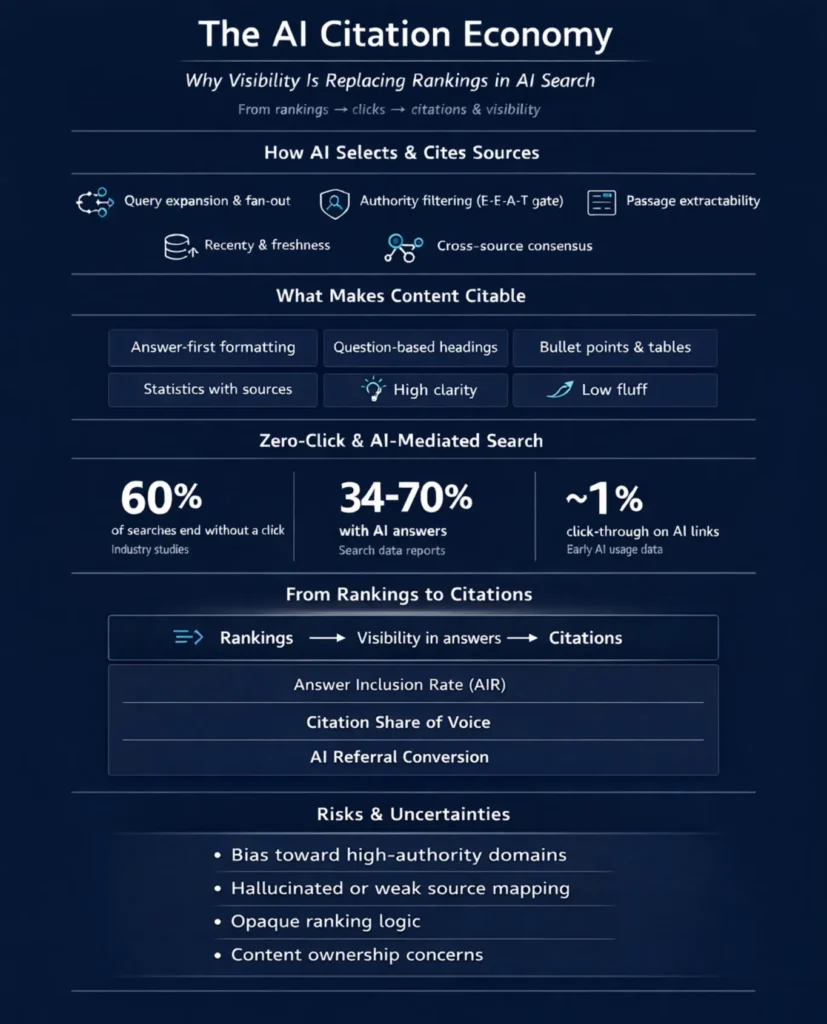
The filtering pipeline is sequential: retrieval, then authority filtering, then passage-level extractability.
- Retrieval: keyword match + semantic similarity across a broad document pool
- Authority gate: E-E-A-T-style filtering eliminates low-trust content regardless of relevance
- Passage selection: self-contained, directly answerable passages are prioritized
- Consensus weighting: claims supported by multiple sources carry more citation weight
Most content fails at the authority gate — not because it’s irrelevant, but because it lacks the domain trust signals AI systems require.
Why Domain Trust Determines Citation Access
Research on ChatGPT’s citation behavior makes the stakes concrete. Domains in the highest trust band averaged 8.4 citations versus 1.6 for lower-trust domains — a 5.25× gap primarily driven by domain authority filters, with content quality and structure still mattering once a domain passes the authority threshold.
- High-trust domains receive citations by default on regulated topics (health, legal, financial)
- New or low-authority domains face systematic exclusion regardless of content substance
- Government sites, institutional affiliations, and recognized brands get structural preference
- Multi-location operators in healthcare and professional services face the highest authority thresholds
Authority is built through consistent, citation-verified, structured content published at scale — not through any single article.
How Are AI Overviews, ChatGPT, and Perplexity Changing Search Behavior for Your Audience?
AI platforms have changed how potential clients research your services. Your audience is still asking the same questions — they’re getting answers differently, and the sites they visit as a result are the ones that earned citations.
Zero-Click as the Default Search Outcome
For every 1,000 Google searches, only 360 clicks in the U.S. go to the open web. The remaining 640 resolve without any site visit.
- ~60% of searches result in zero clicks in the U.S. and EU markets
- AI Overviews resolve informational queries before organic listings are reached
- Healthcare, B2B services, and insurance categories see 90%+ AI Overview coverage
- “People Also Ask” and featured snippets further reduce click pressure on organic results
The question isn’t whether AI is disrupting your organic traffic model. It’s whether your content is positioned to earn the citations that drive the traffic that still converts.
Platform-Specific Behavior and Citation Patterns
Each AI platform operates a distinct citation model—operators building for citation need to understand which mechanisms apply where.
- Google AI Overviews: Cites 5–15 sources per answer; ~70% from top-10 organic results; “core sources” repeat across refreshes, creating compounding visibility
- ChatGPT: Uses Bing’s index plus OpenAI crawlers; 3–6 numbered citations per response; 44% of citations drawn from the first third of a page
- Perplexity: Makes source attribution central to its UX; explicitly evaluates publisher authority, evidence backing, and provenance transparency
- Citation share compounds: Once a URL becomes a “core source,” AI systems reinforce that status across subsequent queries
Single-channel optimization leaves citation share on the table across all three platforms.
What Reduced CTR Means for Organic Traffic Models
Users clicked on a traditional result in only 8% of searches when an AI summary appeared, versus 15% when no summary was present—a roughly 50% reduction driven primarily by AI answers appearing above the fold and satisfying intent on-page.
- Ahrefs documented a 34.5% drop in position-1 CTR when AI Overviews appeared
- Seer Interactive reported organic CTR falling from 2.94% to 0.84% with similar average positions in both groups
- BrightEdge found impressions up 49% over the first year of AI Overviews, while click-throughs fell nearly 30%
- Only ~1% of users click cited links inside AI summaries — yet those citations still shape brand perception
Impression volume is growing while traffic conversion from impressions is declining. Brands inside the answer are building awareness at scale. Those absent are increasingly invisible.
What Makes Content Citable by AI Systems—and What Gets Filtered Out?
Citable content isn’t written differently from good content — it’s structured differently. AI systems scan for passages that can be cleanly extracted and dropped into a synthesized answer. The structural choices that determine passage qualification are specific, learnable, and implementable at scale.
Answer-First Structure and Passage Extractability
The most consistent finding across AI citation research: answer-first structure drives citation selection. Approximately 44% of ChatGPT citations come from the first third of a page — introductions and early sections are the primary extraction zones.
- Lead with a 40–60-word direct answer to the primary question — no setup, no preamble
- Gemini favors 134–167-word self-contained passage units that fully answer a sub-question
- Bury the answer deep in the narrative, and the model moves to the next candidate
- Every COL article opens with a direct answer to the H1 — not context, not background
This structural discipline is the difference between content that ranks and content that gets cited.
Question-Based Architecture and Structured Headings
Question-based H2S and H3S enable retrieval systems to map user intent to specific passages, creating a direct semantic match between the model’s sub-queries and the page structure.
- H2S formatted as questions mirrors the sub-query patterns AI systems generate
- “What is…,” “How does…,” and “Why does…” formats improve embedding-based retrieval matching
- Tables and comparison structures expose discrete facts that AI systems can lift directly
- Topic-based, thematic headings are less machine-friendly than question-based ones
Question-based H2 architecture isn’t a stylistic preference in the COL production system — it’s a citation engineering decision.
Statistical Backing and Machine-Readable Provenance
Content with verifiable statistics, properly attributed data, and transparent sourcing earns preferential treatment in systems designed to prioritize consensus and evidence.
- Perplexity’s evaluation framework explicitly values pages with “verifiable quotes, transparent authorship, and clear context”
- Pages with unique, well-supported statistics often become recurring “core sources” — the same data point is needed across query variations
- Structured data (FAQ, HowTo, Article schema) boosts AI Overview selection probability by 73%
- Multimodal pages combining text, images, and structured schema see 156% higher selection rates
Publishing proprietary data and clearly attributed statistics is how you become an indispensable node in the citation graph.
If your operation needs to produce 20–50+ articles per month without sacrificing compliance or citation quality, Content Ops Lab builds the infrastructure to make that possible. Contact us to discuss your content production requirements.
What Conversion Data Reveals About AI Search Traffic Versus Traditional Organic?
The business case for AI citation infrastructure isn’t theoretical. Independent research across hundreds of companies documents AI search conversion rates that consistently outperform traditional organic search, and 23-month production data from a regulated, multi-location healthcare operation validates those benchmarks under real-world conditions.
Pre-Qualified Intent and the Buyer Journey Difference
Traditional search sends users to your site at the beginning of their research process. AI search sends them after the research is largely complete.
- AI users compare options and evaluate trade-offs inside the conversation before clicking any citation
- By the time a user follows a citation link, they’ve completed much of the consideration phase
- AI citations function as implicit endorsements — the system has effectively recommended the source
- Session durations for AI-referred visitors consistently run longer, reflecting deeper pre-arrival qualification
This pre-qualification dynamic explains why AI search converts at multiples of traditional organic.
Conversion Rate Benchmarks Across Platforms
- Ahrefs: 0.5% of visitors from AI search generated 12.1% of all signups — 23x better than traditional organic
- Superprompt (12.3M visits, 347 companies): 14.2% AI search CVR vs. 2.8% Google organic — a 5.1x multiplier
- Microsoft Clarity: Copilot referrals converted at 17x direct traffic and 15x search traffic rates
- Professional services specifically: 5.6x conversion advantage (21.3% vs. 3.8% baseline)
Volume is still small. The performance multiplier is not.
What a 23-Month Production Engagement Shows in Practice
A multi-location regulated healthcare operator running the COL production system generated 95+ confirmed AI search conversions across 537+ sessions in an 8-month window — a 21.4% average CVR against a 3.32% site baseline.
- ChatGPT traffic grew 887% in 7 months (July 2025–February 2026)
- Peak CVR reached 40% in January 2026 with 52 sessions
- CVR trajectory held upward: 9.5% → 32.8% → 40%
- Perplexity peaked at 25.7% CVR during the July–October 2025 window
- Less than 0.3% of total traffic delivers a disproportionate conversion share
These figures came from a systematic content infrastructure applied consistently at scale — not a standalone AI optimization initiative.
Related: How AI Search Engines Decide Which Sources to Cite
How Do You Build Content Infrastructure That Earns AI Citations at Scale?
Earning AI citations consistently requires production infrastructure that generates citation-qualified content at scale, maintains the structural standards AI systems reward, and publishes frequently enough to establish the freshness and consensus signals that determine “core source” status.
Structured Data and Schema as Citation Infrastructure
Structured data is a citation multiplier. Research shows it boosts AI Overview selection probability by 73%, and multimodal pages with structured schema see 156% higher selection rates.
- The FAQ schema maps directly to the question-based sub-queries that AI systems generate
- HowTo and Article schema help Gemini associate entities and claims during re-ranking
- Schema implementation needs to be part of the production workflow, not retrofitted post-publication
Structured data is one of the highest-ROI investments in the AI citation stack — and one of the most consistently underimplemented by multi-location operators.
Content Velocity and Freshness Requirements
AI citation systems aggressively apply recency filters. Content that hasn’t been updated recently can be excluded from retrieval entirely, regardless of historical authority.
- ChatGPT live search can limit eligible content to the last 30 days for time-sensitive queries
- Google AI Overviews weight freshness as an active selection criterion, not just a tiebreaker
- Perplexity includes “freshness” in its formal evaluation criteria alongside authority and evidence
- Becoming a “core source” requires sustained publishing cadence — not one-time optimization
An operator publishing 20–50+ articles per month maintains freshness across topic clusters simultaneously. An operator publishing 4–8 cannot.
Multi-Platform Optimization vs. Single-Channel SEO
Content optimized exclusively for Google’s traditional ranking signals will systematically underperform in ChatGPT, Perplexity, and Gemini citation contexts — structured for ranking, not extraction.
- Traditional SEO: Keyword density, link authority, structured metadata
- AEO: Answer-first formatting, featured snippet targeting, 40–60-word direct responses
- LLM Optimization: Citation-ready phrasing, question-based H2 architecture, bullet density
- GEO: Authoritative tone, verified statistics, transparent sourcing
Building for four optimization targets simultaneously requires a production system — templates, verification protocols, and multi-stage quality control enforced across every article at scale.
How Should Operators Measure and Allocate Resources in the AI Citation Economy?
AI visibility measurement is still early. There’s no standardized citation share dashboard across ChatGPT, Perplexity, and Google AI Overviews. The directional frameworks are clear enough to inform budget allocation — and operators building measurement discipline now will have a data advantage as the tools mature.
Emerging Metrics: AIR, Citation Share of Voice, Core Source Stability
- Answer Inclusion Rate (AIR): Percentage of tracked queries where your brand is cited in AI answers
- Citation Share of Voice (C-SOV): Share of visible citations across all sources cited for a topic cluster
- AI Referral Conversion Rate: Conversion performance of AI platform traffic relative to organic and paid
- Core Source Stability: Frequency with which a URL appears as a core source across time windows and query variants
These metrics capture a layer of competitive performance that average position and organic CTR cannot see.
Why Rankings Remain a Foundation, Not a Finish Line
The AI citation economy doesn’t make traditional SEO irrelevant — it makes it necessary but insufficient. Approximately 70% of Google AI Overview citations come from top-10 organic results, meaning ranking authority remains a baseline qualification for citation eligibility.
- Domain authority built through traditional SEO directly feeds AI citation eligibility
- Organic search still drives the majority of traffic and conversions — AI is additive, not a replacement
- Operators over-rotating toward AI optimization at the expense of foundational SEO make a strategic error
Both failure modes are real. Integrated infrastructure is the only correct answer.
The First-Mover Calculus for Multi-Location Operators
The citation economy has a compounding dynamic that makes timing consequential. AI systems reinforce existing citation patterns — core source status compounds with each additional citation.
- Competitive window in most multi-location verticals: 12–18 months
- Very few healthcare practices are currently optimizing for AI search citations
- Industry observers estimate that fewer than 10% of law firms currently track AI referral traffic from platforms such as ChatGPT, Perplexity, and Copilot.
- Tool development, agency packaging, and mainstream awareness are all accelerating through 2026–2027
Operators building citation infrastructure no longer compete against AI-optimized competitors. They’re establishing a position before those competitors exist in their category.
How Content Ops Lab Builds Content Infrastructure for the AI Citation Economy
A 12-location regulated healthcare operator running the Content Ops Lab production system for 23 months generated 95+ confirmed AI search conversions at a 21.4% average CVR — 6.4x the site baseline — while publishing 1,000+ citation-verified articles with zero compliance violations.
- 23-month production test inside a 12-location regulated healthcare organization
- 1,000+ citation-verified articles and pages with zero compliance violations
- 45% of all leads from organic search — outperforming paid search nearly 2:1
- 21.4% average AI search CVR vs. 3.32% site baseline — 6.4x performance multiplier
- 887% ChatGPT traffic growth in 7 months (July 2025–February 2026)
- 653% impression growth and 1,700% click growth for an emerging brand in 14 months
- 5x production scale: 10 articles/month to 50+ without adding headcount
The Content Ops Lab Production System
- Research: Verified sources before any AI generation — no hallucinated citations
- Verification: Line-by-line citation cross-check with STAT vs. CLAIM labeling and full audit trail
- Optimization: Multi-platform formatting for Google, ChatGPT, Perplexity, Claude, and Gemini simultaneously
- Delivery: WordPress staging or Google Docs — publish-ready, Grammarly-reviewed, compliance-cleared
Ready to build a content infrastructure that earns AI citations without the compliance risk? Get in touch today — we’ll assess your current content operation and outline what a systematic approach would look like for your organization.
FAQs About the AI Citation Economy
How is the AI citation economy different from traditional SEO ranking?
Traditional SEO competed for position in an ordered list — a higher rank meant more clicks. The AI citation economy introduces a parallel competition: whether your content is selected as a cited source inside AI-generated answers. A page can rank in the traditional top three and still be excluded from the cited pool of 5–15 sources. Citation selection depends on domain trust, passage extractability, and content structure — not keyword optimization alone.
What does it cost to build content that gets cited by AI systems like ChatGPT and Perplexity?
Content Ops Lab offers two models: Done-For-You handles research, generation, citation verification, and multi-platform optimization for organizations publishing 20–50+ articles per month. System Build delivers the complete production infrastructure — templates, workflows, quality control — for teams that want to operate it internally. Both deliver citation-qualified content; the difference is who runs the system.
How do multi-location businesses track AI citation performance and measure ROI?
The most actionable current approach combines GA4 referral tracking segmented by AI platform, UTM-tagged campaigns for AI-specific traffic, and emerging metrics like Answer Inclusion Rate and Citation Share of Voice. AI referral CVR — how AI-referred visitors convert relative to organic and paid — is the metric that most directly translates citation performance into business value.
Is organic search still worth investing in if AI Overviews are reducing click-throughs?
Yes — organic SEO remains the foundation of AI citation eligibility. Approximately 70% of Google AI Overview citations come from top-10 organic results, meaning ranking authority is a prerequisite for citation access. Organic search still drives the majority of overall traffic and conversions. Maintain foundational SEO while building the structural standards that qualify content for AI citations.
How long does it take to start appearing in AI citations after optimizing content infrastructure?
For organizations with existing domain authority, structural changes — such as answer-first formatting, question-based H2S, and structured data — can begin influencing citation selection within weeks. Building “core source” status for a topic cluster typically requires 3–6 months of consistent, high-volume production. New or low-authority domains face a longer runway regardless of content quality.
Key Takeaways
- The AI citation economy measures search success by whether AI systems select your content as a cited source — ranking position alone is no longer sufficient
- AI systems filter content through sequential gates (retrieval → authority → passage extractability); most content fails at the authority stage, not relevance
- Zero-click behavior affects 58–60% of searches; AI Overviews reduce position-1 CTR by 34–70% — visibility inside the answer is worth more than ranking below it
- AI search traffic converts at 3–23x traditional organic rates; a 23-month regulated-industry engagement produced a 21.4% average CVR at a 6.4x multiplier
- Content earns citations through answer-first structure, question-based architecture, verified statistics, and structured data — not through length or keyword density
- The competitive window for citation-first infrastructure in most multi-location verticals is measured in quarters — early citation dominance compounds as AI systems reinforce existing patterns
Build Content Infrastructure That Compounds: The AI Citation Economy
The shift from rankings to citations isn’t a future-state prediction — it’s the current operating environment. Zero-click rates are approaching 60%. AI Overview coverage in healthcare, B2B services, and professional categories exceeds 90%. The content that earns citations converts at 6x the rate of traffic that earns rankings alone.
Operators building citation infrastructure now are establishing positions before their category becomes contested. Those who wait are ceding the highest-converting channel in search of competitors willing to invest.
Content Ops Lab’s methodology was validated within a regulated healthcare operation — over 23 months, 1,000+ articles, and zero compliance violations. The question is whether you build it before or after your competitors do.
Related: Why AI Referrals Convert Better Than Regular Search