

Why Traditional SEO Alone No Longer Wins Informational Search
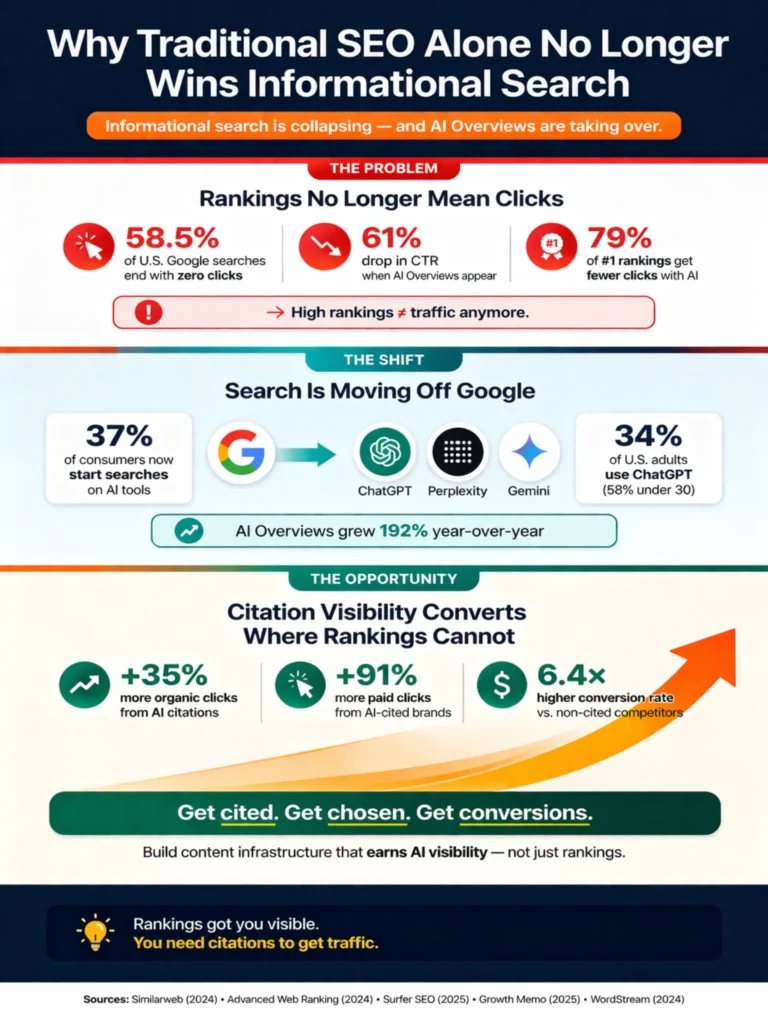
Traditional SEO no longer controls informational search outcomes — and the data makes that shift impossible to ignore. A 2024 analysis using Datos clickstream data found that 58.5% of U.S. Google searches and 59.7% of EU searches ended without any click to a website. When AI Overviews appear, organic CTR on informational search queries drops from 1.76% to 0.61% — a 61% decline — even for pages holding top rankings.
For multi-location operators running high-volume blog programs, this isn’t a temporary algorithm fluctuation. It’s a permanent change in how informational intent gets resolved. Content Ops Lab built its content production methodology within a regulated, multi-location operation specifically to capture the channel, filling the gap — AI search — where traffic converts at an average of 21.4%, 6.4x the organic baseline.
Related: Answer Engine Optimization: What Multi-Location Operators Need to Know
Why Is Traditional SEO Losing the Informational Search Battle?
Traditional SEO was built around a simple model: rank at the top, earn the click, convert the visitor. In 2026, that model is broken — structurally, not cyclically — for informational content categories.
The Zero-Click Structural Shift
Zero-click search isn’t new, but the scale has crossed a threshold that changes the strategic calculus.
- 58.5% of U.S. Google searches end without any click to a website
- Problem-solving searches see zero-click rates above 70%
- Roughly 65% of global Google searches in 2024 were zero-click, driven by mobile SERP features
Users are getting complete answers without leaving Google—or even going to Google at all. Zero-click isn’t user indifference. It’s the search engine doing its job so well that the website becomes optional.
Traditional SEO metrics were never built to measure this. Impression counts and ranking reports don’t distinguish between “ranked and clicked” and “ranked and ignored.” That gap matters enormously when informational queries — conditions treated, services explained, procedures described — are exactly what multi-location content programs target most.
What AI Overviews Do to Organic CTR
Google’s AI Overviews represent the most direct threat to organic click volume from informational content. The CTR data is unambiguous.
- Organic CTR on informational queries with AI Overviews fell 61% — from 1.76% to 0.61%
- Paid CTR on the same queries fell 68% — from 19.7% to 6.34%
- Even queries without AI Overviews saw organic CTR decline 41% year-over-year
That last figure matters: off-SERP AI tools (ChatGPT, Perplexity, Gemini) are capturing informational research sessions that used to start in Google. The traditional SERP is losing informational traffic from both directions — from within (AI Overviews) and from outside (AI-native platforms).
Rankings Without Traffic
The most operationally dangerous scenario is a strong ranking report masking declining actual performance. Research from Authoritas indicates a top-ranked result can lose up to 79% of its clicks when an AI Overview appears — without any change in ranking position.
- Pew analysis found users clicked links only 8% of the time when AI Overviews were present, versus 15% without
- Only 1% of users clicked a link cited within the AI Overview itself
- First-position CTR on informational queries has been declining for years, even before AI Overviews launched
Reporting “#1 ranking” to leadership without also reporting on SERP visibility, AI citation frequency, and actual click delivery now paints an incomplete picture.
What Has Changed About How People Search for Informational Content?
The problem isn’t only that Google is answering more queries on-page. A growing share of informational research never reaches Google at all. User behavior has shifted simultaneously at the query and platform levels.
Keyword Fragments vs. Conversational Queries
Traditional search engines trained users to compress questions into fragment-style queries. AI systems don’t require that compression — users ask full questions with context, constraints, and follow-ups.
- Natural language questions increasingly trigger AI-oriented results: snippets, People Also Ask, voice responses
- LLM-powered platforms support multi-turn dialogue and contextual follow-ups
- UX research finds users “relish the opportunity to speak like people again” when interacting with AI search
Content written to serve keyword fragments — dense, keyword-front-loaded prose optimized for crawler parsing — performs differently than content structured around genuine questions with direct answers.
AI systems reward the latter. Question-based H2 architecture, answer-first paragraph structure, and conversational semantic variation aren’t optional enhancements. They serve as the baseline for informational content in an AI-mediated search environment.
The AI Search Platform Migration
The migration is no longer speculative. The usage numbers are in production.
- 34% of U.S. adults have used ChatGPT as of mid-2025, including 58% of adults under 30
- Perplexity served over 500 million queries in 2024, growing to 100 million queries per week by 2025
- 37% of consumers now start at AI tools rather than Google for at least some searches
These platforms capture information from research sessions that traditional SEO cannot capture through rankings alone. A user asking Perplexity, “What’s the difference between chiropractic care and physical therapy?” never touches a traditional SERP. That session generates a recommendation — often with citations — without the user visiting a website.
Informational vs. Transactional Intent Split
Not all content is equally affected. Understanding the intent split determines where to adapt and where traditional SEO still holds.
- Informational intent (“what,” “how,” “why”) is most vulnerable to AI Overview and zero-click displacement
- Transactional intent (“book,” “schedule,” “buy”) still drives clicks to booking interfaces and lead forms
- Zero-click displacement is most pronounced where a concise answer fully satisfies the need
Operators who let their informational content strategy atrophy in response to CTR declines may find their transactional pages losing authority traction within 12-18 months.
Which Types of Informational Search Content Are Being Hit the Hardest?
Zero-click and AI Overview displacement isn’t uniform. Three content categories are absorbing the majority of the impact — and they’re the most common outputs of multi-location content programs.
Definition and Explainer Queries
Definitional content — “what is sciatica,” “how does Botox work” — is precisely what AI systems are designed to answer in one synthesized response. These queries trigger featured snippets or full AI Overviews that provide a concise explanation plus supporting bullets.
- Users get a complete answer without clicking through to the source article
- Ranking for these queries now signals relevance to AI systems, not necessarily click volume
Definition and explainer articles still need to be written and optimized. Still, they now serve a different primary function: building the citation authority that gets a brand referenced in AI answers, rather than directly generating click-through traffic.
Problem-Solving and How-To Content
“How to stretch for lower back pain,” “what to expect at a first chiropractic appointment” — high-value informational queries for multi-location healthcare operators, and the queries most thoroughly answered by AI Overviews and step-list formatting.
- How-to queries are summarized into AI overviews and step lists that fully resolve the user’s need
- Define Media Group’s portfolio saw a 16% immediate traffic drop after AI Overviews launched, deepening to 42% below baseline by Q4 2025
How-to content needs to be engineered for citation extraction. When Perplexity answers “how to prepare for a chiropractic adjustment,” the operator whose content is cited builds brand authority even without a click. The operator whose content isn’t cited gets nothing.
Top-of-Funnel Blog Traffic
Generic informational blog content targeting educational keywords is where the most absolute click volume is being lost. The blogs that hold value are the ones AI systems cite — structured correctly, backed by verified claims, specific enough to stand apart from commodity content. Volume without citation-worthiness is a diminishing asset.
If your content program is generating impressions without proportional leads — or if you’re publishing consistently but not appearing in AI-generated answers — Content Ops Lab builds the infrastructure that closes that gap. Contact us today to discuss your content production requirements.
What Is Actually Replacing Traditional SEO for Informational Visibility?
Ranking is still a prerequisite. Two optimization disciplines have emerged to fill the gap between “ranking” and “being the answer.”
Answer Engine Optimization (AEO) Defined
AEO focuses on structuring content so that AI-powered answer systems — Google’s AI Overviews, voice assistants, ChatGPT — can directly extract, trust, and surface it as a response.
- H2s formatted as explicit questions: “What is…?”, “How does… work?”
- Concise, fact-rich answers surfaced immediately under each heading
- Structured data and schema markup (FAQ, HowTo, LocalBusiness), making Q&A pairs machine-readable
- E-E-A-T signals — credentials, bylines, citations — that AI systems use as trust proxies
A page can rank well while being nearly useless as an AI citation source if it lacks answer-first formatting and structured extractability.
Generative Engine Optimization (GEO) Defined
GEO focuses on visibility within AI-generated answers — treating ChatGPT, Gemini, Perplexity, and Copilot as a distinct distribution layer.
- Primary goal shifts from ranking in SERPs to appearing as a cited source inside AI-generated narratives
- Optimization targets clarity, structure, and citation-worthiness — not keyword density
- Success metrics include AI visibility, share of voice in AI answers, and citation frequency
- Off-site presence matters: AI systems draw from industry publications, authoritative third-party sources, and review platforms
GEO requires producing original data, expert commentary, and proprietary research that other sites and AI systems want to reference. Commodity content that aggregates widely available information doesn’t earn citations.
Citation-Based Visibility as the New Position One
AI systems surface a handful of citations per answer. Being one of those sources is now more valuable than ranking fifth on a page that no one scrolls past the AI Overview.
- Brands cited in AI Overviews earn 35% more organic clicks and 91% more paid clicks than non-cited brands on the same queries
- Citation-level visibility delivers conversion even in zero-click environments — the brand is named, trusted, and associated with the answer
- Early citation dominance compounds: AI systems reinforce existing citation patterns over time
What Does Answer-First Content Infrastructure Actually Require?
Content that gets cited isn’t distinguished primarily by topic or keyword selection. It’s distinguished by architecture — how content is structured, how claims are supported, and how consistently it meets AI extraction standards at scale.
Structural Requirements for AI Extraction
AI systems parse content differently from human readers. The structural requirements for AI citation are specific.
- Answer-first paragraphs: 40-60-word direct answers immediately following each H2 question
- Bullet-heavy formatting: 40-60% of section content in scannable form
- H3 subtopic organization: labeled subsections AI can index independently
- FAQ integration: question-and-answer pairs formatted for direct snippet extraction
Content that doesn’t lead with the answer rarely gets cited, even when the underlying information is strong. AI systems don’t read for context — they extract for answers.
Multi-Platform Optimization Framework
No single platform dominates informational search. Traditional SEO, AEO, and GEO require simultaneous optimization across systems with different extraction behaviors.
- Traditional SEO: Keyword density, internal linking, meta optimization, crawlability
- AEO: Featured snippet targeting, schema markup, E-E-A-T signals
- LLM optimization: Citation-ready phrasing, structured formatting for ChatGPT, Claude, Perplexity
- GEO: Authoritative tone, verified claims, consistent entity signals across platforms
Retroactively adding schema to keyword-optimized blog posts is not multi-platform optimization. These four modes need to be built into content simultaneously, before drafting begins.
Citation Verification at Scale
Citation verification is the operational bottleneck most content programs don’t solve — and the differentiating factor that determines whether content earns AI trust or generates liability.
- Every statistic requires a traceable source — not paraphrased, not approximated
- Fabricated citations don’t just fail compliance audits; they signal unreliability to AI systems trained on the broader web
- Multi-location programs publishing 50 articles per month need systematic verification protocols, not manual spot-checks
A single fabricated statistic on a location page can cascade across a 12-location network if a content template propagates it. Without a systematic verification workflow — exact-quote extraction, line-number documentation, STAT vs. CLAIM labeling — error rates compound over time.
Related: SEO vs AEO vs GEO: How Multi-Location Businesses Should Think About Modern Search
How Content Ops Lab Builds Content Infrastructure for AI-First Search
AI search traffic converts at an average of 21.4% — 6.4x the organic baseline — when the content driving those citations is built on verified research and an answer-first architecture. That figure comes from 23 months of continuous production inside a regulated, multi-location operation, not a test campaign.
Content Ops Lab’s methodology was built in that environment — iterating on live article output, version-controlled quality-control systems, and compliance standards that couldn’t tolerate hallucinated sources. The result is a content production system that targets Google rankings and AI citations simultaneously.
Production proof points from a 12-location regulated healthcare deployment:
- 23-month production test in a regulated industry during significant market disruption
- 1,000+ citation-verified articles and pages with zero compliance violations
- 45% of all leads from organic search — outperforming paid search nearly 2:1
- AI search converting at 21.4% average vs. 3.32% site average (6.4x multiplier)
- 887% ChatGPT session growth in 7 months (July 2025 – February 2026)
- 653% impression growth and 1,700% click growth for an emerging brand over 14 months
- 5x production scale — 10 articles/month to 50+ — without adding headcount
- Dual-brand methodology validated on both mature brand maintenance and emerging brand growth
The Content Ops Lab Production System
- Research: Verified sources before generation — no AI writing from memory, no hallucinated citations
- Verification: Line-by-line citation cross-check, STAT vs. CLAIM labeling, full audit trail
- Optimization: Multi-platform targeting — Google, ChatGPT, Perplexity, Claude, Gemini — built in simultaneously
- Delivery: WordPress staging or Google Docs packages — publish-ready, Grammarly-reviewed, compliant
The competitive window for AI citation dominance is measured in quarters. Operators who build answer-first content infrastructure now will compound those citation patterns before the market catches up.
FAQs About Why Traditional SEO Alone No Longer Wins Informational Search
Does traditional SEO still matter, or should operators abandon it entirely?
Traditional SEO remains foundational — technical health, crawlability, and relevance signals determine whether content gets indexed and considered by AI systems. The error is treating it as sufficient on its own. Operators need both: traditional SEO as the baseline and AEO/GEO as the layer that converts rankings into AI citations and visibility.
How long does it take for AEO and GEO changes to show results?
Answer-first structural changes to existing content can improve featured snippet performance within 4-8 weeks. AI citation visibility builds more gradually — typically 3-6 months before meaningful traffic from ChatGPT and Perplexity becomes trackable. Operators who are now seeing AI search results started building answer-first infrastructure 6-12 months ago.
How do you measure informational search visibility across AI platforms?
AI platform referrals appear under source labels such as “chatgpt.com,” “perplexity.ai,” and “claude.ai” in GA4, or they are absorbed into direct traffic. Dedicated UTM parameters on key landing pages improve attribution. Track session volume by source, CVR by source, and brand search volume trends — rising brand search often signals AI citation activity not yet captured in referral data.
What informational search content should multi-location businesses rebuild first?
Start with the highest-volume informational queries your patients or clients are already asking — condition explainers, treatment comparisons, and “what to expect” content. Consolidate thin, duplicative posts into authoritative evergreen guides. Re-architect existing content with answer-first paragraphs and FAQ schemas before writing a new volume.
Is AEO/GEO different for regulated industries than general businesses?
Yes — healthcare and legal content cited by AI systems needs to be traceable to credible primary sources because AI systems amplify inaccurate claims as readily as accurate ones. Systematic citation verification isn’t optional in regulated industries. It’s the compliance requirement and the citation quality signal working in the same direction.
Key Takeaways
- Zero-click search affects the majority of informational queries — 58.5% of U.S. Google searches end without any click, with rates above 70% for problem-solving content
- When AI Overviews appear, organic CTR on informational search drops 61% — even for top-ranked pages
- 37% of consumers now start informational research at AI tools instead of Google; Perplexity grew 192% year-over-year to 160M monthly visits
- Brands cited in AI Overviews earn 35% more organic clicks and 91% more paid clicks than non-cited competitors on the same queries
- Answer-first content architecture — question-based H2s, 40-60 word direct answers, 40-60% bullet formatting — is the structural requirement for AI citation
- Multi-location operators face compounding risk: unverified content and thin blog posts lose both click traffic and AI citation consideration simultaneously
- The first-mover window is measured in quarters; operators building answer-first infrastructure now will compound citation patterns before the market catches up
Related: Generative Engine Optimization: How Brands Get Recommended by AI
The Operator’s Path Forward on Traditional SEO and Informational Search
Zero-click rates above 58%, AI Overview CTR declines of 61%, and 37% of consumers starting searches directly in AI tools aren’t isolated signals — they’re a coordinated structural shift in how informational search works. Ranking remains necessary, but it no longer wins the informational queries that build brand authority and top-of-funnel demand.
The operators who hold position in this environment won’t be the ones publishing the most articles. They’ll be the ones whose content gets cited — because it’s structured correctly, backed by verified sources, and built for AI extraction from the first paragraph. That’s not an SEO enhancement. It’s a different infrastructure entirely.
Content Ops Lab builds that infrastructure. Twenty-three months of production in a regulated, multi-location environment — 1,000+ articles, zero compliance violations, AI search converting at 6.4x the organic baseline — is a proven system available to operators ready to stop optimizing for 2019 search and start building for 2026.
Ready to build content infrastructure that gets cited by AI systems — not just ranked by Google? Get in touch with us — we’ll assess your current content operation and outline what a systematic approach would look like for your organization.