

How Should You Evaluate Citation Quality in AI Search Results?
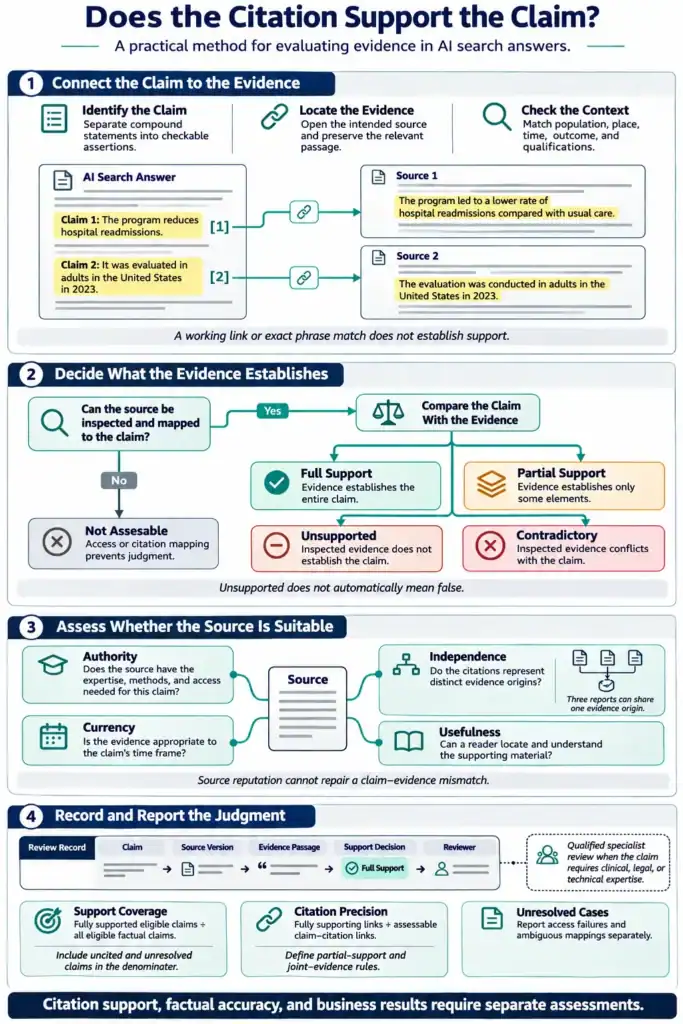
Evaluate citation quality in AI search by checking whether each cited passage supports the specific claim beside it, then assessing the source’s authority, currency, independence, and usefulness. Keep those judgments separate from whether a citation appears, whether the answer is factually correct, and whether it produces business results.
The historical ALCE benchmark separates these dimensions: “We develop automatic metrics along three dimensions—fluency, correctness, and citation quality—and demonstrate their strong correlation with human judgements” — Gao et al.
A dashboard can hide those distinctions. Content Ops Lab approaches claim-to-source verification as a research-first operating discipline, making evidence and review decisions inspectable.
Related: What Can AI Source Verification Tools Actually Verify?
What Does Citation Quality in AI Search Actually Measure?
Citation evaluation measures the relationship between an answer’s claims and its attributed evidence, along with the suitability of that evidence for the question. A useful review identifies what each check establishes. A working URL, familiar publisher, or lengthy source panel cannot substitute for inspecting the relevant proposition.
Citation Presence and Source Identity
Start by separating the visible attribution from the material behind it. These working definitions prevent an accessible page from receiving credit for judgments the reviewer has not yet made.
| Check | What It Establishes | What It Leaves Unresolved |
| Citation presence | An attribution appears. | Claim mapping and support. |
| Source validity | An identifiable intended source is identified. | Relevance, support, and accuracy. |
| Topical relevance | Shared subject matter. | Support for specific wording. |
| Claim support | Evidence establishes the proposition. | Underlying evidence accuracy. |
| Factual accuracy | Separately established truth. | Displayed citation support. |
- Record redirects and unexpected changes in destination.
- Distinguish original publications from syndicated article copies.
- Flag inaccessible evidence for a separate retrieval outcome.
A historical news audit observed: “Generative search tools fabricated links and cited syndicated and copied versions of articles” — Tow Center / Columbia Journalism Review.
Eight tools faced 1,600 news-excerpt identification queries in February 2025: a single-run specialized task, not current accuracy evidence.
An identifiable source still requires a separate judgment about the proposition it supposedly supports.
Claim Support and Answer Accuracy
Citation correctness means claim support. A citation can faithfully represent an incorrect source. Conversely, an answer can state something true while attaching evidence that does not establish it. Both distinctions matter when diagnosing failures.
- Assess support against the actual cited material.
- Assess truth through a separate factual investigation.
- Assess relevance against the user’s actual question.
These separate findings determine whether the problem concerns attribution, underlying information, or the answer’s usefulness.
Citation Coverage and Reader Usefulness
Coverage asks how much of the answer’s eligible factual content is adequately supported. Reader usefulness asks whether someone can locate and inspect the evidence without reconstructing the attribution themselves.
- Include uncited factual assertions in coverage reviews.
- Connect markers to clearly bounded factual claims.
- Preserve passages that readers can independently inspect.
The next judgment requires examining each assertion at the specificity with which it was written.
Does the Cited Evidence Support the Claim as Written?
Evidence supports a claim only when it establishes the proposition at its stated specificity. Check the population, geography, period, outcome, and qualifications before assigning full support. Topic overlap or an exact phrase match can help locate material, but neither resolves what the passage actually establishes in context.
Break Compound Statements Into Checkable Claims
Compound wording lets one supported detail lend apparent credibility to several unsupported assertions. Decomposition makes those differences visible without forcing reviewers to accept or reject the sentence as a whole.
Illustrative hypothetical: “The Northside clinic offers same-day physical therapy at every location and is the city’s best choice for sports injuries.”
- Confirm the named clinic provides physical therapy.
- Check same-day availability for the stated location.
- Verify availability across every location being described.
- Examine the basis for the comparative recommendation.
Decomposition exposes the evidentiary gaps, but reviewers still need passages that resolve each individual proposition.
Match Each Claim to Its Evidence Passage
Preserve the passage together with enough surrounding text to interpret its scope. A quotation can be exact while omitting a limitation that changes how the claim should be understood.
- Retain qualifications surrounding the apparently supporting sentence.
- Match outcomes and populations without silent substitutions.
- Document jointly supporting sources and their contributions.
Record joint evidence; judge actual wording without restoring omitted qualifications.
A faithful passage match must preserve the limits that determine whether the claim is actually supported.
Distinguish Partial Support From Missing Evidence
Use separate fields for evidentiary support and retrieval status. An unavailable source creates uncertainty about support; an inspected source that fails to establish the assertion produces a different finding.
Liu et al.’s partial-support definition includes cases where “some of the information in the statement is supported by the citation, but other parts are not supported” — Liu et al.
Use these operational outcomes:
- Full: evidence establishes the entire stated proposition.
- Partial: evidence establishes only some stated elements.
- Unsupported: inspected evidence does not establish the proposition.
- Contradictory: inspected evidence conflicts with the proposition.
- Not assessable: access or mapping prevents judgment.
Contradictory and not-assessable are operational additions to that taxonomy. Record access and mapping failures separately; unsupported evidence does not prove falsity.
Support classification answers one question; source suitability determines how much confidence that support deserves overall.
Are the Sources Credible, Current, and Independent?
Sources deserve confidence when their expertise, methods, timing, and evidence origins fit the claim under review. Assess those qualities after establishing the support relationship. A prominent domain cannot repair a mismatch, and several publishers cannot establish independent corroboration when they repeat one underlying source.
Assess Authority for the Specific Claim
Authority depends on what the source is positioned to know. A clinic can document its own appointment process, while a treatment-effectiveness assertion requires evidence suited to evaluating that outcome.
- Identify accountable authors and relevant subject expertise.
- Inspect methods appropriate to the asserted finding.
- Check whether you can access the reported information directly.
- Consider commercial interests when interpreting supporting claims.
Even suitable expertise leaves a timing question when the answer describes circumstances that may change.
Match Freshness to the Claim’s Time Frame
Freshness depends on the proposition, rather than a universal age cutoff. A historical finding needs its original observation period; current service availability needs evidence applicable when the answer was generated.
NIST’s information-integrity discussion includes information that “has a clear chain of custody, and creates reasonable expectations about when its validity may expire”— NIST.
NIST credits the 2022 White House research roadmap. This governance guidance does not validate citation scores.
- Historical research: preserve observation and publication dates.
- Service availability: confirm current location-specific operations.
- Policy claims: distinguish announcement and effective dates.
- Updated pages: verify whether underlying evidence changed.
A retrieval date does not refresh evidence; an update label alone establishes no substantive change.
Current information can still share a single origin, making provenance the next question to resolve.
Trace Repeated Citations to Their Evidence Origin
Different URLs can create an impression of corroboration while carrying the same underlying report. Trace the evidence backward before treating publisher diversity as evidence diversity within an answer.
- Separate unique URLs from unique publishing organizations.
- Record common ownership where it affects interpretation.
- Group reports sharing the same underlying evidence.
The Cochrane Handbook states: “It is wrong to consider multiple reports of the same study as if they are multiple studies” — Cochrane Handbook.
Applied to AI citation portfolios, this is a methodological analogy: repeated reporting remains one evidence origin.
Those distinctions must survive aggregation, or an apparently stronger dashboard may conceal unchanged evidence underneath.
If your operation needs to produce 20–50+ articles per month without sacrificing compliance or quality, Content Ops Lab builds the infrastructure to make that possible. Contact us to discuss your content production requirements.
Which Citation Quality Metrics Can Leaders Trust?
Trust metrics whose units, denominators, support rules, exclusions, and review procedures you can inspect. You can’t responsibly reduce citation quality in AI search to an unexplained percentage. A score’s meaning depends on which answers were evaluated, how claims were divided, and what happened to partial or unresolved cases.
Declare the Evaluation Unit and Denominator
Count claims and claim–citation links separately. Coverage concerns the answer’s eligible factual assertions; precision concerns the evaluated attribution relationships. Combining those populations can make a heavily cited answer look better supported.
- Define eligible claims before reviewing sampled answers.
- Keep uncited eligible claims inside coverage denominators.
- Declare partial-support and joint-support counting rules explicitly.
Eligible claims are externally checkable assertions, including recommendations’ factual premises. Document exclusions of pure opinions and nonfactual instructions. Coverage credits full support; report partials separately.
A consistent counting rule also needs visible treatment of cases that reviewers cannot resolve confidently.
Keep Quality Dimensions Visible
A combined score can conceal whether sources became accessible, assertions gained support, or unresolved cases disappeared. Preserve the components so leaders can interpret what actually changed between reporting periods.
| Measure | Counting Rule | Required Qualification |
| Supported-claim coverage | Fully supported eligible claims ÷ all eligible factual claims. | Include uncited/unresolved claims; count joint support once. Exclude partials from numerator. |
| Citation precision | Fully supporting claim–citation links ÷ assessable evaluated links. | Exclude partials from numerator. Exclude unresolved links; report counts. Report joint sets separately. |
| Source-resolution rate | Identifiable, readable intended-source occurrences ÷ attempted occurrences. | Declare redirects and occurrence counting; resolution establishes no support. |
| Not-assessable share | Unresolved claims ÷ eligible claims; unresolved links ÷ evaluated links. | Separate counts, access failures, and mapping failures. |
| Independent evidence origins | Distinct underlying origins among inspected sources. | Report shared/unknown origins; domains do not establish independence. |
- Display credibility and currency alongside support findings.
- Report visibility separately from evidentiary quality measures.
- Keep conversions separate from citation evaluation results.
Jointly sufficient evidence can earn full claim coverage while individual links remain partial for precision. Declare that difference. Report zero-denominator results as “not applicable.”
Transparent arithmetic still depends on whether reviewers and automated evaluators apply the underlying rules consistently.
Calibrate Automated Judgments Against Human Review
Automation can screen broken links, propose claim boundaries, and identify candidate passages. Consequential support decisions still need calibrated review because detection and evidentiary judgment involve different error sources.
CiteEval cautions about coarse supportiveness measures: “This can potentially be too coarse when there are multiple citations and multiple evaluation aspects to consider”— Xu et al.
This June 2025 preprint concerns controlled retrieval settings; peer-review status is unestablished for this version. It validates neither commercial scores nor business impact.
- Compare independent reviewers on shared pilot cases.
- Adjudicate disagreements and retain the original judgments.
- Track false-support decisions against adjudicated review outcomes.
- Version the evaluator, prompts, and written rubric.
Calibration supports consistent application; neither automation nor human approval guarantees correct judgments on every case.
Related: Can Public Posts Manipulate AI Search Citations?
How Can Teams Make Citation Reviews Repeatable Across Platforms?
Repeatable review requires preserved observations, stable definitions, and accountable decisions. It does not require identical answers on every run. To compare citation quality in AI search, hold evaluation conditions as consistent as practical and disclose differences that could change which answers, claims, or sources enter the reviewed population.
Preserve the Query and Generation Conditions
A query alone does not define the observation. Platform surfaces and interaction settings belong in the record because apparent quality changes may reflect a different generation context or evaluated population.
- Preserve query version, platform, surface, and mode.
- Record exposed model label, timestamp, and timezone.
- Retain language, location, personalization, and conversation context.
Google explains: “AI Mode and AI Overviews may use different models and techniques, so the set of responses and links they show will vary” — Google Search Central.
This living documentation, checked October 31, 2026, describes behavior, not comparative accuracy. Track nonresponses, refusals, and absent AI features separately. Purposive pilots do not establish population-wide rates.
Comparable conditions establish the observation, while a preserved review record makes each resulting judgment inspectable.
Maintain a Claim-to-Evidence Review Record
Use stable identifiers and preserved source versions so another reviewer can reconstruct decisions after pages change. Retain many-to-many relationships when claims share sources or require combined evidence.
- Complete answer, bounded claims, and marker positions.
- Source-panel links stored separately from claim mappings.
- Retrieved source version, passage, and surrounding context.
- Support decision, retrieval outcome, reviewer, and review date.
- Adjudication, rationale, and linked correction or follow-up.
A reproducible record supports accountability only when material findings reach someone authorized to address them.
Escalate Consequential Errors and Track Corrections
Review priority should reflect the claim’s consequences and the uncertainty around it. An incorrect location-specific service statement can warrant attention even when an aggregate support percentage looks strong.
- Route clinical claims to qualified clinical reviewers.
- Assign legal assertions to appropriate legal reviewers.
- Verify numerical claims with accountable data owners.
- Confirm location details with local operational owners.
Editorial owns wording corrections and the published claim record. Track owned-content corrections separately from subsequent external-answer changes; sequence alone does not establish causation.
This boundary also defines what publishing-side verification can contribute to a broader citation review program.
How Does Content Ops Lab Make Citation Verification Inspectable?
Content Ops Lab reports a 5x increase in monthly output, from 10 to 50+ articles, for a 12-location regulated healthcare operation. Across the April 2024–March 2026 engagement, its proprietary reporting records 1,000+ articles and pages delivered with verified citations across the full 23-month engagement.
Those figures describe operational experience at sustained volume. They are not an independent audit, evidence of zero errors, or a measured improvement in external AI answers. Publishing-side verification establishes what the organization reviewed before release; external representation requires its own observations.
For citation quality in AI search, preserve why claims were accepted. COL’s publishing controls document that reasoning:
- Research before drafting to establish the evidence base.
- Trace original-source claims across intermediate summaries and reports.
- Exact evidence-passage extraction with surrounding qualifications retained.
- STAT/CLAIM classifications distinguishing editorial evidence types during review.
- Line-number documentation connecting claims with their supporting material.
- Multiple-draft quality review before content reaches final delivery.
- Version-controlled institutional documentation preserving decisions across production cycles.
- Production-scale proof: 10 → 50+ monthly; 1,000+ articles and pages.
Editorial labels organize review; they are not scientific quality grades. Exact quotation also requires context checks. A passage can be reproduced accurately while the surrounding assertion overstates what it establishes.
The Content Ops Lab Production System
The production system keeps evidence decisions connected to the content they govern. Each stage leaves material that the next reviewer can inspect, question, and correct before work moves forward.
- Research: Establish the evidence base before drafting.
- Verification: Check claims against original passages and their qualifications.
- Optimization: Structure supported content for search and reader comprehension.
- Delivery: Preserve reviewed outputs and documentation for accountable publishing.
These controls support publishing operations while keeping external-answer judgments tied to separately documented observations and decisions.
Ready to build content infrastructure that scales without the compliance risk? Get in touch — we’ll assess your current content operation and outline what a systematic approach would look like for your organization.
FAQs About Citation Quality in AI Search
Is Citation Quality Still a Concern When the Answer Is Correct?
Yes. A factually correct answer can cite material that doesn’t support its claims, leaving readers unable to verify the explanation through the displayed sources. Record factual accuracy and citation support separately. This distinction helps teams diagnose attribution failures without incorrectly labeling every unsupported assertion false or giving weak evidence credit because the conclusion happens to be right.
How Much Should a Business Audit Before Trusting Its Citation Quality Reports?
Start with a risk-based pilot covering important questions, locations, surfaces, and failure types. Include independent review and adjudication before expanding automation. Increase coverage where consequences, disagreement, or unresolved cases warrant it. No universal sample size makes citation quality in AI search trustworthy; confidence depends on the evaluated population, selection method, judgment consistency, and transparent reporting of limitations.
Who Should Review High-Risk Claims in AI Search Answers?
Assign consequential judgments to reviewers qualified for the claim: clinical specialists for clinical assertions, appropriate legal reviewers for legal statements, data owners for numerical findings, and operational owners for location details. Editorial should preserve the wording, evidence, and disposition. Document disagreements and escalation decisions rather than treating approval as a guarantee that every interpretation is correct.
Can You Compare Citation Quality Scores Across Different Monitoring Tools?
Only after aligning definitions, evaluated populations, claim segmentation, support rules, and denominators. Check how each tool handles partial support, joint evidence, inaccessible pages, and ambiguous markers. Compare components on the same preserved answers before interpreting aggregate differences. Identical percentage labels can reflect different calculations, so a higher displayed score does not automatically indicate better citation performance.
How Can Content Ops Lab Support Citation Verification Across Multiple Locations?
Content Ops Lab supports publishing controls through pre-draft research, original-source tracing, evidence-passage extraction, documented review, and version-controlled institutional records. Those practices help teams inspect the basis for published claims across locations. Evaluating external AI answers remains a separate review activity, requiring preserved observations and claim-specific judgments; publishing verification does not control what another system retrieves or says.
Key Takeaways
- Evaluate the claim-to-evidence relationship before treating visible citations, reputable publishers, or accessible links as signs of reliable support.
- Keep support, factual accuracy, source credibility, currency, and commercial outcomes separate; one favorable measure cannot establish the others.
- COL’s proprietary reporting records monthly output rising from 10 to 50+ articles for an anonymized 12-location regulated healthcare operation.
- Its reported 1,000+ articles and pages delivered with verified citations demonstrate production experience, supported by original-source tracing and documented review.
- Pilot a documented claim-level audit, preserve unresolved cases, calibrate reviewers, and assign consequential findings to owners qualified to assess them.
Make Citation Quality in AI Search an Inspectable Decision
Citation quality in AI search becomes useful when leaders can move from a dashboard number to the claim, evidence passage, and review decision behind it. Preserve that connection while keeping source suitability, independent factual accuracy, visibility, and commercial performance distinct.
Begin with a bounded pilot around questions that matter to customers and operational owners. Define the counting rules before interpreting results, retain unresolved cases, and use disagreements to improve the rubric. Expand only with a clear account of what the review covers and what remains uncertain.
Content Ops Lab’s position is grounded in inspectable evidence and accountable review within scalable content operations. The practical standard is a judgment another reviewer can reconstruct.
One Comment
Comments are closed.