

How Do You Measure AI Search ROI?
Measure AI search ROI by connecting identifiable AI referrals to qualified opportunities and booked revenue, then comparing an explicitly defined financial value with the investment required to produce and measure that result. Keep visibility and reported influence in separate lines. Salesforce states, “The basic formula is MROI = (Marketing Value − Marketing Cost) / Marketing Cost” — Salesforce.
The hard part is determining which values and costs belong in those terms. Citations are not sales; last-click credit does not establish causality. Content Ops Lab pairs verifiable content production with measurement that can be reconciled against business outcomes.
Related: How Do You Monitor Brand Mentions in AI Search?
What Counts as AI Search ROI?
The return is a financial calculation with a defined value basis, cost base, attribution convention, and reporting period. Visibility helps explain where a brand appears; identifiable leads and deals help estimate attributed return. Neither an impression nor a credited sale, by itself, shows how much additional business the investment caused.
AI Visibility Is a Leading Indicator
The first measurement layer tracks whether relevant content appears when buyers ask questions. It helps diagnose reach, but it cannot close a revenue calculation by itself.
| Measure | Observation source | Confidence label | Role in ROI |
| AI mentions and citations | Prompt sample | Observed within sample | Leading indicator |
| Google generative AI impressions | Search Console generative AI reports | Platform reported | Leading indicator |
| AI assistant visits and conversions | GA4 sessions with usable source data | Observed referral | Outcome entry point |
| Reported AI discovery | Customer response and CRM field | Self-reported influence | Influence context; overlap possible |
| Qualified opportunities and booked revenue | CRM, joined to identifiable source records | Observed outcome, attribution conditional | Value under credit rule |
| Allocated production and measurement expense | Finance and operating records | Recorded or estimated allocation | ROI denominator |
- Track topic visibility against a consistent prompt sample.
- Separate citations from identifiable website visits and leads.
- Record impressions without assigning a sale.
Google describes “dedicated views of your impressions within generative AI features on Search” — Google Search Central.
Google confirms the rollout: “As of August 31, 2026, we’ve rolled out these insights to all websites worldwide” — Google Search Console Help. Appearances in AI Overviews, AI Mode, and generative Discover have no automatic revenue value.
Visibility creates exposure; the next question is what happens after a person reaches you.
Business Outcomes Are ROI Inputs
The financial layer begins when you can associate a person or account with a recorded outcome. In a long sales cycle, each stage has a different evidentiary weight.
- Record qualified leads under a documented acceptance definition.
- Associate opportunities with contacts and buying accounts.
- Distinguish open pipeline from signed, booked revenue.
Even a well-defined outcome remains incomplete until you count the associated investment consistently.
A Return Requires a Defined Cost Base
Budget ownership rarely maps neatly to one referral source. A usable calculation allocates shared work according to a documented rule and applies that rule across comparison periods.
Attributed AI search ROI (%) = ((AI-attributed financial value − allocated AI search investment) / allocated AI search investment) × 100
- Include research, writing, editing, verification, and publishing.
- Allocate analytics, monitoring, and specialist labor consistently.
- State revenue or margin, attribution rule, and period.
This produces attributed ROI under a stated accounting rule, while causal lift requires a different test.
Which AI Search Visits Can Analytics Identify?
Analytics can identify some arrivals from AI assistants when the visit carries usable source information. It cannot recognize every AI-influenced journey, and Google’s AI Overviews and AI Mode sit outside GA4’s AI Assistant channel. Start with the channel report, then inspect the underlying sources and landing pages before connecting visits to CRM records.
GA4’s AI Assistant Channel
The default channel gives teams a practical starting cohort for identifiable assistant traffic. Use session-level dimensions for visit comparisons, and keep user and event scopes distinct.
- Review AI Assistant sessions and associated landing pages.
- Compare session sources with subsequent conversion events.
- Preserve acquisition dates for long sales-cycle analysis.
Google says the channel covers sources “like ChatGPT, Gemini, Deepseek, Copilot, or Grok” and “excludes Google’s AI Overviews and AI Mode” — Google Analytics Help. Visits without usable referrers may escape the classification.
The channel gives you a cohort, but source-level inspection reveals classification gaps and overlap.
Source and Custom Channel Checks
Before drawing a trend, compare session channel assignment with source and medium. A custom grouping can help audit known referrers if you keep rules and precedence documented.
- Compare default channel with session source and medium.
- Inspect landing pages for plausible assistant entry patterns.
- Check custom rules against existing organic classifications.
Quick audit: check channel totals, session source/medium, landing pages, and duplicate classification. Google instructs teams to “Input a regex matching the AI assistant URLs you want to include” — Google Analytics Help. Document the source list and rule order. A custom group may improve coverage of identifiable referrals, but it cannot recover a session whose source never reached analytics.
Source audits still cannot isolate every click from Google’s generative results within organic traffic.
Google AI Search Visibility and Traffic
Search Console reports Google generative visibility, while GA4 places identifiable visits from AI Overviews and AI Mode in Organic Search. These scopes and their underlying identifiers differ.
- Track Google AI impressions by page and date.
- Inspect organic landing-page traffic for related changes.
- Keep search visibility separate from assistant referrals.
The harder measurement gap begins when discovery produces no identifiable referral.
How Do You Account for AI Discovery Without a Referral?
Record untracked AI discovery as a separate evidence category. Ask customers how they found you, preserve any observable visit history, and use aggregate demand trends only as context. A customer can research in an answer, return through branded search, and convert without any AI referrer appearing in analytics.
Where Referral Data Disappears
An AI answer may satisfy a question without sending a click. Even when a prospect later visits, copied links, applications, browser behavior, and renewed searches can obscure the earlier interaction.
- Note answer consumption that produces no visit.
- Distinguish copied links from attributable platform referrals.
- Watch later direct and branded search arrivals.
The SparkToro and Datos study reports, “59.7% of European Union Google searches and 58.5% of American Google searches resulted in zero clicks” — SparkToro. This Google-wide figure does not measure AI influence or revenue.
A missing referrer warrants better first-party evidence, though a customer’s account has its own limits.
What Customers Report
Add a discovery question to the lead form or sales intake and retain the answer in the CRM. Let people describe more than one influence in plain language.
- Ask which sources shaped their initial shortlist.
- Offer AI assistants as one of several nonexclusive choices.
- Store verbatim responses beside normalized discovery categories.
For instance: observed means an assistant session matched to a lead; self-reported means the prospect recalls an AI assistant; inferred means branded demand grew without a person-level trace. These categories can overlap. Do not add them as separate conversions.
Customer testimony reveals plausible influence; aggregate trends still require restraint when no account-level link exists.
What Trend Data Can Suggest
Compare branded search, direct traffic, and recurring sales-call language against the publication timeline and other marketing campaigns. These patterns prompt more focused investigation without proving AI influence.
- Track branded demand alongside baseline seasonal patterns.
- Review direct traffic by landing page and cohort.
- Tag recurring discovery language in sales notes.
Once the evidence categories are stable, follow identifiable visits into the sales record.
If your operation needs to produce 20–50+ articles per month without sacrificing compliance or quality, Content Ops Lab builds the infrastructure to make that possible. Contact us to discuss your content production requirements.
How Do AI Referrals Become Pipeline and Revenue?
Connect a tracked referral to a person, then a qualified opportunity and its final disposition. In B2B reporting, conversion events are only an early checkpoint: the decision rests on qualified pipeline, deal progression, and booked value. Compare referral cohorts using equivalent definitions and time windows before interpreting differences in conversion rates.
Compare Conversion Quality, Not Just Traffic
Evaluate the same meaningful event across channels and inspect who arrived, when, and on which pages. A percentage alone can disguise small cohorts or mismatched intent.
- Use equivalent lead and qualification event definitions.
- Segment by product, geography, and landing intent.
- Show cohort counts beside every conversion rate.
Seer’s single-site study lists “Google Organic – 1.76%” and “ChatGPT – 15.9%” for tracked key events — Seer Interactive. Its comparison does not establish a universal rate, deal value, or ROI.
The next step is to preserve source context when a visitor becomes a qualified prospect.
Join Sessions to Qualified Opportunities
Define an identity path that survives lead creation, account matching, and handoff to sales. Inspect records that fail the join instead of silently discarding them.
- Carry source, date, and landing page forward.
- Link lead identities with associated buying accounts.
- Record qualification reasons and disqualified lead counts.
An opportunity join provides a pipeline record, but only the deal outcome can supply realized value.
Follow Deals to Closed Revenue
The CRM should preserve close status, booking date, value basis, and the attribution convention applied to each deal. Compare mature cohorts before judging long cycles.
- Separate open opportunity value from booked contracts.
- Define first-touch or multi-touch credit consistently.
- Include close lag when choosing reporting windows.
Illustrative record path: an identifiable assistant referral reaches a product page; the visitor submits a form; the lead passes qualification; sales associates the contact with an account opportunity; the opportunity closes; finance records booked revenue. If the deal remains open, report qualified pipeline without moving its forecast value into the realized-revenue line. If several channels touched the account, show how the selected rule divides or assigns credit.
These joins create an auditable outcome series for an executive dashboard, subject to its stated gaps.
Related: What Does Google Search Console’s AI Search Report Actually Measure?
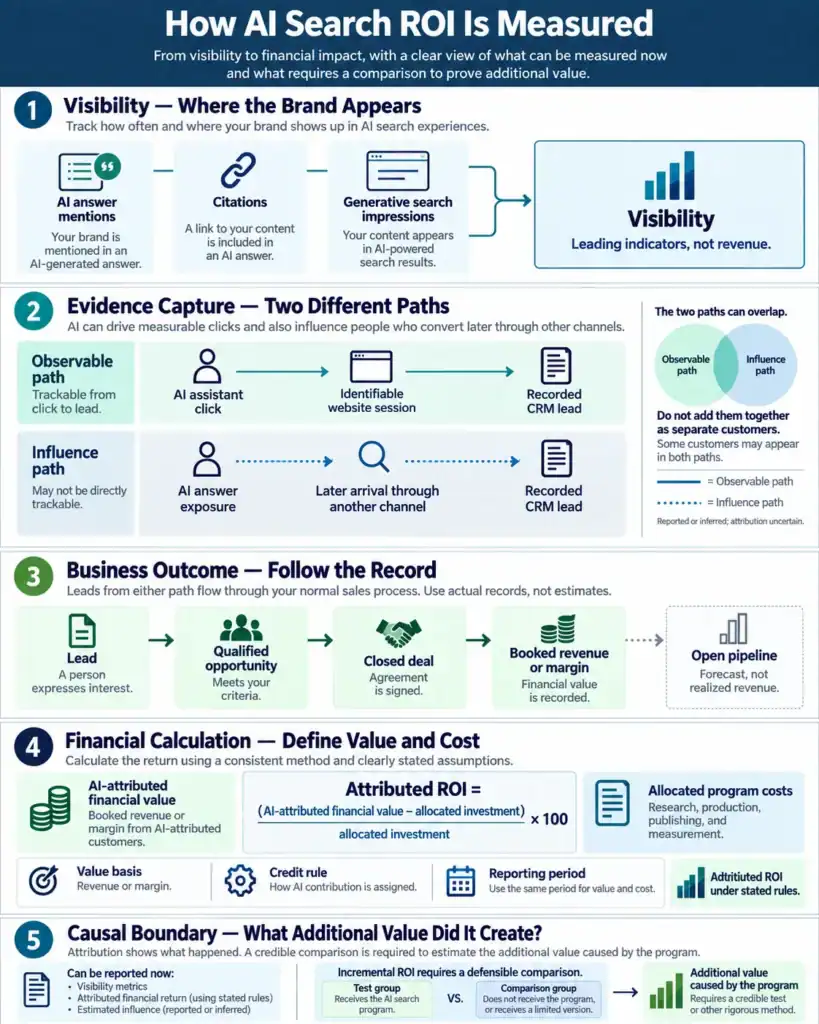
What Should an Executive AI Search ROI Dashboard Show?
An executive dashboard should show six distinct lines: visibility, observed referrals, qualified pipeline, booked revenue, allocated investment, and evidence confidence. Present attributed return only where value and cost are defined on the same basis. Keep self-reported discovery and estimates visible without blending them into recorded revenue.
Leading Signals
Show whether the program is gaining relevant exposure across engines and topics, using a stable prompt set and Search Console’s separate Google view where relevant impressions are reported. Explain sampling changes.
- Track topic coverage across defined buyer questions.
- Separate Google AI impressions from prompt samples.
- Label platform and monitoring coverage by period.
Leading indicators show where to look; revenue claims depend on subsequent observed business results.
Observed Business Results
Place visits, lead quality, opportunity creation, and closed deals in a consistent cohort view. Separate source coverage from outcome performance so tracking gaps remain visible.
- Display identifiable assistant sessions and qualified leads.
- Show opportunity counts, stage movement, and aging.
- Break out booked revenue and contribution margin.
The dashboard becomes decision-ready when spending assumptions and confidence sit beside those outcomes.
Investment and Confidence
Tie the financial panel to finance’s expense record and the selected CRM value basis. Give every reported line an evidence status that a reviewer can reproduce.
| Metric | Source | Status | Executive use |
| Visibility by topic and engine | Monitoring and reportable Search Console data | Observed within defined coverage | Diagnose reach, not revenue |
| Assistant sessions and lead conversions | GA4 and captured lead source | Observed referral; source dependent | Assess identifiable demand |
| Qualified pipeline | CRM opportunity records | Observed stage; forecast value | Track future potential separately |
| Booked revenue or margin | Closed CRM deals and finance | Observed outcome; attributed credit | Numerator on stated basis |
| Program investment | Finance and documented allocations | Recorded plus allocated estimate | Denominator and cost scrutiny |
| Reported discovery and demand patterns | Intake responses and aggregate trends | Self-reported or inferred | Describe possible wider influence |
| Attributed ROI | Defined value less allocated cost | Calculated; attribution dependent | Compare return under one convention |
- State the measurement window and cohort maturity.
- Distinguish observed, self-reported, inferred, and estimated.
- Publish allocation rules and missing-data coverage clearly.
Even complete records assign credit; a causal claim demands evidence about what would otherwise happen.
When Can You Claim Incremental AI Search ROI?
Claim incremental financial return only when a defensible test estimates additional financial value caused by the investment, net of its costs. Attribution explains which touchpoints receive credit for observed outcomes. It does not establish the counterfactual: whether those customers would have bought without the program.
Attribution Assigns Credit
A first-touch or last-click rule provides repeatable accounting for observed deals. Multi-touch models can distribute credit, but their output depends on the recorded touches and model assumptions.
- State which touch earns each deal’s credit.
- Retain other recorded touches for account review.
- Avoid counting one contract across multiple channels.
To claim an additional gain, compare outcomes against a credible account of what would have happened otherwise.
Incrementality Tests Additional Value
A useful incrementality test changes a definable treatment while keeping a defensible, reasonably comparable group. Select specific financial outcomes and observation windows before examining the results.
- Define treated topics, markets, or account cohorts.
- Hold comparison groups comparable before program changes.
- Track concurrent campaigns and spillover between groups.
Measured states that establishing causality requires “splitting an audience into test and control groups and measuring the difference in conversion behavior” — Measured. A staggered rollout across comparable markets or topics can help, though discovery crosses boundaries. Check pre-period differences and concurrent campaigns; contaminated groups weaken a lift claim.
When a credible experiment is unavailable, honest scenario reporting still supports investment decisions.
What to Report Before a Causal Test
Keep three lines separate: measured outcomes under a credit rule, scenario estimates under explicit assumptions, and possible influence without an assigned financial value. Give each a confidence label.
- Publish attributed return with its attribution convention.
- Model scenarios with visible assumptions and ranges.
- Note untracked influence without fabricating conversion counts.
- Reserve incremental ROI language for causal evidence.
That discipline lets you evaluate a repeatable production system without turning every visibility gain into a promised financial return.
How Does Content Ops Lab Make AI Search Investment Measurable?
For a multi-location healthcare client, Content Ops Lab recorded a 21.4% average AI search conversion rate versus the 3.32% site average (6.4× higher), alongside 95+ conversions from AI search platforms between July 2025 and February 2026.
They show observed referral quality and conversion volume under the client’s measurement, not revenue, allocated investment, or incremental return. Repeatable output supports consistent measurement over time.
- Research starts with buyer questions and source evidence.
- Client knowledge grounds service and location-specific claims.
- Claim-level checks keep citations tied to supporting passages.
- Repeatable reviews catch unsupported or inconsistent content.
- Clear page structure supports search and answer extraction.
- Shared standards support production across multiple locations.
These capabilities do not explain conversions on their own. With analytics and CRM access, define source capture, qualification, close status, and cost allocation. Without a reliable join, establish the observation path before presenting financial return.
The Content Ops Lab Production System
Each stage leaves an artifact the next reviewer can inspect, so content decisions and subsequent performance don’t disappear into a monthly output total.
- Research: Map buyer questions, source evidence, and business context.
- Verification: Check each material claim against its actual support.
- Optimization: Structure content for discovery and clear answer extraction.
- Delivery: Publish, document changes, and review measured business outcomes.
The system gives teams a repeatable investment to instrument, while financial claims still depend on their records.
Ready to build content infrastructure that scales without the compliance risk? Get in touch — we’ll assess your current content operation and outline what a systematic approach would look like for your organization.
FAQs About AI Search ROI
Can you measure AI search ROI when many AI interactions never send a click?
Yes, but label the result as attributed return from observable journeys, not the full contribution of AI discovery. Tie identifiable referrals to CRM outcomes, then report self-reported discovery and aggregate demand separately. If a customer first researched without clicking, a later direct or branded visit may hide that influence. Avoid assigning a precise value to the missing interaction.
What costs should be included in an AI search ROI calculation?
Include the labor and vendor expense of research, production, verification, editing, publishing, measurement, and program management that supports the selected period. Document how shared content and analytics costs are allocated when they also serve other channels. Use the same rule across periods, account for work that produces results later, and show how alternative allocations change the result.
How do you prevent an AI search dashboard from overstating revenue attribution?
Separate booked revenue from open pipeline, count each closed deal once, and publish the rule that assigns channel credit. Keep self-reported discovery alongside, rather than inside, the observed referral total. Show unmatched CRM records, source gaps, and cost assumptions. Label a modeled scenario as estimated; never present a visibility score, conversion event, or forecast opportunity as realized revenue.
Should AI referral conversion rates be compared with traditional organic search?
Yes, if you compare the same event, matched periods, appropriate intent and landing-page cohorts, and meaningful sample sizes. Report counts beside rates and follow both cohorts into qualification and closed revenue. One site’s high assistant conversion rate is a useful prompt for investigation, not a benchmark for another business or evidence that the higher-rate cohort generates more profit.
What would Content Ops Lab measure in a managed content program versus a system build?
A managed program documents research, verification, publication, and measured outcomes. A system build defines that repeatable workflow for the client to operate. Both require client analytics, CRM, and cost records to calculate financial return. A managed engagement can review observed outcomes during production; a system build leaves the client with the same definitions and checks to apply after handoff.
Key Takeaways
- Calculate attributed return from a stated revenue or margin basis, allocated costs, credit rule, and period.
- Keep Google AI visibility, assistant referrals, reported discovery, and inferred demand on distinct evidence lines.
- Trace identifiable B2B referrals through qualification, opportunity, and booked revenue before judging the investment.
- A multi-location healthcare client recorded a 21.4% AI search conversion rate versus a 3.32% site average—a quality signal, not ROI.
- Content Ops Lab’s research, verification, optimization, and delivery system produces repeatable work that clients can instrument and review.
- Reserve incremental ROI claims for defensible causal tests; start by auditing source capture, CRM joins, and cost allocation.
How Should You Report AI Search ROI Now?
Start with an attributed financial return where deals and investment can be supported, then give visibility to less observable influence through its own reporting lines. A conversion rate can identify a promising cohort; it cannot price a deal or establish incremental lift. As more leads mature, reconcile the source record with qualification, closed revenue, and the costs incurred to create that demand. If causal testing is feasible, define a comparison before claiming lift. The next executive review should show both the calculation and its limits, so budget choices can improve without pretending every journey is fully visible.
Content Ops Lab’s method, focused on research, verification, optimization, and delivery discipline, provides a repeatable content investment to instrument and evaluate.
One Comment
Comments are closed.