

Why Does AI Referral Traffic Convert Higher Than Organic Search?
AI referral traffic converts at dramatically higher rates than traditional organic search because AI systems act as research filters before the click happens — sending fewer visitors who have already completed much of the evaluation process. “AI search visitors convert at a 23x higher rate than traditional organic search visitors for Ahrefs” — Ahrefs.
For multi-location operators in healthcare, legal, and home services, this isn’t a curiosity — it’s a structural shift in how buyers move from problem to provider. Content Ops Lab built its citation-first production methodology within a 12-location regulated healthcare organization — and over 8 months, AI search converted at an average of 21.4% against a 3.32% site baseline. The channel is small today. The economics are already compelling.
Related: How AI Search Engines Evaluate Source Trust and Credibility
Why Is Traditional Organic Traffic Losing Conversion Value While AI Referrals Gain It?
Traditional organic traffic is declining in both volume and conversion quality as AI platforms absorb the research and comparison stages of the buyer journey. The clicks that survive that filter arrive later in the decision process — and the majority don’t arrive at all.
Zero-Click Erosion of Discovery Volume
“Bain’s recent survey finds that about 80% of consumers now rely on ‘zero-click’ results in at least 40% of their searches, reducing organic web traffic by an estimated 15% to 25%” — Bain & Company.
The top-of-funnel discovery that once drove organic traffic is moving inside AI interfaces — and staying there.
- Roughly 60% of searches now end without a click to another site
- AI Overviews absorb informational intent before it converts to traffic
- Zero-click behavior cuts across demographics, not just tech-forward users
The volume problem isn’t temporary. It’s the new operating environment.
Organic Traffic Decline Trajectory
Ahrefs’ cross-web analysis already shows average search traffic down ~21% YoY, while AI traffic is up 9.7x—but from a very small base — Ahrefs. Top-of-funnel content built for Google is now partially answered inside the AI interface.
- Multi-location healthcare sites are particularly exposed to informational queries
- Brands not tracking AI referral performance are measuring a shrinking channel as if it’s stable
- The decline trajectory reflects sustained platform behavior change, not a one-quarter anomaly
The Compounding Attention Gap
AI Overviews and LLM interfaces handle synthesis, comparison, and shortlisting before a user reaches your site. By the time someone clicks through from an AI citation, multiple stages of your conversion funnel have already happened.
- Users arrive with context, comparisons made, and a shorter path to a decision
- Page sessions from AI referrals show higher dwell time and deeper engagement
- The traditional multi-visit conversion path compresses into one or two sessions
Traditional organic traffic still has volume. The conversion economics are shifting toward a channel that sends fewer, more qualified visits — which is why the per-visit performance data is worth tracking now.
What Does the AI Referral Traffic Landscape Actually Look Like in 2025–2026?
AI referral traffic is simultaneously the highest-converting channel in multiple independent datasets and statistically indistinguishable from organic in at least one rigorous study. Both things are true, and operators need to understand why before building a strategy around the data.
Cross-Industry Conversion Benchmarks
Multiple independent datasets consistently show AI referrals converting at rates organic search can’t match, while representing a fraction of overall session volume.
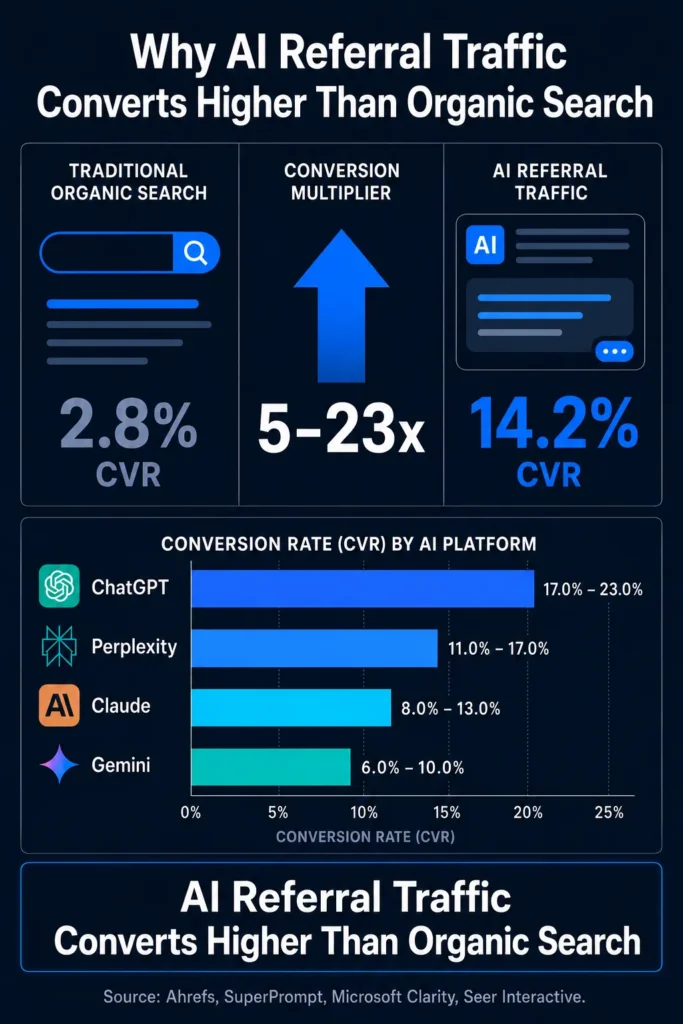
- Ahrefs: 0.5% of traffic → 12.1% of signups (23x conversion rate vs. organic) — Ahrefs
- SuperPrompt (12.3M visits, 347 businesses): AI search 14.2% CVR vs. Google organic 2.8% — SuperPrompt
- Seer Interactive (7-month B2B case study): ChatGPT 15.9%, Perplexity 10.5%, Claude 5%, Gemini 3% — vs. Google organic 1.76% — Seer Interactive
- Microsoft Clarity (1,277 publisher domains): Copilot referrals converting at 17x the rate of direct and 15x the rate of search — Microsoft Clarity
The volume constraint is consistent, too — AI traffic represents 0.07% to 1% of total sessions across these studies.
Platform-by-Platform Performance Breakdown
Conversion rates vary meaningfully by platform, likely reflecting differences in how each one selects and frames citations.
- ChatGPT: highest volume share at approximately 80% of AI referrals in most tracked environments
- Perplexity: consistently strong CVR, smaller share due to platform traffic dynamics
- Claude and Gemini: smaller shares but appearing in more referral datasets through 2025–2026
- Microsoft Copilot: standout publisher performer — 17x direct conversion rates in the Clarity study
For multi-location operators, the dependency on ChatGPT is the immediate tracking priority. Building for citation across all major platforms is the correct long-term architecture.
Where the Contrarian Evidence Lives
“Amsive’s six-month, 54-site GA4 study found LLM referrals converting at 4.87% versus organic at 4.6% — a difference that didn’t reach statistical significance (p=0.794)” — Search Engine Land. FindCraft’s review of 14 datasets describes this as a measurement paradox: the same channel shows 18% CVR in some environments and no discernible lift in others — FindCraft.
That tension doesn’t invalidate the channel — it underscores that measurement setup matters. The operators seeing 23x lifts are tracking properly configured GA4 channel groupings and platform-level segmentation. The operators, seeing no lift, may be measuring aggregate traffic without distinguishing AI-referral behavior from baseline organic traffic.
Why Does AI Referral Traffic Convert at Rates Traditional Channels Can’t Match?
“AI search traffic converts at 14.2% compared to Google’s 2.8%—a 5x difference that’s reshaping digital marketing forever” — SuperPrompt.
The conversion advantage is a structural consequence of how AI platforms process queries before sending traffic. The click that reaches your site has already survived a filtering and recommendation process that traditional search doesn’t replicate.
AI as a Research and Filtering Layer
AI search platforms synthesize, compare, and shortlist — then surface a small set of cited sources as recommended answers. That process compresses the buyer journey before the visit happens.
- McKinsey: remaining clicks from AI-augmented search will now be more likely to come from informed consumers further along the purchase funnel — McKinsey
- NN/g research finds AI tools are used for substantial shortcuts around the often tedious and time-consuming work required to research a topic — Nielsen Norman Group
- Perplexity explicitly evaluates sources for “helpfulness, factuality, and freshness” — its citations function more like editorial recommendations than search results — University of Florida Business Library
The user who clicks through from a Perplexity footnote or a ChatGPT source attribution has already seen your brand framed as a credible, relevant answer.
Intent Shift from “Find” to “Do”
“Profound’s analysis of 50M+ ChatGPT prompts found transactional intent jumping from 0.6% to 6.1% (9x) in AI queries compared to traditional search, while navigational intent collapsed from 32.2% to 2.1%” — Profound.
- Informational intent still dominates AI queries but reflects deeper synthesis — not “what is X” but “compare X and Y for my situation”
- For healthcare and legal operators, this intent profile describes a patient or client who has already self-educated and is evaluating providers
- That buyer arrives at your site with a decision question, not a curiosity
The Recommendation Mechanism
“BrightEdge’s sentiment analysis found ChatGPT treats cited sources as recommendations in the majority of cases — approximately 55% positive framing, under 1% negative” — BrightEdge. The framing matters for trust transfer.
- Google reports AI Overview clicks are “higher quality (meaning, users are more likely to spend more time on the site)”
- An AI citation carries implicit endorsement — the system selected this source as credible and relevant
- SuperPrompt data shows 73% of AI visitors convert in the first session, versus 23% from Google — direct evidence of a compressed decision journey on arrival
If your operation needs to produce 20-50+ articles per month without sacrificing compliance or quality, Content Ops Lab builds the infrastructure to make that possible. Contact us to discuss your content production requirements.
What Does AI Referral Traffic Performance Look Like in a Regulated Healthcare Environment?
“By 2028, $750 billion in US revenue will funnel through AI-powered search” — McKinsey.
Production data from a 12-location regulated healthcare operation shows AI referral performance that aligns with — and in some months exceeds — the high end of industry benchmarks. The channel is small in volume. The conversion economics validate the infrastructure investment.
ChatGPT Session Growth in a 12-Location Operation
ChatGPT referral sessions grew 887% in 7 months — from 8 sessions in July 2025 to 79 in February 2026 — while the content production system maintained citation verification standards throughout.
- Peak CVR: 40% in January 2026 with 52 sessions
- CVR trajectory: 9.5% (August 2025) → 32.8% (December 2025) → 40% (January 2026)
- February 2026 maintained 19.23% CVR despite session fluctuation — 5.8x site average
The growth rate matters as much as the conversion rate. The operators tracking and optimizing for this channel now are building citation patterns that compound before competitors enter the space.
AI Search CVR vs. Site Baseline
Across 8 months of tracked AI search performance (July 2025 – February 2026), the operation generated 537+ total AI search sessions, 95+ confirmed conversions, and a 21.4% average CVR against a 3.32% site baseline — a 6.4x performance multiplier from under 0.3% of total traffic.
- Perplexity peak CVR: 25.7% (July–October 2025)
- ChatGPT, Perplexity, Claude, and Gemini are all appearing in referral data
- Conservative AI search revenue contribution: $142,500–$285,000 over 8 months at $1,500–$3,000 average patient value
Zero compliance violations across 1,000+ articles during the same period validate that optimizing for AI citation doesn’t require loosening verification standards.
Why Regulated Industries See Amplified Lift
Healthcare, legal, and financial services are high-consideration categories — exactly the contexts where AI platforms function most effectively as research filters.
- First Page Sage’s 2026 data shows healthcare ChatGPT CVR at 4.5% vs. 2.8% overall
- Legal services: 5.6% vs. 3.8% overall — similarly elevated above baseline
- The compliance and citation-verification standards that protect these industries also make that content more likely to be cited by AI systems evaluating source credibility
Regulated industries carry operational constraints that make AI optimization harder. They also carry intent profiles that make the resulting traffic disproportionately valuable.
Related: Why Most Websites Are Invisible to AI Search
How Should Multi-Location Operators Measure and Optimize for AI Referral Traffic?
“We’ve seen that when people click from search results pages with AI Overviews, these clicks are higher quality (meaning, users are more likely to spend more time on the site)” — Google.
Measuring AI referral traffic accurately requires deliberate setup. Most operators are currently undercounting this channel — which means they’re also undervaluing the content investments that generate it.
GA4 Attribution Setup for AI Channels
AI referral traffic arrives in GA4 fragmented across multiple source/medium classifications. Without a dedicated channel grouping, ChatGPT traffic may register as direct, referral, or organic.
- Build a custom channel group keyed to: chatgpt.com, perplexity.ai, copilot.microsoft.com, gemini.google.com, claude.ai, and related subdomains
- Track decision-stage conversion events specific to AI traffic: consult requests, booking starts, click-to-call, insurance verification checks — not just form fills
- Segment by platform to compare ChatGPT vs. Perplexity vs. Gemini behavior — they send meaningfully different traffic profiles
The operators who set this up now will have 12+ months of clean data before their competitors start asking the question.
Content Architecture That Earns Citations
AI systems select sources that are structured for extraction, backed by credible evidence, and formatted to make answers easy to synthesize. That’s a content architecture decision.
- Answer-first H2 structure: 40 to 60-word direct answers to the question the heading poses
- Question-based headings matched to conversational query patterns in the target vertical
- Statistical backing with verified, traceable citations — hallucinated or paraphrased stats reduce AI confidence in your content
- 40-60% bullet ratio enabling AI parsing without dense paragraph extraction
McKinsey notes that in many categories, a brand’s own sites account for only 5–10% of sources AI search references — on-site architecture and off-site presence both contribute to the likelihood of citation.
KPI Reframe: Value per Visit over Session Volume
Traditional reporting prioritizes sessions and aggregate organic traffic. Neither metric captures what’s happening with AI referral channels — where 0.5% of traffic can account for 12% of conversions.
- Elevate value-per-visit and revenue-per-AI-session as primary KPIs for this channel
- Track zero-click influence: branded search volume growth and direct conversion rate lift following AI citation exposure
- Report AI channel contribution as a share of pipeline value, not share of sessions
Bain and McKinsey both project that traditional organic traffic will decline 15–50% as AI search adoption scales. Operators building new KPI frameworks can now demonstrate channel ROI when that shift accelerates.
Is AI Referral Traffic a Channel Worth Building Infrastructure Around?
The channel accounts for less than 1% of sessions today and is the highest-converting channel across multiple independent datasets. The strategic question isn’t whether current volume justifies attention — it’s whether early infrastructure investment creates a compounding advantage before the window closes.
The Volume vs. Efficiency Trade-Off
AI referral traffic won’t replace organic search volume in the near term. Google still sends 210x as much traffic as the major AI platforms combined. But operators who evaluate this channel solely by session counts will consistently undervalue it.
- At 21.4% average CVR vs. 3.32% site baseline, 100 AI referral sessions outperform roughly 645 average organic sessions in conversion output
- SuperPrompt data shows AI-sourced customers carry 67% higher lifetime value than Google-sourced ones
- The efficiency math favors early investment even at current volume — and the volume is growing fast
First-Mover Advantage in Citation Dominance
AI systems reinforce existing citation patterns. Sources that appear consistently for a given topic become more likely to appear again — early citation presence compounds.
- McKinsey reports that only 16% of brands today systematically track AI search performance
- In healthcare, fewer than 5% of practices are optimizing content architecture for AI extraction
- 887% ChatGPT traffic growth in 7 months happened during a window when nearly no healthcare competitors were targeting the channel
The operators building citation presence now are establishing patterns that will be harder to displace once mainstream adoption occurs. That window is measured in quarters, not years.
What Operators Who Move Early Get Right
The operators seeing 20–40% CVR from AI referral traffic have built content infrastructure designed to earn citations: verified claims, structured formatting, question-based architecture, and answer-first paragraphs that AI systems can extract.
- Content that earns citations in healthcare must also pass compliance standards — the verification infrastructure that keeps you compliant also makes content more citation-worthy
- Multi-platform presence across ChatGPT, Perplexity, Claude, and Gemini reduces single-platform dependency
- Session-level tracking by platform enables ongoing optimization, not just passive monitoring
How Content Ops Lab Builds Content Infrastructure for AI Citation
Content Ops Lab’s methodology, built and production-tested inside a 12-location regulated healthcare organization, generated 95+ confirmed AI search conversions over 8 months — with an average CVR of 21.4% against a 3.32% site baseline. That performance came from building a production system specifically designed to earn AI citations without creating compliance exposure.
- 23-month production test inside a 12-location regulated healthcare organization
- 1,000+ citation-verified articles delivered with zero compliance violations
- 45% of all leads from organic search — outperforming paid search nearly 2:1
- AI search converting at 21.4% vs. 3.32% site baseline — 6.4x performance multiplier
- 887% ChatGPT traffic growth in 7 months (July 2025–February 2026)
- 653% impression growth and 1,700% click growth for an emerging brand over 14 months
- 5x production scale: 10 articles/month to 50+ without adding headcount
- Dual-brand methodology validated on both mature brand maintenance and emerging brand growth
The Content Ops Lab Production System
Every article is built to earn citations — not just rank. The system runs four stages without exception.
- Research: Verified sources before any content generation begins — no AI writing from memory
- Verification: Line-by-line citation cross-check with STAT vs. CLAIM labeling and full audit trail
- Optimization: Simultaneous formatting for Google, ChatGPT, Perplexity, Claude, and Gemini
- Delivery: WordPress staging or Google Docs — publish-ready, compliance-reviewed, citation-intact
The compliance and citation standards are the same. Verified claims, structured formatting, and answer-first architecture satisfy both simultaneously.
Ready to build a content infrastructure that scales without the compliance risk? Get in touch today — we’ll assess your current content operation and outline what a systematic approach would look like for your organization.
FAQs About AI Referral Traffic
Why should I prioritize AI referral traffic when it represents less than 1% of our sessions?
Session share is the wrong metric for this channel. At 21.4% average CVR versus a 3.32% site baseline, 100 AI referral sessions produce more conversion output than several hundred average organic sessions. The case isn’t current volume — it’s per-visit economics and the compounding effect of early citation presence before mainstream adoption closes the window.
How long does it take to start seeing measurable AI referral traffic after optimizing content?
Meaningful tracking requires 60–90 days of properly configured GA4 attribution before conclusions are reliable. The RxWellness environment showed 8 ChatGPT sessions in July 2025, growing to 79 by February 2026 through 7 months of consistent, citation-optimized production. Volume and CVR both improve as AI systems establish citation patterns for your content.
Does optimizing for AI citations create any compliance exposure in regulated industries like healthcare?
No — the content architecture that earns AI citations is the same architecture that satisfies compliance requirements. Verified citations and traceable claims reduce both hallucination risk and regulatory exposure simultaneously. The 12-location healthcare operation behind this methodology delivered 1,000+ articles with zero compliance violations and achieved a 21.4% AI search CVR.
How is AI referral traffic different from traditional referral or direct traffic in terms of buyer behavior?
AI referral visitors have already completed the research and comparison process before clicking through. SuperPrompt’s 12.3M-visit benchmark found that 73% of AI visitors convert within the first session, compared with 23% from Google. They arrive on deeper pages, need confirmation rather than education, and compress the standard multi-visit conversion path into one or two sessions.
Does Content Ops Lab build content infrastructure specifically for earning AI citations, or is that a byproduct?
It’s the primary design objective. Every structural element — answer-first H2 paragraphs, question-based headings, verified citations, 40-60% bullet ratio — is chosen because it satisfies both AI extraction requirements and traditional SEO standards. Done-For-You clients get a managed production system at 20-50+ articles per month. System Build clients get the infrastructure and training to run it in-house.
Key Takeaways
- AI referral traffic converts at 5–23x the rate of organic search across multiple independent datasets — because AI systems filter and pre-qualify visitors before the click, not because of channel mechanics
- The channel represents under 1% of sessions today; proper GA4 attribution setup is the immediate priority for operators who want accurate performance data
- A 12-location regulated healthcare organization saw 21.4% average AI search CVR over 8 months, with ChatGPT sessions growing 887% in 7 months — production results, not benchmark projections
- The content architecture that earns AI citations — verified claims, structured formatting, answer-first paragraphs — is identical to the architecture that satisfies compliance standards in regulated industries
- McKinsey projects $750 billion in US revenue flowing through AI-powered search by 2028; early citation infrastructure compounds before that shift reaches full scale
- Fewer than 5% of healthcare practices are currently optimizing for this channel — the first-mover window is open and time-limited
Why AI Referral Traffic Requires Systems, Not Shortcuts
AI referral traffic converts at a higher rate than organic search because AI systems do the work your conversion funnel used to do — filtering, educating, and shortlisting before the click happens. The visitors who arrive have already decided they’re looking for a solution. They’re evaluating whether you’re the right one.
That dynamic doesn’t reward volume-based content strategies. It rewards citation infrastructure — verified claims, structured formatting, and consistent production across the topics your buyers are researching in AI interfaces. The 23-month production test behind Content Ops Lab’s system delivered 95+ confirmed AI search conversions at 21.4% CVR, zero compliance violations, and 887% growth in ChatGPT sessions. Not from chasing the channel, but from building content AI systems that are recognized as credible and easy to extract.
The window for first-mover advantage is measured in quarters. The operators building that infrastructure now are the ones who will own citation presence when the market catches up.
Related: How to Build a Scalable Content Production Workflow