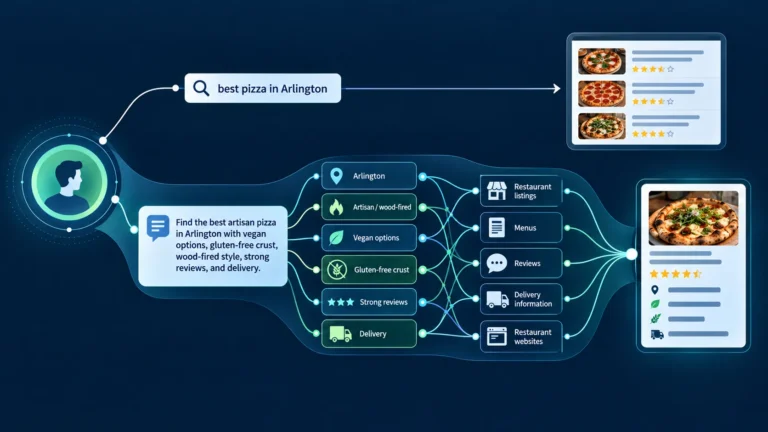

How AI Search Engines Evaluate Source Trust and Credibility
AI search engines evaluate source trust and credibility through a layered system of retrieval, evidence scoring, and cross-source corroboration that operates largely independent of traditional organic rankings.
Most operators are running content strategies optimized for a trust model that no longer fully applies. “In total, nearly two-thirds of all citations generated by GPT-4o were either fabricated or contained errors, indicating a major reliability issue” — JMIR Mental Health.
For multi-location operators managing 20-50+ content assets per month, that fabrication risk compounds across every location page simultaneously. Content Ops Lab built its verification infrastructure inside a 12-location regulated healthcare organization — 1,000+ citation-verified articles delivered with zero compliance violations over 23 months.
Related: Why Most Websites Are Invisible to AI Search
Why Does Traditional SEO No Longer Predict Where AI Search Engines Will Cite You?
Traditional SEO rank is a necessary but insufficient condition for AI citation. Ranking #1 in Google does not guarantee your content gets cited by ChatGPT, Perplexity, or AI Overviews — and lower-ranked pages are regularly cited when they better serve the AI’s evidence requirements. The trust and credibility evaluation system AI engines use is distinct from the one that determines organic position.
“Both AI Overviews and AI Mode may use a ‘query fan-out’ technique — issuing multiple related searches across subtopics and data sources — to develop a response” — Google Search Central.
The Rank-Citation Disconnect
AI engines don’t retrieve a single top result — they fan out across multiple subtopics and data sources before synthesizing an answer. Citation eligibility is evaluated at the evidence level, not the position level.
- Rank #1 doesn’t guarantee citation
- Evidence quality, structure, and verifiability determine inclusion
- AI systems optimize for answer accuracy, not result order
Traditional ranking signals get your content into the candidate pool. What happens after that is an entirely separate evaluation.
What Query Fan-Out Actually Does to Your Visibility
When a user queries an AI search engine, the system issues multiple parallel sub-searches across related subtopics before assembling its response. Your content needs to appear as credible evidence across multiple retrieval passes—not just rank well for a single primary keyword.
- Multiple sub-queries are issued per user question
- Each sub-query has its own candidate pool
- Your content must surface consistently across subtopics
A page optimized for a single keyword may win that retrieval pass and still miss the final citation if other sources better serve the adjacent sub-queries the engine issues.
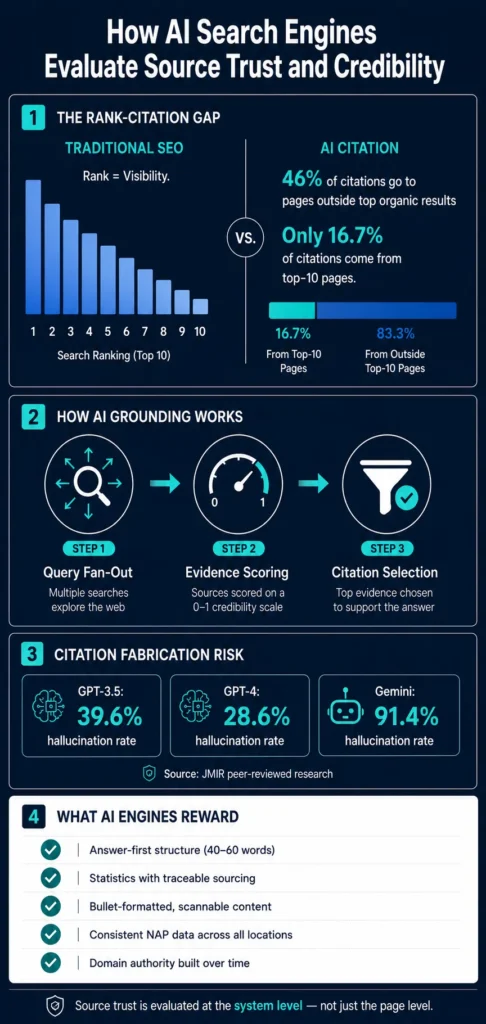
Why 46% of AI Citations Go to Pages Outside the Top Results
“The data shows that 54% of the AI Overviews citations matched the web pages ranked in the organic search results” — Search Engine Journal. That means 46% of citations go to pages outside the visible organic result set entirely.
Most overlap growth came from pages ranking 21–100, not the top 10, and only 16.7% of citations came from top-10 pages — BrightEdge.
- 46% of citations: not in visible organic results
- Most overlap growth from pages ranked 21-100
- Only 16.7% of citations from the top-10 pages
The engines are actively diversifying their evidence pool beyond what ranks at the top of the SERP.
What Content Signals Do AI Search Engines Use to Evaluate Source Trust and Credibility?
AI search engines evaluate trust through two distinct layers: the traditional ranking infrastructure they inherit (indexability, E-E-A-T, domain authority) and an additional grounding and scoring layer that evaluates evidence strength, factual corroboration, and entity consistency. Optimizing only for the first layer leaves the second entirely unaddressed.
“The data shows that 54% of the AI Overviews citations matched the web pages ranked in the organic search results” — Search Engine Journal.
The E-E-A-T Layer AI Systems Inherit
Google’s Search Quality Rater Guidelines frame page quality evaluation around E-E-A-T — Experience, Expertise, Authoritativeness, and Trust — identifying trust as the most important component. In YMYL categories (health, legal, finance), this framework is applied most stringently.
- Trust is the highest-weighted E-E-A-T component
- YMYL content triggers heightened authority scrutiny
- Healthcare and legal show 68-75% AI citation overlap with organic results
Strong E-E-A-T creates the foundation for citation eligibility — but it doesn’t complete the picture.
Grounding Scores and Evidence Strength
Beyond E-E-A-T, AI systems apply explicit grounding checks that evaluate how strongly a specific answer candidate is supported by retrieved facts. Content that doesn’t present clear, extractable claims — with statistics, structure, and direct answers — scores lower and gets filtered out before it ever appears as a citation.
- Grounding score: 0 to 1 scale, applied per answer candidate
- Low-confidence responses are filtered before reaching users
- Structured, fact-rich content scores higher than dense prose
Vague, hedging, or poorly structured content is measurably less citation-worthy.
Domain Authority Bands vs. Per-Page Optimization
BrightEdge AI Catalyst reports a ’70× volatility gap between frequently and rarely cited domains,’ showing that AI engines’ trusted domain sets are far more stable than long-tail sources — BrightEdge.
Once a domain enters the engine’s de facto authority set, its citation presence stabilizes dramatically.
- 70× stability difference between trusted and non-trusted domains
- Citation presence compounds once authority is established
- Domain-level governance outweighs individual page tweaks over time
Per-page SEO is how you enter the competition. Domain authority is how you win it consistently.
Why Is Citation Fabrication a Compliance Crisis for Regulated Industries?
Citation fabrication in AI-generated content is an operational liability in healthcare, legal, and financial content. When an AI system fabricates a source, the downstream effect is content that fails regulatory scrutiny and potentially exposes the organization to legal risk. At scale, across 12 locations publishing 50+ articles per month, a single fabricated statistic can propagate across dozens of pages before anyone catches it.
Hallucination Rates by Platform
Peer-reviewed research documents how widespread citation fabrication is across major AI platforms. “Hallucination rates stood at 39.6% (55/139) for GPT-3.5, 28.6% (34/119) for GPT-4, and 91.4% (95/104) for Bard (P<.001).” [STAT] —JMIR.
“Tens of thousands of publications from 2025 might include invalid references generated by AI, a Nature analysis suggests” — Nature.
- GPT-3.5 hallucination rate: 39.6% of citations
- GPT-4 hallucination rate: 28.6% of citations
- Bard hallucination rate: 91.4% of citations
These figures describe unverified AI output — the starting point for any content production process, not the endpoint.
The Chain-of-Verifiability Problem
A 2026 paper in Accountability in Research argues that hallucinated citations may constitute research misconduct when they function as data — Accountability in Research.
Fabricated citations break the audit trail that regulated industries depend on — you can’t verify what doesn’t exist, and you can’t defend what you can’t trace.
- Fabricated citations break audit trail integrity
- Healthcare and legal content require traceable sourcing
- AI-generated references require human verification before publication
For operators in regulated industries, the standard isn’t “mostly accurate.” It’s defensible under audit.
How Fabricated Citations Propagate Across Multi-Location Content
Template-based content multiplies errors across location variants. A single fabricated statistic published in one article template can be replicated in location-specific versions across dozens of properties. Without line-level citation verification in the production workflow, there’s no systematic mechanism to catch these errors before publication.
- Template-based content multiplies errors across locations
- A single bad citation can appear in 12+ location variants
- Pre-publication verification prevents what post-publication audits can’t
The organizational exposure isn’t one bad article. It’s systematic contamination across an entire content operation.
If your operation needs to produce 20-50+ articles per month without exposing your organization to citation risk or compliance failures, Content Ops Lab builds the infrastructure to make that possible. Contact us to discuss your content production requirements.
How Do AI Grounding Systems Score and Filter Source Trust and Credibility?
AI engines don’t just retrieve content — they evaluate it numerically before including it in a response. The grounding infrastructure that platforms like Google, OpenAI, and Microsoft have built treats factuality as a measurable, filterable parameter. Understanding how scoring works tells you exactly what content characteristics increase or decrease your citation probability.
“The check grounding API returns an overall support score of 0 to 1, which indicates how much the answer candidate agrees with the given facts” — Google Cloud.
Support Scores and Answer Acceptance Thresholds
Google’s Vertex AI grounding infrastructure returns a numerical support score for each answer candidate, measuring how strongly the proposed answer aligns with retrieved facts. Responses that fall below a confidence threshold can be blocked or sent for revision before they reach users.
- Support scores applied per answer candidate, not per page
- Low-support answers filtered or revised before display
- Clear statistical claims score higher than qualitative assertions
Content architecture directly affects grounding score — answer-first structure, explicit statistics, and bullet-formatted evidence are grounding inputs, not stylistic choices.
Cross-Source Corroboration Requirements
AI engines cross-reference across multiple retrieved documents before accepting a statement as sufficiently supported. Content that presents claims consistent with what other credible sources say about the same topic scores higher because it passes the corroboration check.
- AI engines validate claims across multiple sources simultaneously
- Claims corroborated by multiple sources receive higher support scores
- Contradictory or isolated claims are filtered or flagged
If your content consistently corroborates claims that other trusted sources also make, your citation probability increases.
What Makes Content Machine-Groundable
Groundability is a content architecture characteristic — it describes how easily an AI system can extract a discrete, verifiable claim and assign it a support score. Dense paragraph prose scores lower than structured, claim-forward content because the extraction step requires more interpretation.
- Short, direct answer paragraphs are more extractable
- Statistics with explicit sourcing score higher than general claims
- Bullet-heavy structure reduces extraction friction for AI systems
Content that a human can quickly extract insight from is also content that an AI system can ground against retrieved facts.
Related: How AI Search Engines Decide Which Sources to Cite
What Does Optimizing for AI Source Trust and Credibility Actually Deliver in Production?
The performance case for AI citation optimization is measurable in session volume, conversion rates, and citation frequency. The data show a channel that converts significantly better than the organic baseline, grows faster than traditional SEO, and stabilizes in a durable competitive position once trust is established.
“Through rigorous evaluation, we demonstrate that GEO can boost visibility by up to 40% in generative engine responses” — GEO: Generative Engine Optimization (arXiv).
GEO Optimization Lift Data
The Princeton GEO research demonstrates that targeted content changes — adding statistics, authoritative citations, clarifying structure, and direct answer formatting — can increase generative engine visibility by up to 40% without corresponding changes in classic organic rankings. The visibility metric is citation frequency in generative responses, not click-through rate or position.
- GEO optimization: up to 40% visibility lift in generative responses
- Content structure changes, not just keywords, drive lift
- Visibility gains are independent of organic rank changes
This is the clearest evidence that AI citation optimization is a distinct discipline from traditional SEO — with its own optimization levers and measurable outcomes.
The Trusted Domain Band Effect
BrightEdge AI Catalyst data shows a 70× stability gap between frequently cited domains and those that are not. Once a domain crosses into the trusted citation band, its presence becomes dramatically more stable across search engines, query types, and time periods.
- Citation frequency stabilizes once the domain authority threshold is crossed
- 70× lower volatility for frequently vs. rarely cited domains
- Early citation dominance compounds — AI systems reinforce existing patterns
The earlier you build infrastructure that earns AI’s trust, the higher your citation stability will be as competition intensifies.
AI Search Conversion Performance vs. Organic Baseline
In an active 12-location healthcare deployment, AI search traffic converted at 21.4% average over 8 months against a 3.32% site baseline — a 6.4x performance multiplier. ChatGPT referral traffic peaked at 40% CVR in January 2026, with 887% growth in sessions over 7 months. The channel accounts for less than 0.3% of total traffic while delivering a disproportionate share of conversions.
- 21.4% AI search CVR vs. 3.32% site baseline (6.4x multiplier)
- 887% ChatGPT session growth: July 2025 → February 2026
- Peak CVR: 40% in January 2026 (52 sessions)
AI search traffic converts at higher rates because users arrive pre-qualified — the citation earns their trust before the visit.
How Should Multi-Location Operators Build Infrastructure for AI Source Trust and Credibility?
Building for AI trust isn’t a one-time optimization — it’s an infrastructure decision that requires governance, verification workflows, and content architecture operating in parallel. For multi-location operators, trust must be consistent across every location, every article, and every data point in the system.
Entity Consistency as a Trust Prerequisite
AI engines that use Google’s index, Knowledge Graph, and Business Profile data evaluate entity consistency as a trust signal. Inconsistent NAP data fragments the evidence surface AI systems use to confirm which location is relevant for a given query.
“NAP consistency—referring to the uniformity of a business’s Name, Address, and Phone number—is a critical factor in local SEO success” — Bird Marketing.
- Consistent NAP required across all directories and profiles
- Inconsistent entity data degrades AI grounding confidence
- Each location requires synchronized schema, profile, and content data
For a 12-location operator, entity consistency is an ongoing governance process — not a one-time fix.
Verification Workflows That Survive Regulated Industry Audits
Citation verification and AI trust optimization solve the same problem from different angles. A verification workflow that catches fabricated statistics before publication also produces the citation-quality content that AI engines prefer to ground against.
- Pre-publication citation verification eliminates hallucination risk
- Line-level source documentation creates an audit trail
- Verified content is inherently more groundable than unverified content
The verification infrastructure required for regulatory defensibility is the same infrastructure that earns AI citation trust.
Done-For-You vs. Building Internal Infrastructure
The choice depends on two variables: timeline and team capacity. A Done-For-You engagement deploys production-tested workflows immediately without requiring internal team development. A System Build engagement transfers ownership of the complete infrastructure to your team over 12 weeks, with 90 days of post-launch support.
- Done-For-You: immediate deployment, managed operations, no team ramp required
- System Build: full infrastructure ownership, 12-week implementation, 90-day support
- Both models deliver the same citation-quality output and verification standards
Both paths produce compliant, AI-citation-ready content at scale.
How Content Ops Lab Builds Citation-Trustworthy Content Infrastructure
Content Ops Lab built its production methodology within a 12-location, regulated healthcare organization — 23 months of live iteration, producing 1,000+ citation-verified articles with zero compliance violations. The system was designed from the ground up to produce content that earns AI citations, not just organic rankings.
- 23-month production test inside a 12-location regulated healthcare organization
- 1,000+ citation-verified articles and pages delivered with zero compliance violations
- 45% of all leads from organic search — outperforming paid search nearly 2:1
- AI search converting at 21.4% average vs. 3.32% site baseline — 6.4x performance multiplier
- 887% ChatGPT session growth over 7 months (July 2025–February 2026)
- 653% impression growth and 1,700% click growth for an emerging brand (14-month period)
- 5x production scale: 10 articles/month to 50+ without adding headcount
- Dual-brand methodology validated on mature brand maintenance and emerging brand growth simultaneously
The Content Ops Lab Production System
Every article goes through the same four-stage verification infrastructure — from source to publication, no shortcuts.
- Research: Verified sources retrieved and documented before any content is generated
- Verification: Line-by-line citation cross-check, STAT vs. CLAIM labeling, full audit trail created
- Optimization: Structured simultaneously for Google, ChatGPT, Perplexity, Claude, and Gemini
- Delivery: WordPress staging or Google Docs — reviewed, compliant, and publish-ready
The same system that prevents compliance failures is the system that earns AI citations — because groundable content and defensible content are built the same way.
Ready to build a content infrastructure that earns AI source trust and credibility without the hallucination risk? Get in touch — we’ll assess your current content operation and outline what a systematic approach would look like for your organization.
FAQs About How AI Search Engines Evaluate Source Trust and Credibility
Can’t we keep optimizing for Google rankings and assume AI citations will follow?
Organic rank helps you enter the AI citation candidate pool, but it doesn’t determine whether you get cited. BrightEdge data shows that 46% of AI Overview citations go to pages not in the visible organic results set, and only 16.7% come from top-10 pages. AI engines apply a separate grounding and evidence-scoring layer on top of traditional ranking — optimizing only for rank leaves that layer entirely unaddressed.
How long does it take for content infrastructure changes to show up in AI search citations?
Initial citation visibility improvements from structural content changes can appear within weeks of publication as AI engines re-index content. Domain-level trust, which drives citation stability, builds over 3-6 months of consistent, verified output. GEO research demonstrates up to a 40% visibility lift from targeted optimization, but compounding citation authority requires sustained production at a high quality.
How does source trust and credibility verification infrastructure protect healthcare and legal operators from hallucination risk?
Verification infrastructure intercepts fabricated or erroneous citations before publication. Line-level cross-checking against source documents — with STAT vs. CLAIM labeling and documented line numbers — creates an audit trail confirming every statistic traces to a real, retrievable source. In a 23-month, 1,000+ article production test in a regulated healthcare environment, no compliance violations occurred when this protocol was applied systematically.
How is AI source trust and credibility optimization different from what a traditional SEO agency delivers?
Traditional SEO agencies optimize for keyword density, backlinks, and organic position — all of which address the ranking layer AI engines inherit. They don’t address the grounding layer: evidence scoring, cross-source corroboration, citation verification, or entity consistency across locations. AI trust optimization requires structured content architecture, verified citations, and domain-level governance — infrastructure most traditional agencies aren’t built to deliver.
What does building a citation-trustworthy content infrastructure actually involve for a multi-location operation?
It requires four interconnected components: a research-first production workflow, line-level citation verification, a multi-platform content architecture optimized for AI extraction, and entity governance to maintain consistent NAP data across all locations. Content Ops Lab delivers this through Done-For-You (managed service) and System Build (12-week implementation with 90-day support) — both producing citation-verified, compliance-ready output at the velocity multi-location operators require.
Key Takeaways
- AI search engines evaluate source trust and credibility through a grounding layer — evidence scoring, cross-source corroboration, and support scores — that operates independently of traditional organic rankings.
- 46% of AI Overview citations go to pages outside the visible organic result set; only 16.7% come from top-10 pages — rank alone does not determine citation eligibility
- Citation fabrication rates in unverified AI output range from 28.6% (GPT-4) to 91.4% (Bard) — making pre-publication verification a compliance requirement in regulated industries
- BrightEdge data shows a 70× stability gap between frequently and rarely cited domains — AI citation trust compounds once a domain enters the trusted authority band
- GEO research demonstrates up to 40% visibility lift from targeted content optimization, independent of organic rank changes
- In a 23-month regulated healthcare deployment, AI search traffic converted at 21.4% average vs. 3.32% site baseline — a 6.4x multiplier
- The first-mover window for AI citation authority is measured in quarters — operators who build citation infrastructure now establish compounding advantages before mainstream adoption closes the gap
Build Citation Infrastructure That Compounds: How AI Search Engines Evaluate Source Trust and Credibility
AI search engines have built a trust evaluation system that extends well beyond traditional ranking — and most operators haven’t updated their content strategy to match. “Through rigorous evaluation, we demonstrate that GEO can boost visibility by up to 40% in generative engine responses” —GEO: Generative Engine Optimization (arXiv).
Operators who build structured, verified, entity-consistent content infrastructure now will enter the trusted domain band before competitors recognize the channel exists. Those who wait face a compounding deficit — AI systems reinforce existing citation patterns, making early authority harder to displace over time.
Content Ops Lab built this infrastructure within a live, regulated healthcare deployment and has production data to prove it works. The methodology is transferable. The window to act is not indefinite.
Related: Why Does AI-Generated Content Fail Without Verification?