
How Do You Build a Scalable Content Production Workflow?
Building a scalable content production workflow is an operations problem before it’s a writing problem. Organizations that treat it as a factory — with standardized stages, role-based approvals, centralized knowledge, and governed AI — consistently outperform teams that hire more writers and hope that throughput will follow. “The scarier figure is the 47% of executives who made major decisions based on AI content they never verified at all” — Four Dots.
For regulated multi-location operators, that gap doesn’t just create bad content — it creates compliance liability. Content Ops Lab built its production infrastructure inside a 12-location regulated healthcare organization and delivered 1,000+ citation-verified articles over 23 months with zero compliance violations.
Related: Content Systems vs Content Teams – Why Structure Wins at Scale
Why Do Most Scalable Content Production Workflows Break Before They Scale?
Most content workflows fail at scale, not because teams run out of ideas or writers — they fail because the coordination infrastructure never existed. “Marketing teams are producing more content than ever, but disconnected tools and manual workflows slow everything down and create friction across every stage of the content lifecycle” — Screendragon.
The breaking point isn’t drafting capacity. It’s the invisible queues that form when tasks, approvals, and handoffs have no defined owner, SLA, or system.
The Approval Bottleneck Problem
Every content operation hits an approval ceiling before it hits a writing ceiling. When all content flows through a small number of brand, legal, or SME reviewers, even adding writers doesn’t increase throughput.
- Sequential approval queues create idle time between stages
- Legal and compliance review becomes a single-lane chokepoint
- SME availability limits research and verification velocity
- Revision backlogs compound across weekly publishing cycles
Fixing one slow approver typically exposes the next constraint — which is why piecemeal solutions don’t solve the underlying system design problem.
Where Coordination Failures Accumulate
Coordination failures are harder to see than writing failures because they’re distributed across handoffs. A brief with missing constraints, a research file in someone’s personal Drive folder, a formatting task blocking publishing — each is invisible until the entire cycle is delayed.
- Undocumented handoffs between research, writing, and review
- Asset retrieval is consuming hours instead of seconds
- Manual formatting tasks are delaying final production
- No visibility into where work sits idle between stages
These aren’t individual performance problems. There are structural gaps that no amount of individual effort can compensate for.
The Volume-Quality Trade-Off
The conventional response to scaling demands — hire more writers, increase output, move faster — consistently produces the same result: quality degrades before volume meaningfully increases.
- Generic AI drafts without verification shift the bottleneck downstream
- Style inconsistency multiplies across location-specific variants
- Citation errors surface during compliance review, not before
- Rework cycles consume the time gains from faster drafting
The volume-quality trade-off indicates the system wasn’t designed to handle scale.
What Are the Real Options for Multi-Location Content Production at Scale?
Multi-location operators have three legitimate options: build internal capacity, engage a traditional agency, or implement systematic content infrastructure. All three are worth evaluating honestly.
“Our research has found that organizational bottlenecks can be best managed or avoided not by addressing them piecemeal but by taking a holistic view of work systems and resource portfolios and aligning them in ways that improve organizational performance” — MIT Sloan Management Review.
The option you choose determines whether you’re solving the structural problem or adding capacity to a system that will hit its ceiling again.
Internal Team Capacity Limits
Internal teams have real advantages: brand knowledge, access to SMEs, and institutional context. The capacity ceiling appears quickly when volume demands exceed what a small team can verify and publish without burning out.
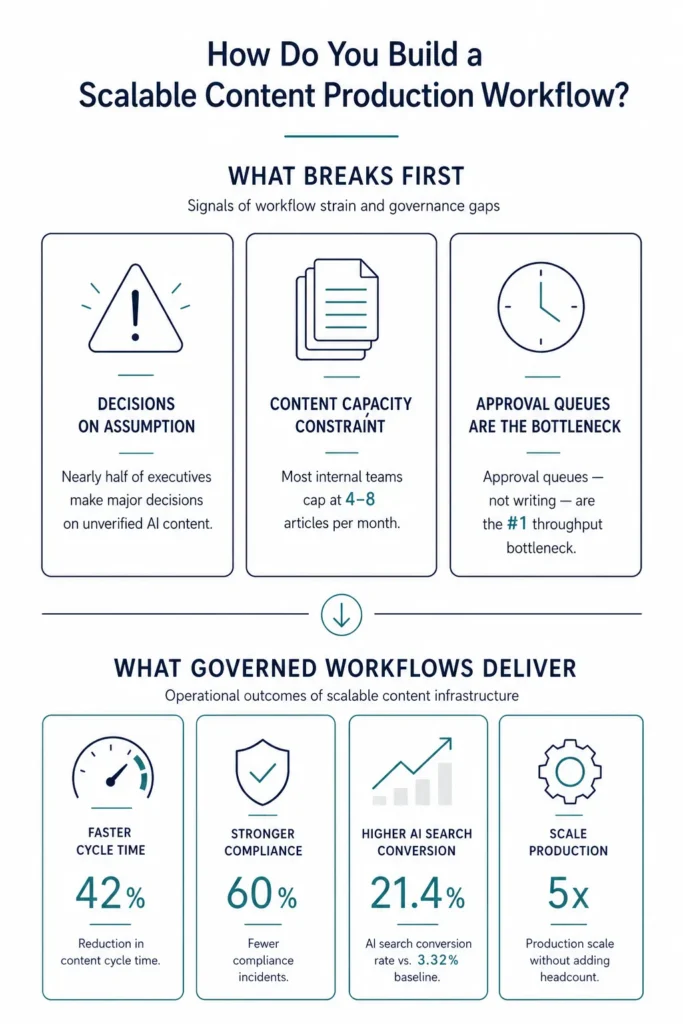
- Most internal teams max out at 4-8 articles/month before quality degrades
- Research, verification, and formatting tasks compete with strategic work
- Content quality becomes personality-dependent rather than system-dependent
- Local SEO optimization across multiple locations requires dedicated infrastructure
Internal teams work well as strategic oversight — not as the production engine for 20-50+ articles per month.
Traditional Agency Trade-Offs
Traditional agencies solve the volume problem. What they don’t solve is the verification problem — and in regulated industries, that trade-off is often worse than the original constraint.
- Template-driven output without proprietary knowledge integration
- AI-generated content without citation cross-checking protocols
- Single-draft delivery with no systematic quality control
- No optimization for AI search platforms beyond traditional SEO
Agencies are right that operators need scale. They’re wrong that volume alone delivers a competitive advantage in 2026.
What Systematic Infrastructure Actually Requires
A scalable content production workflow isn’t a tool, a prompt library, or a content calendar — it’s a governed factory with discrete stages, documented roles, and embedded verification at every step.
- Standardized stages with explicit owners and SLAs at each step
- Role-based governance baked into approvals, not tacked on afterward
- Centralized knowledge infrastructure (SME documentation, research repositories)
- Multi-platform optimization is built into the production template, not added post-publication
The organizations that scale content without sacrificing quality treat it as supply chain management rather than creative production.
What Does a Governed Scalable Content Production Workflow Actually Look Like?
A governed content production workflow breaks every article into discrete, observable stages — from intake through publication — with defined ownership, SLA targets, and quality checkpoints at each handoff. Without it, scale just amplifies inconsistency.
Stage-Based Workflow Architecture
The most consistent finding across enterprise content operations research: the bottlenecks aren’t in drafting. They’re in the stages on either side — intake, approval, and localization.
Stage Owner Common Failure Mode
| Stage | Owner | Common Failure Mode |
| Intake & Briefing | Marketing Ops | Vague constraints, missing keyword targets |
| Research & Outline | Strategist | Duplicative research, scattered asset storage |
| Drafting | Writer / AI-assisted | Generic output without knowledge integration |
| Internal QA | Editor | Manual formatting, inconsistent style checks |
| Brand/Legal Review | Compliance Lead | Sequential queues, revision back-and-forth |
| Localization | Regional Lead | Unsanctioned local variants, jurisdictional gaps |
| Publish & Distribute | Marketing Ops | Developer dependency, channel fragmentation |
| Measurement | Marketing Ops | No visibility into cycle time or rework volume |
Role-Based Governance and Approvals
Governance that lives in a policy document doesn’t work at scale. Governance embedded in the workflow — role-based access, structured approvals, version control, audit trails — scales without requiring leadership enforcement on every cycle.
- Role-based access limits who can edit, approve, and publish
- Parallel approval paths eliminate sequential bottlenecks where possible
- Version control documents every iteration with a full audit trail
- Structured sign-offs create defensible compliance documentation
Enterprise ContentOps platforms report a 60% reduction in compliance incidents when governance is embedded in workflow infrastructure. The mechanism isn’t more oversight — it’s removing ambiguity about who owns each decision.
Centralized Knowledge Infrastructure
Scattered assets create throughput ceilings unrelated to writing capacity. When research lives across personal folders and SME knowledge is undocumented, every article starts from scratch.
- Centralized knowledge repositories eliminate redundant research cycles
- SME documentation converts tribal expertise into reusable production assets
- Style guide integration ensures brand voice without manual review of every draft
- Structured templates reduce formatting time and eliminate variant inconsistency
One ECM case study documented organizing content by streams and contextual tags that “reduced a 6-hour search workflow into seconds — saving an average of 3 minutes per search for over 1,600 reps” — Paperflite. Asset retrieval time is a hidden throughput constraint that scales with team size.
If your operation needs to produce 20-50+ articles per month without sacrificing compliance or quality, Content Ops Lab can build the infrastructure to make it possible. Contact us to discuss your content production requirements.
How Does AI Fit Into a Scalable Content Workflow Without Adding Compliance Risk?
AI accelerates content production only when it’s embedded inside a governed workflow with verification infrastructure. Without that infrastructure, AI moves the compliance problem downstream and makes it worse.
“Generative AI systems, such as chatbots and AI-enhanced search engines, commonly produce hallucinations — generating smooth, convincing text that is” false — ScienceDirect.
For multi-location operators in regulated industries, malicious content can propagate across all locations simultaneously.
Where AI Reduces Friction vs. Creates Risk
AI is most valuable in stages where it reduces coordination friction without introducing verification risk: research assistance, structural drafting, metadata generation, and QA routing. It’s most dangerous where it’s used as an end-to-end publisher without human review.
- Research assistance: AI-accelerated source identification, not source verification
- Structural drafting: Template-guided first drafts under defined formatting constraints
- Metadata generation: Title tags, descriptions, URL slugs from human-approved content
- QA routing: Automated checklists, style scoring, readability flags
- Citation verification: Human-owned, not AI-delegated
Microsoft’s Azure OpenAI guidance explicitly recommends organizations “encourage human review of outputs before publication or dissemination” — Microsoft Learn. Framing human-in-the-loop as a governance requirement, not an optional quality check.
The Verification Layer Most Workflows Skip
Most AI content workflows treat citation as decoration — a URL appended to a claim to signal credibility. Verification-first workflows treat citation as infrastructure — a source that must be cross-checked and documented before the claim earns publication.
- Every statistic is traced to the source material with line-number documentation
- STAT vs. CLAIM labeling distinguishes data from sourced assertions
- Compliance-ready audit trail documents every source decision
The workflows that fail the compliance review share a common failure mode: they rely on copy editing rather than subject-matter verification. Copy editors catch grammar. Verification infrastructure catches hallucinated URLs and fabricated statistics.
Citation Verification as a Production Standard
Citation verification isn’t a compliance add-on for regulated industries — it’s the mechanism that determines whether AI-generated content gets cited by other AI systems.
- Exact quote extraction prevents interpretation errors from paraphrasing
- Audit trails satisfy healthcare, legal, and financial content standards
- Verified citations build AI system confidence in content authority
- Zero hallucination protocols protect brand reputation at scale
The 23-month RxWellness production test delivered 1,000+ articles and pages with zero compliance violations because verification was built into the production standard rather than bolted on afterward.
Related: What Are Multi-Location Content Systems?
What Does a Scalable Content System Actually Deliver in Production?
Production results from a governed content system look different because the metrics are different. Click volume and article count are inputs. Lead contribution, AI search CVR, and organic share of pipeline are outputs.
“We’ve seen that when people click from search results pages with AI Overviews, these clicks are higher quality (meaning, users are more likely to spend more time on the site)” —Google Search Central.
The content that earns AI citations attracts visitors who are further along the decision journey before they arrive.
Throughput and Cycle Time Gains
The throughput gains from a governed workflow come primarily from removing friction in review, approval, and localization — not from writing faster. Enterprise workflow orchestration platforms report up to a 42% reduction in content cycle time and a 25-40% reduction in manual review time when structured handoffs replace ad-hoc coordination — Screendragon.
- 42% cycle time reduction through end-to-end workflow orchestration
- 20-30% improvement in operational efficiency at scale
- 5x production increase achievable without linear headcount additions
The 23-month RxWellness engagement scaled from 10 articles/month to 50+ articles per month using the same team structure, with gains driven entirely by systematic workflow refinement.
Compliance and Quality Outcomes
Governance infrastructure doesn’t slow production down — it speeds it up by eliminating rework cycles that follow compliance failures. Fewer rework cycles mean more net published content per production cycle.
- Zero compliance violations across 1,000+ articles in a regulated healthcare environment
- Citation verification eliminates post-publication corrections and retractions
- Brand voice consistency reduces editorial review time per article
- Structured approval paths create defensible documentation without manual audit prep
Compliance and quality aren’t trade-offs against scale. In a governed workflow, they’re the mechanism that makes scale sustainable.
AI Search Citation Performance
The downstream outcome of structured, verified, answer-first content is AI search citation, and AI search traffic converts at a fundamentally different rate than traditional organic traffic. Over 8 months in a regulated healthcare environment, AI search platforms delivered an average CVR of 21.4% against a 3.32% site baseline. ChatGPT traffic grew 887% in 7 months while maintaining conversion rates 5-6x the site average.
- 21.4% average AI search CVR vs. 3.32% site average — 6.4x performance multiplier
- 887% ChatGPT session growth in 7 months (July 2025–February 2026)
- 95+ confirmed conversions from AI platforms in 8 months
- AI traffic is under 0.3% of the total volume, but has a disproportionate conversion share
The citation performance isn’t separate from the workflow design. It’s the output of it.
How Do You Know When Your Content Operation Is Ready to Scale?
Most operators don’t decide to build content infrastructure — they recognize that the absence of it is costing more than the investment would. The signals appear in production: missed publishing targets, compliance reviews that halt cycles, AI-generated content that fails verification, and organic performance plateauing despite increased volume.
Signals Your Current Workflow Has Hit Its Ceiling
The ceiling signals are operational, not creative. If publishing cadence is slipping despite adequate writing capacity, the workflow has hit its structural limit.
- Publishing cadence slips despite adequate writing capacity
- Compliance reviews are creating unpredictable delays across location content
- Brand voice inconsistency appears across location-specific variants
- AI-generated content produces hallucinated statistics that surface during review
- No visibility into where content sits idle between stages
When coordination failures consume more time than creation, the system needs architectural investment — not more headcount.
The Build vs. Buy Infrastructure Decision
Building content infrastructure in-house is viable when you have a content strategist with production system experience and a team that will own and iterate the system after launch. Having it built for you is typically faster and produces a more refined system because it draws on tested methodology rather than first-iteration design.
- Build internally: Higher long-term control, requires significant upfront investment in design and iteration
- System Build engagement: Faster implementation, proven template, structured training, and hand-off
- Done-For-You managed service: Full production outsourced, fastest time to output, no internal build required
- Hybrid: System built for infrastructure, internal team for execution, with ongoing strategic support
The wrong model is no model — continuing to operate an ad-hoc workflow while content demands grow.
Implementation Sequencing for Multi-Location Operators
Multi-location operators face a sequencing challenge that single-location businesses don’t: their infrastructure must handle location-specific compliance, local SEO variations, and brand consistency simultaneously.
- Phase 1: Knowledge documentation — SME interviews, brand standards, compliance requirements
- Phase 2: Template development — article structure, formatting standards, citation verification protocols
- Phase 3: Production scaling — workflow rollout, QA systems, publishing cadence establishment
- Phase 4: Platform optimization — AI search architecture, internal linking, performance tracking
- Phase 5: Continuous iteration — quarterly system refinement based on production data
The organizations that scale successfully treat implementation as a 12-week infrastructure project, not a content calendar exercise.
How Content Ops Lab Builds Content Infrastructure
A 12-location regulated healthcare organization needed to scale from 10 articles/month to 50+ while maintaining compliance standards across two brands during a significant AI search disruption.
Over 23 months, the Content Ops Lab methodology delivered 1,000+ citation-verified articles and pages with zero compliance violations — and built an AI search citation presence that now converts at 6x the organic baseline.
- 23-month production test inside a 12-location regulated healthcare organization
- 1,000+ citation-verified articles and pages — zero compliance violations
- 5x production scale: 10 articles/month to 50+ without adding headcount
- 45% of all leads from organic search — outperforming paid search nearly 2:1
- AI search converting at 21.4% average vs. 3.32% site baseline — 6.4x better
- 653% impression growth and 1,700% click growth for an emerging brand (14-month period)
- 887% ChatGPT session growth in 7 months (July 2025–February 2026)
- Dual-brand methodology validated on mature brand maintenance and emerging brand growth
The Content Ops Lab Production System
Every engagement runs the same four-stage production workflow — built from 23 months of live iteration in a compliance-required environment.
- Research: Verified sources before generation — no AI writing from memory or assumption
- Verification: Line-by-line citation cross-check, STAT vs. CLAIM labeling, full audit trail
- Optimization: Built for Google, ChatGPT, Perplexity, Claude, and Gemini simultaneously
- Delivery: WordPress staging or Google Docs — publish-ready, Grammarly-reviewed, compliant
The system is designed to produce scale and quality together — because 23 months of regulated industry production proved that trade-off is a workflow design failure, not an inevitable constraint.
Ready to build a content infrastructure that scales without the compliance risk? Get in touch —we’ll assess your current content operations and outline what a systematic approach would look like for your organization.
FAQs About Building a Scalable Content Production Workflow
Can’t We Just Hire More Writers to Scale Content Production?
Adding writers’ addresses drafting capacity, which research consistently shows is not the primary bottleneck. Approval queues, revision cycles, and SME review create more idle time per article than drafting does. Scaling writers into an under-governed workflow produces more rework, not more published content. The throughput constraint is structural, and the solution is workflow architecture, not headcount.
How Long Does It Take to Build a Scalable Content Production Workflow from Scratch?
A full system build runs approximately 12 weeks — covering knowledge documentation, template development, quality control protocols, and team training. Early articles are published during Phase 3, not after full implementation. Operators using a Done-For-You managed service see production up and running within weeks, since the infrastructure is already built and tested.
How Does a Scalable Content Production Workflow Reduce Compliance Exposure in Regulated Industries?
Governance embedded in the workflow — structured approvals, citation-verification protocols, and audit trails — eliminates the failure modes that lead to compliance violations. Every statistic traces to a verified source before publication. Structured approval paths create defensible documentation without manual audit preparation. The 23-month RxWellness engagement produced 1,000+ articles in a regulated healthcare environment with zero compliance violations.
How Is a Scalable Content Production Workflow Different from What a Traditional Content Agency Delivers?
Traditional agencies deliver articles. A content production system delivers infrastructure — the workflows, templates, and verification protocols that produce consistent output at scale. Agencies optimize for cost-per-article. Systematic infrastructure optimizes for compliance, AI search citation, and organic lead contribution. System-built content is designed to meet those standards from the first draft — agency content typically requires rework when compliance standards tighten or AI search behavior changes.
What’s the Difference Between Building This Workflow In-House Versus Having It Built for You?
A System Build engagement delivers a complete, documented content production infrastructure — built, tested, and handed off to your team. Done-For-You is a managed service where Content Ops Lab runs the full production workflow on your behalf. Both models produce the same output quality. The choice depends on whether you want to own and operate the system internally or have it fully managed.
Key Takeaways
- Scaling content production is an operations design problem — not a hiring problem. Bottlenecks are in approvals, coordination, and verification, not drafting capacity.
- Governance embedded in workflow infrastructure reduces compliance incidents and speeds production by eliminating rework cycles.
- AI accelerates content production only when embedded inside a governed workflow with human review at the verification stage; unmanaged AI increases compliance exposure.
- A 12-location regulated healthcare organization scaled from 10 articles/month to 50+ with zero compliance violations over 23 months — proof that scale and compliance are not a trade-off when the workflow is built correctly.
- AI search traffic converts at 21.4% average vs. 3.32% site baseline — the downstream result of structured, citation-verified, answer-first content architecture.
- The first-mover window for AI search citation dominance is measured in quarters. Organizations implementing systematic content infrastructure now are building citation authority before mainstream agency adoption closes the gap.
- The implementation decision is build, buy, or managed service — not whether to build systematic infrastructure at all.
Build Content Infrastructure That Compounds: How to Build a Scalable Content Production Workflow
Most operators wait until the ceiling is painful before investing in content infrastructure — after compliance reviews halt publishing cycles, after hallucinations surface in live content, after organic performance plateaus despite increased volume.
The research is consistent: throughput gains come from system design, not faster drafting. A governed workflow with verified citations and answer-first structure produces content that AI systems cite — and AI search traffic that converts at 6x the organic baseline.
Content Ops Lab built that infrastructure inside a regulated healthcare operation across 23 months. The methodology is production-tested, not theoretical. Operators who build it now capture AI search citation authority before the market catches up.
Related: What Does Content Production Infrastructure Look Like in Practice?
One Comment
Comments are closed.