

What Is a Good AI Traffic Conversion Rate?
AI traffic conversion rates are not a fixed benchmark — they are a relative performance signal measured against your own channel mix. Across 347 businesses and 12.3 million visits, “AI search traffic converts at 14.2% compared to Google’s 2.8%—a 5x difference that’s reshaping digital marketing economics”— SuperPrompt.
But those headline numbers obscure the measurement reality most VPs of Marketing actually operate within: fragmented GA4 attribution, sub-1% session volumes, and no industry-standard benchmark to evaluate against.
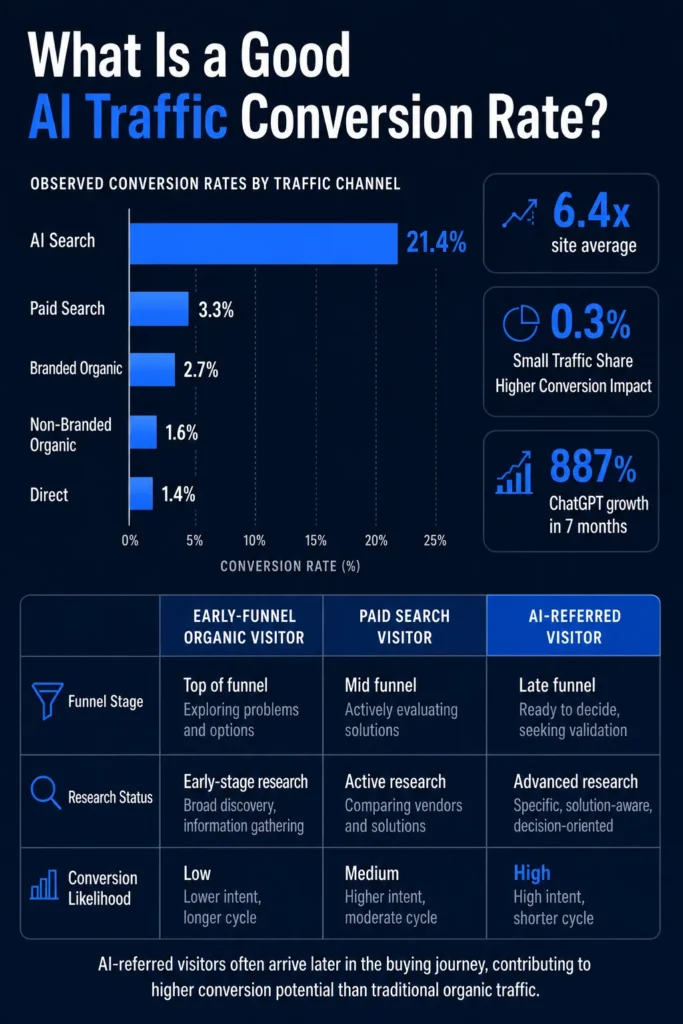
Content Ops Lab’s citation-first content system produced 95+ confirmed AI search conversions at an average CVR of 21.4% over eight months — 6.4x the site baseline — within a 12-location regulated healthcare operation. That result didn’t come from the AI tools. It came from building content architecture that AI systems want to cite.
Related: Why Does AI Referral Traffic Convert Higher Than Organic Search?
Why Are Multi-Location Operators Misreading Their AI Traffic Conversion Rate Data?
Most operators aren’t misreading their AI conversion rates — they’re misapplying the benchmark they’re comparing them to. A 12% AI conversion rate looks unremarkable against a paid search campaign’s 7% average. Measured against your own organic baseline, it’s frequently the highest-converting channel on the property.
The Organic Benchmark Misapplication
The problem with comparing AI traffic to organic search is that they deliver visitors at fundamentally different stages of the funnel.
- Generic organic visitors: early-to-mid funnel, still exploring options
- AI-referred visitors: post-research, decision-ready, often comparing final options
- Same conversion definition, structurally different buyer intent
Applying the same benchmark to both channels understates AI’s actual contribution.
Why Volume Blinds Operators to Channel Efficiency
AI sessions typically represent 0.2–1% of total traffic in current datasets. At that scale, absolute conversion numbers are small enough to dismiss as noise — even when the rate is exceptional.
- 0.07% of sessions in one B2B case study produced 1,370 conversions over seven months
- 0.5% of Ahrefs traffic drove 12.1% of total signups
- Small volume does not mean small contribution — it means standard volume metrics are the wrong diagnostic
Revenue per session and value per visit are the right metrics for low-volume, high-intent channels.
What the Data Actually Shows Across Studies
The research splits into two camps, and both are credible. The “AI converts dramatically better” camp (Ahrefs, SuperPrompt, Seer Interactive) works primarily with B2B SaaS and high-intent professional services. The “AI converts about the same” camp (Amsive’s 54-site GA4 study) works primarily with broader e-commerce datasets.
The more durable question isn’t whether AI converts better than organic in general — it’s whether AI converts better than organic on your site, in your vertical, for your conversion event. That comparison is the only one that drives budget decisions.
What Conversion Performance Do AI Platforms Actually Deliver Across Industries?
The published AI conversion data spans a wide range — from a 31% lift over non-branded organic in e-commerce to a 23x premium in B2B SaaS — and a handful of credible studies find no statistically significant lift at all. Vertical, conversion definition, and content architecture all drive the outcome. “ChatGPT referrals showed a 15.9% conversion rate, Perplexity 10.5%, while Google organic sat at 1.76%” — Seer Interactive.
Where the High-End Data Comes From
The strongest AI conversion multiples consistently appear in B2B professional services and high-consideration healthcare, where buyer journeys are longer, and AI research behavior most closely mirrors intent compression.
- Ahrefs (B2B SaaS): AI visitors converted 23x higher than traditional organic, representing 0.5% of traffic but 12.1% of signups — Ahrefs
- SuperPrompt (347 businesses, 12.3M visits): 14.2% AI conversion vs. 2.8% Google organic — 5x difference — SuperPrompt
- Seer Interactive (B2B case study, 7 months): ChatGPT at 15.9%, Perplexity at 10.5%, Google organic at 1.76% — Seer Interactive
These aren’t outliers. They reflect a consistent pattern in verticals where buyers arrive with a research-intensive decision already underway.
Where the Skeptics Have a Point
Amsive’s 6-month analysis of 54 sites found LLM referrals converting at 4.87% vs. 4.6% for organic — a difference that disappeared under statistical testing (p=0.794) — Search Engine Land.
A separate academic study across 973 e-commerce sites found ChatGPT referrals converting roughly 13% worse than all-organic traffic once branded queries were included — Visibility Labs via LinkedIn.
- Low-consideration, high-frequency purchases show minimal AI lift
- Branded vs. non-branded organic baseline shifts the comparison materially
- Methodology choices produce different conclusions from the same data
The honest read: AI conversion uplift is real in specific verticals and unreliable in others. Healthcare, legal, and home services are structurally closer to the high-conversion pattern than to e-commerce averages.
What Vertical and Funnel Type Do to the Numbers
Healthcare and legal represent the clearest case for AI conversion advantage. Buyers in these categories use AI to synthesize complex options before clicking a single website.
- Healthcare landing pages average 6.5% conversion; top performers reach 16.13% — Waypoint Converts
- Legal services top performers convert up to 15.7% (Ruler Analytics) — Ruler Analytics
- AI referrals in both verticals cluster near top-decile performance — the buyer arrives late in the funnel
For multi-location operators in regulated industries, that’s the strategic case for tracking AI as its own channel.
Why Does AI Search Traffic Convert Like a Recommendation, Not a Keyword Click?
AI-referred traffic converts at higher rates in high-consideration verticals because it doesn’t function like organic search. “Traffic originating from LLMs converts at rates nearly nine times higher than that of conventional search… traffic generated by LLMs behaves more like a personal recommendation rather than a keyword search” — Forbes. Understanding the mechanism is what makes it actionable.
The Intent Compression Mechanism
Visibility Labs coined the most useful framing: “intent compression.” Conversational research in an AI interface guides users through awareness, consideration, and option narrowing before a single external link is clicked.
- Traditional organic: buyer arrives, begins evaluating options on your site
- AI-referred buyer: arrives having already narrowed the field to a shortlist
- The conversion gap is structural, not a content quality difference
This is why session duration and page depth matter less for AI visitors — the evaluation work has already been done elsewhere.
How Buyer Journey Stage Shapes Conversion Outcomes
The intent compression pattern explains why AI conversion rates differ so dramatically across verticals. In categories where buyers conduct extended research before committing, AI captures a disproportionate share of the decision-making phase.
- Multi-location healthcare: patient research involves comparing providers, treatments, and locations — all AI-suited decision tasks
- Legal services: case evaluation, attorney selection, and fee comparison are high-complexity research tasks AI handles well
- Home services: emergency and project-based decisions compress quickly in conversational AI
The higher the decision complexity, the more likely it is that AI has already pre-qualified the visitor.
The Decision-Ready Visitor Profile
The behavioral data support this framing across multiple independent studies. AI-referred visitors view more pages per session, spend more time on-site, and are more likely to convert on a first visit than comparable organic visitors.
- Extended session durations signal deep content consumption post-arrival
- Higher page depth indicates active evaluation, not casual browsing
- First-visit conversion rates are higher than organic — the decision was largely made before the click
McKinsey describes AI as functioning like a “guidance” layer across the consumer decision journey. For regulated local services, that guidance consistently routes buyers who are ready to act.
If your operation needs accurate AI traffic conversion data and a content system built to capture it, Content Ops Lab builds the infrastructure to make that possible. Contact us to discuss your current tracking setup and content production requirements.
What Does AI Search Conversion Look Like Inside a Production Content System?
A 23-month production deployment within a 12-location regulated healthcare organization yielded the clearest test case for citation-first content and AI search conversion. The results come from a live production environment that manages 50+ articles per month across dual brands, with zero compliance violations.
The AI Channel Baseline
Over eight months (July 2025–February 2026), 537+ total AI search sessions generated 95+ confirmed conversions at a 21.4% average CVR — against a 3.32% site average. That’s a 6.4x performance multiplier from a channel representing less than 0.3% of total traffic.
- ChatGPT CVR trajectory: 9.5% (August 2025) → 32.8% (December 2025) → 40% (January 2026)
- Peak month: 52 sessions, 40% conversion rate
- Perplexity peak CVR: 25.7% (July–October 2025)
- ChatGPT traffic grew 887% over seven months (8 sessions → 79 sessions)
These numbers align with the high end of published AI conversion benchmarks and emerged from a content system specifically engineered for AI citation.
Why Citation Architecture Drives Citation Traffic
The conversion results didn’t come from publishing more content — they came from publishing content structured for AI systems to extract, cite, and recommend.
- Question-based H2 structure maps directly to how AI systems parse and retrieve content
- Answer-first paragraphs (40-60 words) give AI systems extractable, complete responses
- 40-60% bullet ratio enables fast AI parsing and structured output
- Zero fabricated citations eliminates the hallucination risk that undermines AI credibility signals
Generic AI-generated content doesn’t capture this traffic. Content architecture optimized for AI extraction does.
What 95+ Conversions Across Eight Months Reveals
At a $1,500–$3,000 average treatment value, 95+ AI search conversions over eight months represent $142,500–$285,000 in conservative revenue contribution from a channel consuming less than 0.3% of total traffic.
- AI search contribution growing at 887% year-over-year trajectory
- Multi-platform presence expanding: Claude, Gemini, and Qwen are appearing alongside ChatGPT and Perplexity
- Early citation dominance compounds — AI systems reinforce existing citation patterns over time
A 4-location market expansion delivered 15.36% CVR (4.6x site average), validating that the conversion performance scales to new geographic markets without degradation.
Related: How AI Search Engines Evaluate Source Trust and Credibility
How Is the AI Search Landscape Shifting the Stakes for Multi-Location Businesses?
The conversion data is important. The market trajectory is what makes it urgent. “Half of consumers polled in a McKinsey survey now intentionally seek out AI-powered search engines, with a majority of users saying it’s the top digital source they use to make buying decisions” — McKinsey.
Multi-location operators in regulated industries are not evaluating a marginal channel — they’re evaluating the channel that is replacing the top of the consideration funnel.
The McKinsey Traffic Risk Projection
McKinsey projects that by 2028, approximately 50% of Google searches will carry AI summaries and around $750 billion in US revenue will flow through AI-powered search. Their data shows 44% of AI-powered search users name it as their primary source of insight — ahead of traditional search (31%), brand sites (9%), and review sites (6%).
- Eight Oh Two’s 2026 AI & Search Behavior Study: 37% of consumers now start searches with AI tools rather than Google or Bing — Eight Oh Two
- Pew Research: Google users are measurably less likely to click result links when an AI summary appears — Pew Research Center
- BrightEdge: search impressions up 49% year-over-year while click-through rates fell roughly 30% — BrightEdge
Impressions growing while clicks fall is the zero-click dynamic in live data.
Where First-Mover Advantage Is Still Capturable
The competitive window for AI citation dominance in regulated local services remains open — but it is measurably narrowing. Current adoption estimates indicate that fewer than 5% of healthcare practices and fewer than 10% of legal firms are actively optimizing for AI search citations.
- AI systems reinforce existing citation patterns — early citation authority compounds over time
- Implementation timeline: 3–6 months from content infrastructure build to citation capture
- Competitive window measured in quarters, not years
The operators who build citation-first content infrastructure now enter an under-contested space.
What Zero-Click AI Overviews Are Doing to Traditional Organic
AI Overviews inside Google are compressing traditional organic performance even for pages that maintain their rankings. Pew Research documented that users shown an AI summary click through to standard results at roughly half the rate of users shown standard results only.
- BrightEdge: click-through rates fell approximately 30% year-over-year as AI Overviews scale
- Ranking position one no longer guarantees the click volume it once did
- Traditional SEO KPIs (position, impressions) are decoupling from traffic and revenue
For multi-location operators, measuring organic performance by sessions alone increasingly undercounts actual influence — and overstates the security of current rankings.
How Should VPs of Marketing Build an AI Traffic Measurement Framework?
“ChatGPT only began passing utm_source=chatgpt.com in June 2025, so measured AI traffic is an undercount of actual AI-influenced visits” — Nadia Mohamed. Before optimizing for AI conversion, most operations need to fix how they’re counting it. The current default GA4 setup buries AI referrals inside generic Referral and Direct buckets — which means documented high-CVR data from production deployments may reflect a floor, not a ceiling.
Creating a Dedicated AI Channel in GA4
Standard GA4 channel definitions don’t recognize AI search platforms. Without a custom channel group, traffic from ChatGPT, Perplexity, Claude, Gemini, and Copilot lands in Referral — or disappears into Direct entirely.
- Build a custom “AI referrals” or “Generative engines” channel using regex on chatgpt.com, perplexity.ai, gemini.google.com, copilot.microsoft.com, claude.ai
- Reorder channel rules so AI is captured before the generic Referral bucket
- Apply across all properties and locations — not just the primary domain
Some practitioners report that AI traffic represents 60% of all referral traffic once properly isolated.
The Right Benchmarking Comparison
The most common measurement mistake is comparing AI conversion rates against industry benchmark tables rather than against your own channel mix. Industry averages are built on datasets dominated by e-commerce and legacy attribution models that don’t reflect regulated multi-location services.
- Compare AI CVR against your own non-branded organic, branded organic, paid search, and direct
- Track revenue per session and value per visit — not just conversion rate
- Segment by location and service line: AI adoption and intent patterns differ across use cases
A 21.4% AI CVR means more when compared against a 3.32% site average than against a 6.6% cross-industry median.
What Operators Who Get This Right Track Differently
The measurement framework that surfaces AI’s true contribution tracks three signals simultaneously: conversion rate by channel, value per session, and assist role.
- AI traffic assists are undercounted in last-click models — the channel’s influence starts in the AI interface
- First-visit conversion rate isolates the intent-compression effect from multi-session nurture
- Session volume trend (week-over-week, month-over-month) indicates citation momentum
The operators running this framework catch 887% growth in ChatGPT traffic early enough to act on it rather than notice it retrospectively.
How Content Ops Lab Builds AI Search Conversion Infrastructure
Content Ops Lab’s 23-month production deployment in regulated healthcare generated 95+ confirmed AI search conversions, with an average CVR of 21.4% — from a channel that represents less than 0.3% of total traffic. That result came from a content production system built and iterated over 23 months, not a tool or a prompt.
- 23-month production test inside a 12-location regulated healthcare organization
- 1,000+ citation-verified articles and pages delivered with zero compliance violations
- 45% of all leads from organic search — outperforming paid search nearly 2:1
- AI search converting at 21.4% average vs. 3.32% site baseline — 6.4x performance multiplier
- 887% ChatGPT traffic growth in 7 months (July 2025–February 2026)
- 653% impression growth and 1,700% click growth for an emerging brand (14-month period)
- 5x production scale: 10 articles/month to 50+ without adding headcount
- Dual-brand methodology validated on both mature brand maintenance and emerging brand growth
The Content Ops Lab Production System
Four sequential stages eliminate the failure point that comes before each one.
- Research: Verified sources before generation — Perplexity Pro workflow, no AI writing from memory
- Verification: Line-by-line citation cross-check, STAT vs. CLAIM labeling, full audit trail
- Optimization: Multi-platform targeting — Google, ChatGPT, Perplexity, Claude, Gemini simultaneously
- Delivery: WordPress staging or Google Docs — publish-ready, compliance-reviewed, formatted for AI extraction
If your AI traffic data shows high conversion rates on low volume, the system is working. If it shows near-zero AI referrals, the content architecture isn’t producing what AI systems are built to cite.
Ready to build content infrastructure that captures AI search conversions at scale? Get in touch today — we’ll assess your current content operation and outline what a systematic approach would look like for your organization.
FAQs About AI Traffic Conversion Rate
Our AI traffic volume is too small to prioritize — why should we invest in optimizing for it now?
Volume is the wrong metric for evaluating the priority of AI traffic. In the production deployment referenced above, AI accounted for less than 0.3% of total sessions but delivered 95+ conversions with a 21.4% CVR over eight months. Seer Interactive’s B2B case study shows 0.07% of sessions produced 1,370 conversions over seven months. At an average treatment value of $1,500–$3,000, small-volume AI traffic generates an outsized revenue contribution. The early-mover case is about compounding: citation dominance established now reinforces as AI systems scale.
How long does it take to see meaningful AI traffic conversion data after implementing citation-first content?
Measurable AI referral traffic typically appears within 60–90 days of publishing structured, citation-verified content at a consistent cadence. Meaningful conversion data generally requires 4–6 months of production history. A documented deployment showed consistent CVR growth from 9.5% in month two to 40% by month seven — indicating that content volume and citation accumulation both contribute to performance trajectory.
How does content built for AI citation hold up against compliance requirements in healthcare or legal industries?
Citation-first content architecture is structurally more compliant than traditional AI-generated content. The verification protocol — exact quote extraction, line-number documentation, STAT vs. CLAIM labeling — eliminates the fabricated statistics and hallucinated citations that create compliance exposure. The methodology has delivered 1,000+ articles and pages in a regulated healthcare environment with zero compliance violations over 23 months.
How is optimizing for AI search citations different from traditional SEO or a standard content agency approach?
Traditional SEO optimizes for keyword density, backlinks, and Google ranking signals. AI citation optimization requires answer-first formatting, question-based architecture, and verified citations that AI systems recognize as credible. Standard content agencies use AI to write from memory — producing generic content with fabricated citations that AI systems ignore. The differentiation isn’t the tools. It’s the citation verification infrastructure that makes the output citation-worthy.
Is Done-For-You or System Build the right model for an operator trying to capture AI search conversions at scale?
Done-For-You is the right starting point for operations that need production volume immediately — 20–50+ articles per month — without the internal capacity to run the system. System Build fits operations with an existing content team that needs the methodology documented, installed, and transferred for internal operation. Both models deliver the same citation-first architecture and verification standards. The question is whether you want to run the infrastructure or own it.
Key Takeaways
- “What is a good AI traffic conversion rate?” is the wrong question. The right question is whether AI converts better than every other acquisition channel on your specific site, in your vertical, for your conversion event.
- Published AI conversion benchmarks range from a statistically insignificant 31% lift in e-commerce to a 23x premium in B2B SaaS — vertical and funnel type explain the spread more than any other variable.
- AI-referred visitors in high-consideration categories arrive post-research, compressing the buyer journey before the first click — which is why intent-matched content converts them at rates top-decile paid search campaigns can’t reliably match.
- A 23-month production deployment in regulated healthcare produced 21.4% average AI CVR and 887% ChatGPT traffic growth — from a content system built for citation architecture, not volume alone.
- Most operations are undercounting AI traffic by a factor of 2–3x due to GA4 attribution gaps; fixing the measurement layer is the prerequisite for accurate performance evaluation.
- The first-mover window for AI citation dominance in regulated local services remains open — but it closes as mainstream adoption accelerates and AI systems reinforce existing citation patterns.
Build Content Infrastructure That Compounds: What Is a Good AI Traffic Conversion Rate
The benchmark question misses the point. A good AI traffic conversion rate outperforms every other channel on your own property — and that result comes from content architecture, not from the AI tools themselves. Published data from hundreds of businesses show AI referrals converting at 5–23x the organic rate in high-consideration verticals.
Content Ops Lab’s production deployment in regulated healthcare delivered an average CVR of 21.4% over eight months from a channel that represented less than 0.3% of total traffic. The operators who build citation-first content infrastructure now capture patterns that AI systems reinforce over time. The operators who wait inherit a more competitive landscape with a narrowing window.