
Why Most Websites Are Invisible to AI Search
Most multi-location websites are invisible to AI search, not because they rank poorly in Google, but because their content architecture was never designed for machine-level retrieval — and AI systems can’t cite what they can’t extract, verify, and trust at scale.
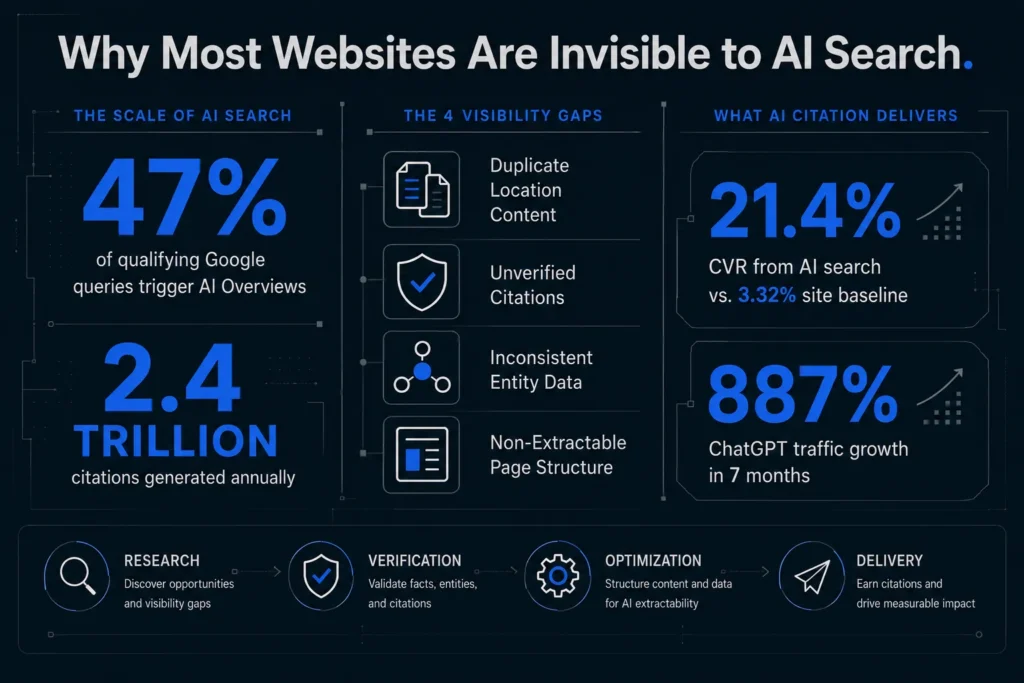
According to a 2026 analysis, AI Overviews now appear on approximately 47 percent of qualifying Google Search queries, reach an estimated 1.7 billion monthly users, and generate roughly 2.4 trillion citations to indexed web pages annually — Presenc AI. That’s not a future trend. It’s the current competitive landscape your content operation is either capturing or missing entirely.
For operators managing 5, 10, or 20 locations, the structural problem is compounded. Templated location pages, duplicated service content, and inconsistent entity data create the very conditions that AI retrieval systems are designed to avoid.
Content Ops Lab built its content infrastructure inside a 12-location regulated healthcare organization — 1,000+ citation-verified articles delivered with zero compliance violations over 23 months — and the data is clear: the gap between ranking and being cited is where most operators’ lead pipelines are quietly leaking.
Related: SEO vs AEO vs GEO – How Multi-Location Businesses Should Think About Modern Search
Why Do Most Multi-Location Websites Fail to Get Cited by AI Search?
Most multi-location websites fail to earn AI citations because their content was built for a crawl-and-rank paradigm that AI retrieval systems operate above. Ranking in a SERP makes you a candidate.
Getting cited requires your content to be findable, parseable, verifiable, and trustworthy — four requirements that templated, duplicated location content rarely meets simultaneously.
The Structural Mismatch Between Template Pages and AI Retrieval
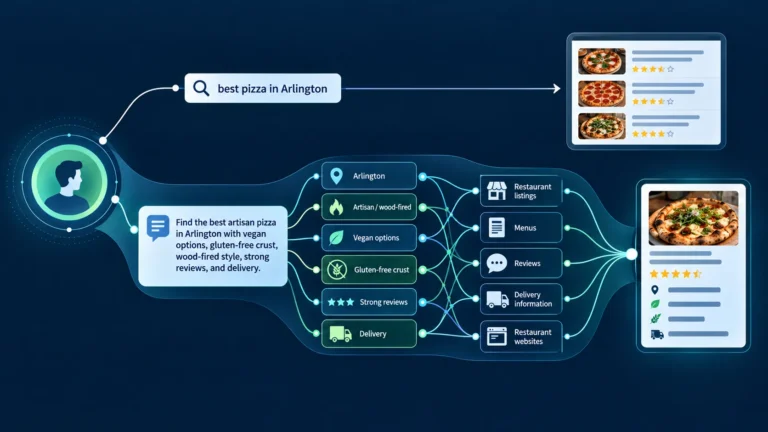
Modern AI search operates on retrieval-augmented generation — fanning out across multiple related queries, retrieving candidate pages, and selecting sources to ground a synthesized answer. A page optimized for human navigation is often a poor match for a retrieval model seeking a 40-60-word citation-ready snippet.
- Pages structured around human navigation, not AI extraction
- Dense paragraph blocks that resist chunking into discrete answers
- Generic service descriptions with no specific, verifiable claims
- Missing question-aligned headings that map to conversational queries
Duplicate Content as a Self-Inflicted Visibility Problem
Template cloning is the core architectural failure at multi-location organizations. “When you create one ‘Cleaning Services’ page and copy-paste it for every city, Google sees dozens of nearly identical pages competing with each other” — LinkedIn / Orr Godatta.
Google’s 2026 AI optimization guidance explicitly instructs site owners to reduce duplicate content — thin, templated local pages won’t become preferred grounding sources.
- Pages competing against themselves for the same queries
- No unique, locally grounded content for AI retrieval to lift
- Thin signal-to-noise ratio across the entire location portfolio
- Algorithmic devaluation of all pages, including the strongest ones
What AI Systems Are Actually Looking For in a Source
AI retrieval systems evaluate sources across dimensions that traditional SEO metrics don’t measure. The question isn’t “does this page rank?” — it’s “would the model trust this page enough to put its answer on it?”
- Specific, verifiable facts with clear contextual framing
- Answer-first structure that maps cleanly to a sub-question
- Consistent entity data across the site and across the web
- Evidence of editorial governance and citation standards
Operators who understand this distinction stop asking “why isn’t our ranking translating to traffic?” and start asking “why isn’t our content being cited?”
What Does “Invisible to AI Search” Actually Mean for Your Lead Pipeline?
Being invisible to AI search doesn’t show up as a traffic crash — it shows up as a slow, compounding lead gap that traditional attribution can’t fully explain. Your organic traffic may look stable while your highest-converting channel goes completely uncaptured.
The Gap Between Ranking and Being Cited
AI Overviews appear as a single block in Search Console reporting, and all cited links appear in the same position. Independent analyses find that nearly half of AI Overview sources come from pages ranking outside the top 10 — extractable structure and depth can outperform position for citation purposes.
- Top organic rankings don’t guarantee citation inclusion
- AI Overview citations reach an estimated 1.7 billion monthly users
- Citation-based visibility exists independently of traditional CTR metrics
- Missing from the block means missing from the synthesized answer entirely
How Zero-Click Exposure Reshapes the Conversion Funnel
When a user asks ChatGPT or Perplexity for a recommendation, the answer engine completes a qualification process before issuing a referral. The user arriving from an AI citation has already been filtered and pre-sold.
- Qualification happens upstream, before the site visit
- Trust transferred from the AI system to the cited brand
- Extended session durations signal genuine purchase intent
- Session behavior reflects a buyer further along the decision journey
A 12-location regulated healthcare organization running the Content Ops Lab methodology saw AI search traffic convert at an average of 21.4% over 8 months — versus a 3.32% site baseline. That’s a 6.4x performance multiplier from a channel currently representing less than 0.3% of total traffic.
Why Flat Traffic Reports Mask a Growing Visibility Problem
AI-referred sessions fragment across multiple GA4 classifications, and brands mentioned in AI-generated answers that don’t drive clicks don’t appear in any traffic report. Operators optimizing only what’s measurable may be managing the wrong metrics.
- Attribution gaps undercount total AI channel exposure
- Flat traffic alongside declining conversions may signal citation displacement
- AI brand mentions don’t generate sessions — only cited sources do
- AI search analytics platforms now track citation frequency and share of voice across Google, ChatGPT, Perplexity, and Gemini
How Is AI Search Different From Traditional SEO — and What Does That Mean for Operators?
AI search and traditional SEO share the same substrate — your indexed web content — but why most websites are invisible to AI search comes down to one shift: the success metric has moved from ranking position to citation selection. AI Overviews appeared in 13.14% of all U.S. desktop searches in March 2025, up from 6.49% in January — Semrush & Datos via Search Engine Journal.
By Q1 2026, coverage on qualifying queries reached 47%. The operators building citation infrastructure now will own that channel when the competitive window closes.
Retrieval-Augmented Generation and Why It Changes the Game
Every major AI search platform retrieves candidate pages, evaluates specific passages, and generates a grounded answer — it doesn’t write from pre-training memory. Most operators have optimized for the first gate while leaving the second entirely unaddressed.
- Traditional SEO stops at “am I in the candidate result set?”
- RAG adds a second gate: “Am I the content the model chooses to cite?”
- Pages that retrieve well may still fail the citation selection test
- Citation selection rewards extractability and verifiability, not just authority
How Query Fan-Out Expands the Candidate Pool Beyond Your Target Keywords
When a user types a query into Google AI Mode or ChatGPT Search, the system generates concurrent related queries and retrieves content across that expanded pool before synthesizing an answer. Content architecture decisions have broader citation consequences than the target keyword alone suggests.
- A single user query triggers multiple internal retrieval queries
- Pages optimized for exact-match keywords may miss fan-out coverage
- Semantic variation and question-aligned structure expand citation eligibility
- A single well-structured article can earn citations across many related queries
What the Major Platforms Reward and Ignore
Google’s 2026 AI optimization guidance is explicit: operators don’t need llms.txt files, AI-specific markup, or aggressive chunking — Search Engine Journal.
Clear headings, semantic HTML, reduced duplication, and technical crawlability remain the foundation — what has changed is the ceiling.
- Unique, non-commodity content with specific, verifiable value
- Answer-first structure enabling passage-level extraction
- Evidence-based claims from credible, cross-verifiable sources
- Consistent entity data across all platforms and locations
If your operation needs to produce 20-50+ articles per month without sacrificing compliance or quality, Content Ops Lab builds the infrastructure to make that possible. Contact us to discuss your content production requirements.
What Content Infrastructure Does a Multi-Location Site Need to Earn AI Citations?
Earning AI citations consistently requires a production system built around the specific requirements AI retrieval systems use to evaluate and select sources. Verified citations, entity-consistent location data, and answer-first architecture must work together as a unified system — not as isolated tactics.
Citation Verification as an AI Visibility Prerequisite
The hallucination problem in AI-generated content is accelerating, and platforms are raising the bar on source verification. Papers containing at least one fabricated reference increased from roughly 1 in 2,828 papers in 2023 to 1 in 458 papers in 2025, reaching approximately 1 in 277 papers during the first 7 weeks of 2026 — The Lancet / Maxim Topaz et al.
- Every statistic is traced to the source material with line documentation
- STAT vs. CLAIM labeling for different evidence verification standards
- No AI writing from memory — verified research before generation
- Audit trail for every data point, defensible in regulated industry reviews
Entity Consistency Across All Location Data
AI systems build an implicit knowledge graph from your entire web footprint — schemas, business profiles, reviews, and third-party listings. A brand with coherent, consistent entity data is a more reliable citation candidate than one with inconsistent NAP data or conflicting service descriptions across platforms.
- Consistent Name, Address, Phone across all location pages and directories
- Location-specific reviews and examples that establish each entity as distinct
- Harmonized claims across corporate, local, and third-party listings
- NAP verification is an ongoing operational function, not a one-time setup
Answer-First Architecture and Extractable Page Structure
Structure is a retrievability requirement, not a formatting preference. Content opening with a 40-60 word direct answer, question-aligned H2s, and 40-60% bullet density gives AI retrieval systems the discrete passages they need to ground a synthesized answer.
- 40-60-word answer, first paragraphs for featured snippet extraction
- Question-based H2s that map to voice search and conversational AI queries
- Bullet-heavy formatting (40-60%) for AI parsing and passage selection
- Specific, data-backed claims that build model confidence in the source
Related: Structured Content for AI Search – How It Gets You Cited by AI
What Does AI Search Performance Actually Look Like in a Production Environment?
Production data from a 23-month content infrastructure deployment in a regulated healthcare environment provides the clearest available picture of what AI search optimization delivers — and the numbers make the investment case straightforward for any VP of Marketing tracking cost-per-lead.
Conversion Rate Differential Between AI and Organic Traffic
AI search traffic converts at a fundamentally different rate because users arrive pre-qualified. When an AI system recommends a specific provider, the transfer of trust is comparable to a personal referral.
- 21.4% average AI search CVR vs. 3.32% site baseline — 6.4x performance multiplier
- 95+ confirmed conversions from less than 0.3% of total traffic
- ChatGPT sessions grew 887% in 7 months (8 sessions → 79 sessions)
- Extended session durations (2:30-4:20) vs. site average (1:30-2:55)
The First-Mover Advantage Window in Regulated Industries
The current AI search landscape in healthcare, legal, and home services represents a first-mover window that is still open but closing. Operators building citation infrastructure now are entering a channel with minimal competition and compounding returns.
- Less than 5% of healthcare practices are optimizing for AI citations
- Less than 10% of legal firms track AI referral traffic
- Competitive window estimated at 12-18 months before mainstream agency adoption
- Implementation takes 3-6 months — the window is measured in quarters, not years
Why Early Citation Dominance Compounds Over Time
AI citation patterns reinforce themselves — a brand earning consistent citations becomes a stronger, more trusted node in AI knowledge graphs over time. Links in AI Overviews get more clicks than they would if the page appeared as a traditional web listing for that query — Google Blog.
- Citation frequency builds model confidence in the source over time
- Late-moving competitors face higher barriers to displace established citations
- Every quarter without infrastructure is a quarter competitors use to entrench
- The compounding effect accelerates as AI search query volume grows
Is Your Content Operation Built for AI Citation — or Just Traditional Rankings?
Most operators running content programs today are building for a search paradigm two to three years behind the current landscape. The diagnostic starts with an honest audit of what your current production actually delivers against AI citation requirements.
The Audit Questions Every VP of Marketing Should Be Asking
Before investing in any content infrastructure change, understand where your current operation fails. Most audits surface the same four gaps: duplicate location content, unverified citations, inconsistent entity data, and page structure that doesn’t support passage-level extraction.
- Are your location pages meaningfully differentiated, or just city-swapped templates?
- Do your published articles include verified citations with traceable sources?
- Is your NAP data consistent across all location pages, GBPs, and directories?
- Do your pages open with 40-60-word direct answers to question-based queries?
Done-For-You vs. System Build: Matching the Model to Your Operation
The right model depends on whether your organization needs a managed production partner or a transferable infrastructure system that you operate independently. Done-For-You fits teams without internal capacity to run systematic production at scale. System Build fits teams with internal capacity who need the architecture, templates, and training.
- Done-For-You: 20-50+ articles/month managed end-to-end, citation-verified and publish-ready
- System Build: Complete infrastructure delivered in 12 weeks with 90-day post-launch support
- Both models deliver the same output standard: structured, verified, AI-optimized content
- Both address the same four gaps: duplication, verification, entity consistency, and extractable architecture
The Cost of Waiting vs. The Cost of Building
The calculation isn’t “can we afford to do this?” — it’s “what does continued invisibility cost per quarter?” At a 21.4% AI search conversion rate and average client values in the thousands, even modest citation volume represents a significant lead contribution from a channel with no paid media cost.
- AI search is the lowest cost-per-lead channel in the mix when optimized
- Organic leads carry zero media spend — content investment is the full cost
- ROI at 10-20x content investment is achievable on the organic channel alone
- Every quarter without an AI citation infrastructure is a quarter competitors use to establish dominance
How Content Ops Lab Builds Content Infrastructure for AI Search Visibility
A 12-location regulated healthcare organization running the Content Ops Lab methodology generated 95+ confirmed AI search conversions in 8 months, with an average CVR of 21.4% — 6.4x the site baseline. That result is the direct output of a production system built to meet AI retrieval requirements from the first draft.
- 23-month production test inside a 12-location regulated healthcare organization
- 1,000+ citation-verified articles delivered with zero compliance violations
- 45% of all leads from organic search — outperforming paid search nearly 2:1
- AI search converting at 21.4% vs. 3.32% site baseline — 6.4x performance multiplier
- 887% ChatGPT traffic growth in 7 months (July 2025–February 2026)
- 653% impression growth and 1,700% click growth for an emerging brand in 14 months
- 5x production scale: 10 articles/month to 50+ without adding headcount
- Dual-brand methodology validated on mature brand maintenance and emerging brand growth
The Content Ops Lab Production System
Every article is treated as a citation-ready knowledge unit built against AI retrieval requirements — not a keyword-targeted page.
- Research: Verified sources before any generation — no AI writing from memory
- Verification: Line-by-line citation cross-check, STAT vs. CLAIM labeling, full audit trail
- Optimization: Multi-platform build — Google + ChatGPT + Perplexity + Claude + Gemini simultaneously
- Delivery: WordPress staging or Google Docs — publish-ready, compliant, Grammarly-reviewed
Ready to build a content infrastructure that scales without the compliance risk? Get in touch — we’ll assess your current content operation and outline what a systematic approach would look like for your organization.
FAQs About Why Most Websites Are Invisible to AI Search
Can’t we optimize our existing pages for AI search without rebuilding the content operation?
Existing pages can be retrofitted, but the gap is usually deeper than a formatting update. Most multi-location sites have three structural problems: duplicate content, unverified citations, and page architecture that doesn’t support passage-level extraction. Fixing formatting without addressing the other two produces marginal gains. Operators who close all three gaps systematically are the ones capturing the 21.4% CVR channel.
How long does it take to see measurable AI search traffic from a content infrastructure investment?
AI citation volume typically begins to appear in referral data within the first few months of consistent publication. Still, meaningful conversion data takes a full quarter to evaluate. A 12-location healthcare organization grew ChatGPT traffic 887% in 7 months. The channel compounds — the earlier the infrastructure is in place, the stronger the effect.
How does citation verification protect multi-location healthcare and legal practices from AI content risk?
A verified production workflow traces every statistic to source material with documented line numbers and STAT vs. CLAIM labeling — no AI writing from memory. That eliminates the risk of hallucination before a fabricated statistic appears in a published article, before it propagates across location pages, or before it triggers a compliance review.
How is a systematic content infrastructure different from what an SEO agency or AI content tool would build?
Traditional agencies maximize volume and optimize for keyword density — a model that fails for AI citation. Generic AI tools write from model memory, producing fabricated citations that are catastrophic in regulated industries. The structural difference is the verification layer: research-first workflows, line-by-line citation cross-checking, and multi-platform optimization built in from the start.
Which engagement model — Done-For-You or System Build — makes sense for a multi-location organization trying to fix AI search visibility?
Done-For-You fits operators who need consistent output now without internal capacity for systematic production. System Build fits operators with an internal team who want full ownership of the infrastructure. Both deliver citation-verified, AI-optimized, compliance-ready content — and both address the same structural gaps keeping most multi-location websites invisible to AI search.
Key Takeaways
- AI Overviews now appear on 47% of qualifying Google Search queries and generate an estimated 2.4 trillion citations annually — the channel is active, not emerging
- Most multi-location websites are invisible to AI search because of duplicate location content, unverified citations, inconsistent entity data, and page structure that doesn’t support passage-level extraction
- Ranking in traditional SERPs doesn’t guarantee AI citation — nearly half of AI Overview sources come from pages outside the top 10, meaning extractability and verification outweigh position
- AI search traffic converts at 6.4x the site baseline when content is built to earn citations — a 12-location regulated healthcare organization recorded 21.4% average CVR from AI platforms over 8 months
- The first-mover window is measured in quarters: fewer than 5% of healthcare practices and 10% of legal firms are systematically optimizing for AI citations, and implementation takes 3-6 months
- Citation dominance compounds — early patterns reinforce over time, making late-moving competitors progressively harder to displace
Build Content Infrastructure That Compounds: Why Most Websites Are Invisible to AI Search
The AI search channel is expanding fast. At 47% of qualifying query coverage and 2.4 trillion annual citations, it’s a lead channel to capture or cede to competitors. The operators currently invisible to AI search aren’t being penalized for bad SEO — they’re being passed over because their content architecture was built for a retrieval paradigm AI systems have already moved beyond.
The fix isn’t tactical. Systematic content infrastructure will change citation behavior: verified research, entity-consistent location data, and an answer-first architecture that works as a production system rather than a checklist. Content Ops Lab built this infrastructure inside a regulated healthcare operation over 23 months — 21.4% average CVR, 887% ChatGPT traffic growth, 95+ confirmed conversions from less than 0.3% of total traffic.
The window to capture this channel before mainstream competition arrives is measured in quarters. The operators who build now will be significantly harder to displace when it closes.