

Why Content at Scale for Multi-Location Businesses Fails
Scaling content at scale for multi-location businesses requires more than publishing capacity — it requires production infrastructure. Google’s March 2024 spam policies explicitly target “scaled content abuse,” defining it as the creation of large volumes of unoriginal content that provides little to no value to users, regardless of how it’s created.
For multi-location brands, that standard disqualifies most templated approaches before a single article goes live. The content systems that perform share three characteristics: verified research, genuine localization, and governance that holds quality consistent as volume grows.
Content Ops Lab built that infrastructure within a multi-location, regulated industry operation — delivering 1,000+ citation-verified articles with zero compliance violations over 23 months.
Related: Why Generic Content Fails in AI Search Even If It Ranks in Google
Why Do Internal Teams Hit a Ceiling When Scaling Content Across Multiple Locations?
Internal teams rarely fail because of effort — they fail because the operational infrastructure required to scale content at scale for multi-location businesses doesn’t exist at the right level. Most in-house teams can produce 5–10 substantive articles per month before quality begins degrading. Pushing past that ceiling without purpose-built workflows doesn’t accelerate content production — it accelerates inconsistency.
Capacity Constraints Without Dedicated Workflows
Benchmark research puts the output capacity of bootstrapped teams without dedicated content staff at 2–4 posts per month — and that’s before multi-location complexity is introduced. Without structured editorial processes, quality depends entirely on who’s writing that week.
- No templates means constant layout reinvention
- No briefs means inconsistent research depth per article
- No review process means approval bottlenecks, not quality gates
- AI assistance alone doesn’t fix structural workflow gaps
Teams hitting 10 articles per month without dedicated tooling are already at their practical ceiling. The constraint isn’t creativity — it’s infrastructure.
Localization Friction at Volume
Each location article must reconcile national brand messaging with location-specific details, local service offerings, regulatory constraints, and stakeholder review requirements. That coordination layer compounds as more locations are added.
- Each location needs unique NAP data, local keywords, and neighborhood references
- State or regional compliance variations require content-level differentiation
- Local stakeholder approvals introduce review latency that generic workflows can’t absorb
- Template reuse without genuine localization produces content that ranks nowhere
Writing good content for location 14 at the same quality as location 1 requires systems, not just effort.
The Multi-Location Coordination Tax
Without clearly defined templates, content briefs, and review processes, internal teams spend more time resolving inconsistencies and chasing approvals than producing content. The coordination overhead becomes operationally disruptive at 8 or 12 locations.
- Central marketing and local teams operate on different timelines
- Brand voice drift accelerates as volume increases and oversight thins
- NAP inconsistencies accumulate across listings, pages, and directories
- Quality verification becomes reactive rather than systematic
What Are the Real Options for Multi-Location Content Production — and Where Does Each Break Down?
Multi-location growth leaders evaluating content at scale for multi-location businesses typically consider three options: internal teams, traditional agencies, and AI-generated content. Each addresses part of the problem. None addresses the full scope without a systematic infrastructure underneath it.
Internal Team Limitations
Internal teams offer the strongest brand voice consistency but the weakest volume capacity. Benchmark data confirms that a two-person content team with AI assistance can match the output of a five-person team from 2020 — but that still caps production well below 20–50 articles per month. Understaffing content marketing leads to inconsistency, burnout, and a degradation of quality long before the volume ceiling is reached.
- Realistic ceiling: 5–10 articles per month without dedicated infrastructure
- Local SEO expertise is often absent or unevenly distributed
- Citation verification is rarely built into internal workflows
- Compliance review adds latency that compounds at scale
Internal teams are the right answer for strategy and oversight — rarely for production volume.
Agency Model Failure Points
Traditional agencies solve the volume problem but introduce a different set of failures. Duplicate location pages — same content, different city names — trigger Google’s thin content filter and suppress rankings.
Each location page needs unique content: local staff bios, location-specific testimonials, nearby landmarks, and locally relevant services. NAP consistency across citations is a ranking factor. Most agencies aren’t operationally equipped to deliver that at scale without significant cost increases.
- Template-driven production generates near-duplicate pages that cluster in Google, not rank
- Neighborhood-level signals are stripped in the interest of production efficiency
- Brand voice consistency degrades as the freelancer count rises with volume
- Pricing scales linearly with location count, eliminating the efficiency advantage agencies claim
Generic AI Output Risks
AI tools accelerate production — but unverified AI output undermines the E-E-A-T signals Google requires and creates compliance exposure in regulated industries. In healthcare or legal content, a single unverified claim published across 12 location pages creates 12 simultaneous compliance liabilities.
- No research verification means no citation integrity
- Generic output fails to reflect brand voice, local expertise, or proprietary knowledge
- Google’s scaled content abuse policies explicitly target mass AI output that provides no user value
- AI search platforms don’t cite content they can’t trust
The problem isn’t AI as a production tool — it’s AI without the verification infrastructure to make output trustworthy.
What Does a Content System That Actually Scales Look Like?
Scaling content at scale for multi-location businesses is an infrastructure problem — solvable, replicable, and defensible as competition intensifies.
Research-First vs. Template-First Architecture
Template-first systems prioritize production speed. Research-first systems prioritize citation integrity. A research-first workflow begins with verified sources before generation, not after.
- Every article is anchored to credible source material before AI drafting begins
- Proprietary client knowledge documented from SME interviews and integrated into production
- Citations extracted with exact quotes and source verification — no paraphrasing risk
- AI generation informed by research, not substituting for it
Templates define structure. Research defines credibility. High-performing scaled content requires both.
Citation Verification as Compliance Infrastructure
Citation verification isn’t a quality-of-life improvement — it’s risk management. For multi-location brands in regulated industries, fabricated statistics published across dozens of location pages represent compounding liability.
- Line-by-line cross-check of every statistic against source documents
- STAT vs. CLAIM labeling — different verification standards for different evidence types
- Audit trail maintained for every data point across every article
- Zero-hallucination standard as the production baseline, not an aspirational goal
Verification at scale requires a protocol, not a proofreader.
Governance and Quality Control at Volume
Quality control that relies on a single reviewer breaks down at scale. Governance structures that scale embed review checkpoints into the workflow rather than appending them at the end.
- Standardized briefs define research requirements, keyword targets, and localization parameters before writing begins
- Multi-stage workflow: confirm → approve → execute → refine
- Grammarly review and readability scoring as production-stage gates, not post-publication cleanup
- Version-controlled system documentation that travels with the content operation as it scales
If your operation needs to produce 20–50+ articles per month without sacrificing compliance or quality, Content Ops Lab builds the infrastructure to make that possible. Contact us today to discuss your content production requirements.
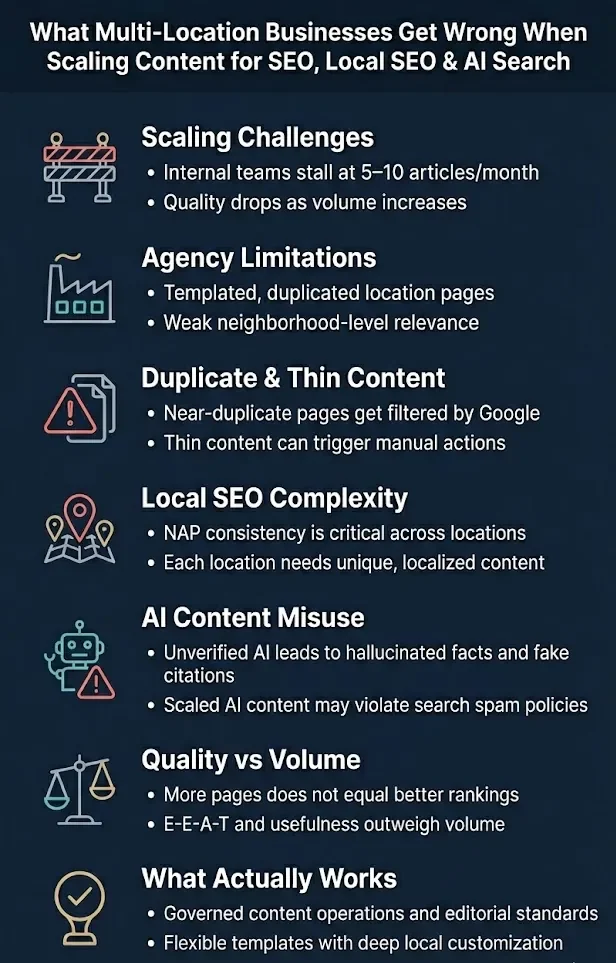
What Happens to Rankings When Scaled Content Lacks Differentiation?
Volume without differentiation doesn’t compound — it clusters. Google’s handling of duplicate and thin content means most near-identical location pages are effectively invisible in search results. There’s no recovery path to pursue — just pages that were never going to rank.
Duplicate Content Clustering Mechanics
When duplicate content is detected, Google groups URLs into a cluster, selects the “best” URL to represent the cluster in results, and consolidates link signals to that representative URL. For a multi-location brand with templated location pages, one page competes for visibility while the others are filtered out.
- Canonical URL selection is Google’s decision, not the publisher’s
- Link equity consolidates to one representative URL — the others receive none
- Near-duplicate pages are indexed but rarely shown, consuming crawl budget without generating impressions
- Swapping city names in boilerplate content doesn’t create differentiation — it creates clustered irrelevance
Thin Content and Manual Action Risk
Thin content is defined as web pages with little to no authentic content, and content that offers little or no added value is explicitly one of the reasons a website can receive a manual action from Google. This includes pages that are long but add no substantial value, which describes most templated location pages that shuffle words without unique insights or local relevance.
- 200+ words of genuinely unique location content is the minimum bar, not a target
- Location-specific elements — staff bios, testimonials, landmarks — are required signals, not optional enhancements
- Manual actions affect entire domains, not just individual pages
Publishing more templated content to address a visibility gap makes the problem worse, not better.
Indexing Suppression Across Location Pages
In markets where large brands publish scores of similar location pages, only a subset ranks — with the rest displaced by directory listings, review platforms, and competitors. Crawl budget consumed by non-performing pages reduces Google’s investment in the pages that could rank.
- Directory displacement means third-party sites capture the ranking position that the location page was meant to fill
- More pages published without differentiation make the existing clustering worse
- The exit path is differentiated content built on a system that prevents near-duplication from the start
Related: What Is Content Infrastructure for Multi-Location Brands?
How Does AI Search Change the Performance Math for Multi-Location Brands?
Traditional search rankings are no longer the complete picture. AI Overviews and conversational AI platforms are capturing increasing shares of search behavior — and they operate on different selection criteria than Google’s organic algorithm.
AI Overview: CTR Impact on Organic Traffic
Ahrefs research finds that when AI Overviews appear, click-through rates on organic results fall to around 1.6%, with total clicks reduced by up to 58% compared to traditional results. For multi-location brands that built their content strategy around organic click volume, that’s a fundamental shift in how ROI is calculated.
- Zero-click behavior is growing, not stabilizing
- Informational queries — the content type most multi-location brands produce — are most affected
- CTR compression hits unoptimized content hardest; AI-cited content gains disproportionate visibility
What AI Systems Actually Cite
Ahrefs’ analysis of pages cited in AI Overviews shows that the average cited page is approximately 1,282 words, but there is near-zero correlation (Spearman’s r = 0.04) between word count and selection. Structure, clarity, and alignment with search intent determine citations—not length.
- Question-based H2 structure maps directly to how AI systems parse content for citation
- 40-60-word opening answers provide extractable snippets without requiring AI to summarize
- Statistical citations with credible sourcing signal trustworthiness to AI platforms
- Generic, unstructured content fails AI extraction regardless of word count
First-Mover Advantage in AI Citation
A 23-month production test inside a multi-location regulated industry operation produced 537+ total AI search sessions and 95+ confirmed conversions over 8 months, with AI search converting at 21.4% average — 6.4x the site baseline. ChatGPT traffic alone grew 887% in 7 months. Less than 0.3% of total traffic delivered a disproportionate share of conversions.
- AI search traffic arrives pre-qualified — users are further along the decision journey
- AI citation compounds: platforms reinforce existing citation patterns, making early dominance defensible
- Less than 5% of multi-location operators in most categories are currently optimizing for AI citations
- The first-mover window is measured in quarters, not years
How Should Multi-Location Growth Leaders Evaluate Their Current Content Infrastructure?
The right question isn’t “are we publishing enough?” — it’s “does our current system produce content that performs across traditional search, local SEO, and AI citation simultaneously?”
Volume vs. Velocity vs. Value Diagnostic
Content velocity is only a positive signal when a site is consistently producing great content. The diagnostic question isn’t monthly output — it’s whether that output is differentiated enough to rank, structured enough to be cited, and verified enough to be trusted.
- Current volume: Are you publishing 20–50+ articles per month, or 4–8?
- Differentiation rate: What percentage of location pages have genuinely unique content?
- Citation integrity: Are statistics traced to verified sources?
- AI formatting: Does your content use answer-first structure and question-based H2S?
Compliance and Brand Risk Assessment
For multi-location brands in regulated industries, content risk compounds as scale increases. A fabricated statistic in a templated article published across 12 location pages is 12 simultaneous compliance liabilities.
- Healthcare and legal content require source verification at the article level, not the site level
- Brand voice consistency requires documented style standards integrated into production.
- NAP inconsistencies across location pages and directory listings suppress local pack performance
Build vs. Buy vs. Partner Decision Framework
The infrastructure decision has three paths: build internally, outsource to a managed service, or partner with a system builder who hands off the operation.
- Build internally: Right for organizations with dedicated content ops resources and runway to iterate through 6–12 months of system development
- Managed service: Right for organizations that need production capacity immediately
- System Build: Right for organizations that want full ownership of the infrastructure without architecting it from scratch
The wrong choice is to continue with a system that is already producing differentiation failure at scale.
How Content Ops Lab Builds Content Infrastructure
Content Ops Lab ran a 23-month production test within a multi-location regulated-industry operation, validating what a scaled content infrastructure actually requires — 1,000+ citation-verified articles, zero compliance violations, and a system that performed across traditional search, local SEO, and AI citation simultaneously.
- 23-month production test inside a regulated, multi-location operation — iterated through live deployment, not theory
- 1,000+ citation-verified articles and pages delivered with zero compliance violations
- 45% of all leads from organic search — outperforming paid search nearly 2:1 over 6 months
- AI search converting at 21.4% average — 6.4x the site baseline over 8 months
- 887% ChatGPT traffic growth in 7 months (July 2025–February 2026)
- 653% impression growth and 1,700% click growth for an emerging brand built from near-zero organic presence in 14 months
- 5x production scale — 10 articles/month to 50+ without adding headcount
- Dual-brand methodology validated on mature brand defense and emerging brand growth simultaneously
The Content Ops Lab Production System
- Research: Verified sources before generation — no AI writing from memory, no hallucinated citations
- Verification: Line-by-line citation cross-check with STAT vs. CLAIM labeling and full audit trail
- Optimization: Multi-platform architecture for Google, ChatGPT, Perplexity, Claude, and Gemini simultaneously
- Delivery: WordPress staging or Google Docs — publish-ready, compliance-reviewed, and Grammarly-verified
Ready to build a content infrastructure that scales without the compliance risk? Get in touch today — we’ll assess your current content operation and outline what a systematic approach would look like for your organization.
FAQs About Content at Scale for Multi-Location Businesses
How much content does a multi-location business need to publish to compete?
Volume requirements depend on the number of locations, competitive intensity, and whether you’re building search presence or defending existing rankings. Most multi-location operations need 20–50+ articles per month to maintain visibility across locations and produce enough structured content to gain AI citations. Fewer than 10 articles per month in competitive verticals means ceding ground to brands with more systematic production infrastructure.
What’s the difference between content at scale for multi-location businesses and a content production system?
Content at scale describes output volume. A content production system describes the infrastructure that makes consistent, high-quality output possible — research workflows, citation verification, style guides, quality checkpoints, and delivery standards. Most brands have the former without the latter, producing content that grows in volume while declining in performance.
How does Content Ops Lab handle location-specific content without duplicating across pages?
Each article begins with location-specific research parameters: unique NAP data, neighborhood references, local service variations, and community details that can’t be templated. The production system builds genuine differentiation into the brief before writing begins — not as a post-production edit. Citation verification and readability standards apply at the article level, ensuring each location page meets quality thresholds independently.
When does it make sense to build an internal content system versus outsourcing?
Build internally when you have dedicated content ops resources and 6–12 months of runway to architect and iterate the system. Outsource when you need production capacity now — without the overhead of system development and quality infrastructure build-out. The System Build model exists for organizations that want full ownership but need an experienced partner to architect it correctly the first time.
How long does it take to see results from a systematic content at scale strategy for multi-location businesses?
Traditional SEO results typically materialize over 3–6 months as content indexes and earn authority signals. AI search citation results can appear faster — AI platforms index and cite well-structured content relatively quickly. The compounding effect — where early citation patterns reinforce future selection — makes early implementation more valuable than delayed adoption.
Key Takeaways
- Scaling content at scale for multi-location businesses without production infrastructure produces inconsistency, compliance risk, and near-duplicate pages that cluster rather than rank
- Google’s scaled content abuse policies target high-volume, low-value content regardless of whether it’s AI-generated or human-written
- Traditional agencies solve volume but introduce duplicate content, weak localization, and linear cost curves
- AI search platforms convert at significantly higher rates — 21.4% average vs. site baselines — but only cite content structured for extraction and verified for accuracy
- Ahrefs data shows near-zero correlation between word count and AI Overview citation; structure and verified claims determine selection
- Less than 5% of multi-location operators in most categories are currently optimizing for AI citations — the first-mover window is open now
- The infrastructure decision is build, buy, or partner — staying with a system producing differentiation failure at scale is the only wrong answer
What Multi-Location Growth Leaders Who Get This Right Do Differently
Scaling content at scale for multi-location businesses is not a publishing problem — it’s a systems problem. The brands that build durable search visibility share a common characteristic: they invested in production infrastructure before production volume. They built citation verification, genuine localization, and governance structures that hold quality consistent at article 200 as reliably as at article 20.
Google’s scaled content abuse policies made volume-first strategies untenable. AI search platforms made citation-worthy content the new performance standard. The combination rewards exactly what systematic content infrastructure produces — verified, structured, genuinely differentiated content that earns visibility in both traditional search and the AI citation economy.
Content Ops Lab built this infrastructure inside a live, regulated, multi-location operation over 23 months. The methodology is validated. The first-mover window is open. The question is whether your content operation is built to leverage it.
Related: Structured Content for AI Search – How It Gets You Cited by AI