

AI Search vs Google Search: What Multi-Location Operators Need to Know
AI search vs Google search is not a comparison of two versions of the same channel — they use different retrieval architectures, reward different content structures, and send fundamentally different visitors to your site. Google ranks documents and returns a list of links. AI platforms synthesize answers and cite a handful of sources.
In 2024, 58.5% of American Google searches ended without a single click to any website. That structural erosion is already happening, and AI search is accelerating it. For multi-location marketers managing content across 5, 10, or 20+ properties, running a single-channel strategy built for 2019-era Google means leaving your highest-converting traffic source completely unoptimized.
Content Ops Lab built its dual-platform content infrastructure inside a 12-location regulated healthcare organization — 1,000+ articles delivered across 23 months, with AI search converting at 21.4% average versus a 3.32% site baseline.
Related: Answer Engine Optimization – What Multi-Location Operators Need to Know
What Is Actually Breaking in Google Search Right Now?
Google’s search channel is not collapsing — but the relationship between ranking and traffic is. Appearing in position one no longer guarantees the click volume it once did. For multi-location operators running content-heavy strategies, this creates a direct ROI problem: you’re investing in rankings that deliver shrinking returns.
The Zero-Click Structural Shift
Google has systematically moved more query answers onto the SERP itself — featured snippets, knowledge panels, local packs, and now AI Overviews. The result is that a significant share of users get what they need without ever visiting a website.
- 58.5% of US Google searches end without any click to any website (2024 SparkToro data)
- Only 360 of every 1,000 searches result in a click to a non-Google, non-ad property
- Nearly 30% of all clicks flow to Google-owned properties (YouTube, Maps, Google Business)
- Two-thirds of searches remain entirely within the Google ecosystem
This is not a temporary fluctuation. It reflects how Google has restructured the SERP to retain user attention rather than distribute it.
AI Overview CTR Impact
AI Overviews compound the zero-click problem by answering informational queries directly on the results page. An analysis of 300,000 keywords found that AI Overviews correlate with a 34.5% lower average click-through rate for the top-ranking page.
Later data pushes that figure higher — some analyses report position-one CTR drops of 47–65% when AI Overviews appear. For healthcare and professional services, where informational content drives a large share of organic traffic, this is a structural revenue risk.
Why Traditional Rankings No Longer Equal Traffic
- A page ranking #1 with an AI Overview above it may generate half the clicks of a #1 without one
- Informational queries — the primary driver of healthcare content strategies — are most affected
- Long-tail and question-based content, historically reliable for organic traffic, is increasingly answered before the click happens
- Content investment decisions made with 2022 CTR benchmarks are materially wrong today.
The channel isn’t broken — but the metrics used to evaluate it are.
How Does AI Search vs Google Search Actually Work at the Architecture Level?
AI search platforms don’t function like search engines with a chatbot layer on top. The underlying architecture is categorically different — which means the content requirements are, too. Understanding the distinction determines whether your content infrastructure is built for one channel or two.
Crawl-and-Rank vs. Retrieve-and-Synthesize
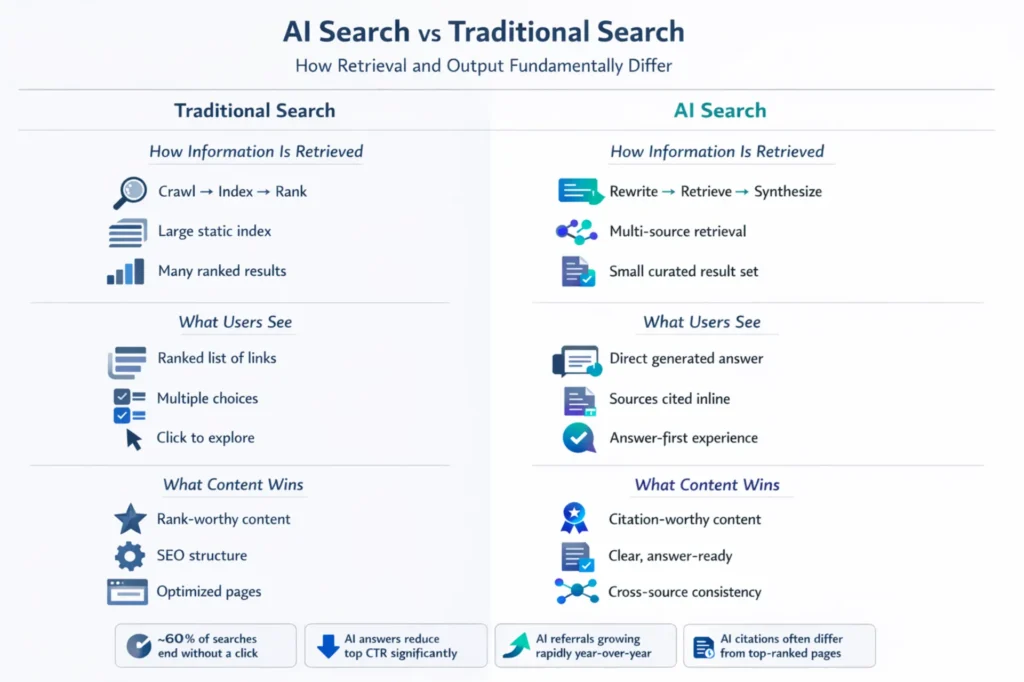
Google and Bing operate on a crawl-and-rank model: Googlebot continuously indexes hundreds of billions of pages and applies machine learning ranking models to return ordered lists of links. AI platforms operate on a retrieve-and-synthesize model: they rewrite a query into targeted searches, retrieve a small set of documents, inject those passages into the model’s context window, and generate a synthesized answer with citations.
- Google output: 10–20 ranked links plus SERP features
- AI platform output: One synthesized narrative with 3–15 cited sources
- User role in Google: Choose which result to click
- User role in AI search: Judge whether the synthesized answer is sufficient
This is why the visibility funnel in AI search is dramatically narrower — and why appearing in position 4 on Google is meaningfully different from being one of 5 cited sources in a ChatGPT answer.
How Each Major AI Platform Retrieves Content
Each platform has a distinct retrieval architecture, though all share the RAG foundation. ChatGPT Search uses a RAG (Retrieval-Augmented Generation) approach. Before generating a response, the system queries the web, retrieves relevant documents, and incorporates that information into the generation with citation linking.
Perplexity runs a multi-layer process: initial retrieval, authority ranking, and additional quality gates that filter sources based on entity clarity and authoritativeness, with cross-verification across multiple domains before citing.
Claude uses Anthropic’s web search API to generate targeted queries and synthesize answers with source citations.
Gemini integrates directly with Google Search, pulling live web results and attaching citation metadata to every answer.
- All four use RAG architecture at their core
- Perplexity applies the most visible multi-layer source verification
- ChatGPT accounts for approximately 80% of AI search referral traffic
- Each platform has distinct source biases that affect which content gets cited
The Narrow Citation Funnel vs. the Broad SERP
A Google SERP for a competitive informational query might surface 10 organic results, 3 ads, a featured snippet, a local pack, and a People Also Ask section. An AI-generated search answer to the same query cites 3–15 sources, often far fewer than that. One cross-platform analysis found that only 12% of AI citations overlap with Google’s top-10 results.
Being well-ranked on Google does not mean being cited in AI search results. They are separate visibility systems that require separate optimization strategies.
What Content Gets Cited by AI Systems vs. What Ranks in Google?
The content requirements for AI citation and Google ranking overlap significantly — but not completely. Getting this wrong means optimizing only for traditional search and missing the highest-converting traffic source, or building AI-only content that underperforms in organic rankings.
ChatGPT Search uses a RAG approach — before generating any response, the system queries the web, retrieves relevant documents, and incorporates them with citation linking. That retrieval step has specific requirements that your content either meets or doesn’t.
Citation-Worthy vs. Rank-Worthy Content
Google’s ranking systems prioritize helpful, reliable, people-first content with demonstrated E-E-A-T signals. AI platforms optimize for extractability — content that can be pulled as a short, self-contained passage and injected directly into a model’s context window with the claim intact and the source verifiable.
- Google rewards: Topical authority, backlink signals, engagement metrics, E-E-A-T
- AI platforms reward: Answer-ready passages, statistical backing, multi-source corroboration
- The overlap: Credibility, authoritativeness, accurate citations, clear sourcing
- The divergence: AI systems don’t see your backlink profile; they evaluate whether your passage answers the question clearly enough to cite
Formatting Requirements for AI Extraction
AI retrieval systems work with small page segments — not full articles. The formatting requirements are specific:
- Answer-first structure: 40–60-word direct answers under each H2, before elaboration
- Question-based headings: H2s structured as questions match how AI platforms rewrite queries
- Bullet-heavy content: 40–60% bullet ratio enables AI parsing of key claims
- Statistical citations with verified sources: Claims backed by credible research build citation confidence
- Schema markup (Article/FAQ/Dataset): Structural signals that help AI systems understand content type
Why Only 12% of AI Citations Overlap with Google’s Top 10
Cross-platform analysis finds that ChatGPT disproportionately cites Wikipedia, Perplexity heavily cites Reddit, and only about 12% of AI citations overlap with Google’s top-10 results. Your existing Google rankings are not a reliable proxy for AI search visibility. A competitor who ranks #8 in Google but publishes answer-first, citation-verified content may be cited regularly in AI responses, while your #1-ranked page never appears. The two visibility systems require explicit, parallel optimization.
If your content strategy is optimized only for Google, you’re invisible in the channel that converts at 6x the rate. Content Ops Lab builds content infrastructure for both. Contact us today to discuss what a dual-platform approach looks like for your organization.
How Big Is AI Search Traffic and What Does It Actually Convert At?
AI search referral volume is small relative to Google, but the conversion data changes the ROI calculation entirely. In June 2025, AI platforms generated over 1.13 billion referrals to the top 1,000 websites globally, up 357% year over year. Google Search delivered 191 billion referrals to those same sites in the same month. By raw volume, there’s no comparison. But volume is not the right metric for evaluating a channel this early in its growth curve.
Current AI Referral Volume and Growth Trajectory
- AI referrals are growing 357% YoY, while Google referrals remain dominant by volume
- ChatGPT drives 80%+ of current AI search referral traffic
- AI referrals to news and media sites grew 770% year-over-year
- Referral rate from AI platforms has shown recent plateauing signals (dropping from 18.8% to 15.8% of visits between October 2025 and January 2026)
- Early citation dominance compounds: AI systems reinforce existing citation patterns over time
Conversion Rate Advantage of AI-Referred Visitors
AI-referred visitors arrive post-synthesis. They’ve already had their question answered, evaluated options, and followed a citation to a specific site. That’s a fundamentally different intent profile than a user who clicked a Google result to begin their research.
- AI-referred users complete the qualification before arriving
- Extended session behavior: more page views, deeper content consumption
- Trust transfer: being cited by an AI platform carries referral-like credibility
- Conversion behavior mirrors referral traffic more than organic search traffic
AI Search Performance Data From a 23-Month Production Test
Content Ops Lab’s production case study in a 12-location regulated healthcare organization provides direct conversion data from an optimized AI search implementation. Over 8 months (July 2025 – February 2026), AI search platforms generated 537+ sessions with 95+ confirmed conversions — a 21.4% average conversion rate against a 3.32% site baseline. That’s a 6.4x performance multiplier from less than 0.3% of total traffic.
ChatGPT traffic alone grew 887% in 7 months, with peak conversion rates reaching 40% in January 2026. An emerging brand within the same network — built from near-zero organic presence — achieved 653% impression growth and 1,700% click growth over 14 months using the same dual-platform content system.
Related: How AI Search Engines Decide Which Sources to Cite
Who Is Adopting AI Search and How Fast Is the Shift Happening?
The AI search adoption story is about behavioral change — how people phrase queries, how long they spend researching, and what role traditional search plays in their decision-making process. More than half of teens say they have used chatbots to search for information (57%) or get help with schoolwork (54%). The next generation of healthcare patients, legal clients, and home services customers is already using AI search as a default research tool.
Consumer and Enterprise Adoption Rates
McKinsey’s research indicates that approximately half of consumers already use AI-powered search engines intentionally. The same analysis estimates that about 50% of Google searches already include AI summaries, potentially rising above 75% by 2028, with roughly $750 billion in US revenue influenced by AI-powered search by that year. On the enterprise side, 65% of organizations report regularly using generative AI, nearly double the share from ten months earlier.
- ~50% of consumers are already using AI-powered search engines
- 65% of organizations regularly use generative AI
- AI Overviews are present in ~50% of Google searches now, projected to be 75%+ by 2028
- <5% of healthcare practices and <10% of legal firms are currently optimizing for AI search citations
Behavioral Changes in How People Research
51% of consumers say their research habits have changed due to generative AI, with 71% of those now phrasing queries more specifically and conversationally. This directly validates question-based content architecture as a structural advantage. Gartner also reports that 31% of consumers spend more time searching because of AI summaries, and 31% consider more product options — AI is lengthening and deepening the decision journey for complex purchases, including elective healthcare, legal services, and professional home services.
The Revenue at Stake by 2028
McKinsey estimates that by 2028, approximately $750 billion in US revenue could be influenced by AI-powered search. For multi-location businesses in healthcare, legal, and home services, the content published today is building — or failing to build — citation authority that will shape purchase decisions at scale over the next 24 months.
Should Multi-Location Operators Run Separate AI Search vs Google Search Strategies?
No — and yes. The underlying content architecture should be unified. The optimization layer needs to explicitly account for both channels. Running a single strategy optimized only for Google leaves the highest-converting channel underserved. The practical path is one content system built with dual-platform output as a design requirement, not an afterthought.
Where the Strategies Overlap
- Credibility and authoritativeness: Both channels reward verified claims, credible sourcing, and demonstrated expertise
- Structured formatting: Clear H1/H2/H3 hierarchies and concise answer blocks benefit both Google featured snippets and AI extraction
- E-E-A-T signals: Evaluated by Google’s quality systems and influence AI citation confidence
- Fresh, accurate content: Both channels deprioritize stale or inaccurate information
- Technical accessibility: Crawlable, indexable pages are the foundation for both channels
Where They Diverge
- Answer-first structure: Google rewards topical depth; AI systems require extractable 40–60 word answers at the top of each section
- Citation verification: AI platforms that cite fabricated data create compliance and credibility exposure
- Passage-level optimization: Google evaluates the whole document; AI retrieval evaluates individual passages
- Source corroboration: Perplexity cross-verifies claims across multiple domains — citing credible primary sources signals higher citation confidence
- Keyword strategy: Traditional SEO optimizes for exact-match density; AI search rewards conversational query matching
How to Sequence the Investment
Implementation takes 3–6 months, from knowledge documentation to template development to full production volume. The first-mover window in most regulated industries remains open — fewer than 5% of healthcare practices are optimizing for AI search citations — but competitive intensity is rising.
Start with content architecture (answer-first structure, question-based H2s, 40–60% bullet ratio), add citation verification, then scale publishing volume to the 20–50+ articles per month threshold where AI search citation authority compounds.
How Content Ops Lab Builds Dual-Platform Content Infrastructure
A 12-location regulated healthcare organization ran Content Ops Lab production system for 23 months — scaling from 10 articles per month to 50+, generating 1,000+ citation-verified articles and pages with zero compliance violations. The methodology that drove 887% ChatGPT traffic growth in 7 months also maintained dominant organic search performance during a significant LLM search disruption.
- 23-month production test inside a 12-location regulated healthcare organization
- 1,000+ citation-verified articles and pages with zero compliance violations
- 21.4% average AI search CVR vs. 3.32% site baseline — 6.4x performance multiplier
- 887% ChatGPT traffic growth in 7 months (July 2025–February 2026)
- 45% of all leads from organic search — outperforming paid search nearly 2:1
- 653% impression growth and 1,700% click growth for an emerging brand (14-month period)
- 5x production scale achieved without adding headcount
The Content Ops Lab Production System
- Research: Verified sources before generation — no AI writing from memory or fabricating citations
- Verification: Line-by-line citation cross-check with STAT vs. CLAIM labeling and full audit trail
- Optimization: Structured for Google ranking, AI extraction, featured snippets, and LLM citation simultaneously
- Delivery: WordPress-staged or Google Docs-packaged, publish-ready, Grammarly-reviewed, compliant
One architecture. Both channels. Built to the same verification standard.
Ready to build content infrastructure that ranks in Google and gets cited by AI platforms? Get in touch — we’ll assess your current content operation and outline what a dual-platform approach would look like for your organization.
FAQs About AI Search vs Google Search
Does optimizing for AI search hurt my Google rankings?
No. The content requirements for AI citation and Google ranking overlap significantly. Answer-first structure, question-based headings, verified citations, and 40–60% bullet ratios benefit both channels. The risk is building content optimized only for AI extraction at the expense of topical depth — a unified architecture designed for both avoids that trade-off.
How long does it take for AI-optimized content to start generating citations?
Initial citations can appear within weeks of publication if the content meets extraction requirements. Consistent volume typically builds over 3–6 months as publishing cadence and topical authority accumulate. The 23-month production case study shows 887% ChatGPT traffic growth across 7 months — a trajectory that begins slowly and compounds as citation patterns reinforce.
How do I track AI search vs Google search traffic and conversions separately?
AI referral traffic currently appears fragmented across multiple GA4 classifications — some as direct, some as referral from chatgpt.com, perplexity.ai, or claude.ai. Comprehensive attribution requires a dedicated UTM strategy plus manual GA4 channel grouping to consolidate AI referral sources. Total AI traffic volume is likely undercounted in most organizations’ current reporting.
What content formats are most likely to get cited by ChatGPT, Perplexity, and Claude?
Content most consistently cited across platforms shares these characteristics: an answer-first structure (40–60-word direct answers), question-based H2 headings, statistical claims backed by verifiable primary sources, FAQ sections mirroring conversational query patterns, and schema markup (Article, FAQ, Dataset). Perplexity specifically favors multi-source corroboration — citing credible primary research signals higher confidence to its reranking system.
Is optimizing for AI search vs Google search worth the investment for a mid-size multi-location business?
The conversion rate data makes the case. A channel that converts at 21.4% versus 3.32% changes the unit economics of content investment materially — even at low referral volumes. The first-mover window in most regulated industries is still open, which means early investment builds citation authority before competitors optimize for the same channel.
Key Takeaways
- AI search vs Google search uses fundamentally different architectures — one ranks documents, the other synthesizes answers and cites sources. Your content must satisfy both, or you’re invisible in one channel.
- 58.5% of US Google searches end without a click, and AI Overviews correlate with a 34.5% CTR reduction for top-ranking pages — traditional organic traffic is structurally eroding.
- Only 12% of AI citations overlap with Google’s top-10 results — strong Google rankings do not predict AI search visibility. The two channels require explicit, parallel optimization.
- A 23-month production case study delivered 21.4% average AI search CVR versus a 3.32% site baseline — a 6.4x performance multiplier from less than 0.3% of total traffic.
- The first-mover window remains open: fewer than 5% of healthcare practices are optimizing for AI search citations. Competitive intensity is rising — the window is measured in quarters, not years.
- A unified content architecture — answer-first structure, question-based H2s, citation-verified statistics, 40–60% bullet ratio — serves both channels from a single production system.
What Operators Who Get This Right Do Differently on AI Search vs Google Search
The search landscape has not replaced Google with AI — it has added a parallel channel with different rules, different content requirements, and dramatically higher conversion rates for complex purchases.
Operators who capture disproportionate share over the next 24 months will treat AI search citation as a production standard, not an experiment. A unified content infrastructure built to rank well on Google and to be cited by AI simultaneously is not a future capability. It’s the standard that first movers are already operating at. Content Ops Lab was built to close the gap.
Related: Why AI Referrals Convert Better Than Regular Search
One Comment
Comments are closed.