

Structured Content for AI Search: How It Gets You Cited by AI
Structured content for AI search increases your chances of being cited because these systems don’t read your pages the way humans do — they parse, chunk, and score discrete passages against specific queries, then select the highest-confidence excerpts to surface as answers. Research shows that AI systems parse HTML into vector chunks of 150–300 contiguous words, with the first 150 words receiving highest-priority extraction weighting, which means your content architecture determines whether your pages are citation candidates or are entirely invisible to AI retrieval.
AI search traffic converts at multiples of traditional organic traffic, and the operators capturing those citations now are building compounding advantages before the competitive window closes. Content Ops Lab built its content infrastructure inside a regulated, multi-location healthcare organization — 1,000+ citation-verified articles delivered with zero compliance violations over 23 months, with AI search converting at 21.4% average versus a 3.32% site baseline.
Related: How AI Search Engines Decide Which Sources to Cite
Why Doesn’t Most Business Content Get Cited by AI Search Engines?
Most business content wasn’t built for structured content for AI search — it was built for keyword-dense paragraphs optimized for 2019-era Google ranking signals, not for the passage-scoring systems that power ChatGPT, Perplexity, and AI Overviews today.
Research tracking citation patterns found that approximately 44.2% of citations come from the first 30% of the content, with citation likelihood declining steadily as the page deepens. If your most substantive answers are buried in paragraph four or five, they may never enter the extraction window.
How AI Systems Score and Select Passages
Modern answer engines use a retrieval-augmented generation (RAG) pipeline: they retrieve relevant passages from indexed documents, then generate answers conditioned on those passages. Your page is never evaluated as a whole — it’s broken into discrete chunks, and each chunk competes independently against the query.
- Passages scored on semantic similarity to query intent, not keyword overlap alone
- Chunks of 150–300 words were evaluated independently for relevance
- High-scoring chunks from multiple sources assembled into a single AI-generated answer
- Multi-source corroboration: systems cross-check passages across domains before citing
A well-structured 300-word section can outperform a 2,000-word article if it delivers a cleaner, more confident answer to the query being evaluated.
The Positional Bias Problem
AI retrieval systems exhibit measurable positional bias — earlier content earns disproportionate citation weight. This reflects how passage rankers are trained: on journalistic and academic writing that leads with conclusions and treats the opening paragraph as the primary information unit.
- First 30% of a page produces ~44% of AI citations
- Pages that bury answers below context, background, or preamble lose citation eligibility
- “Ski ramp” citation pattern: steep drop-off in citation probability after early sections
- Most business content opens with background, builds to the point, and delivers the answer late
That structure worked for engagement-optimized blog content. It fails for AI extraction.
Where Traditional Content Architecture Breaks Down
The structural patterns agencies have delivered for years — long narrative paragraphs, keyword-dense intros, and a conclusion-at-the-end structure — actively undermine AI citation eligibility. The problem isn’t the topic or depth. It’s architecture.
- Dense paragraph blocks force AI to summarize aggressively, increasing extraction error
- Keyword-stuffed intros signal promotional tone, which authority frameworks down-weight
- Generic claims without data give AI systems nothing concrete to attribute or cite
The content isn’t being ignored because it’s wrong. It’s being ignored because it’s not structured to be extracted.
What Structural Formats Do AI Systems Actually Favor When Selecting Sources?
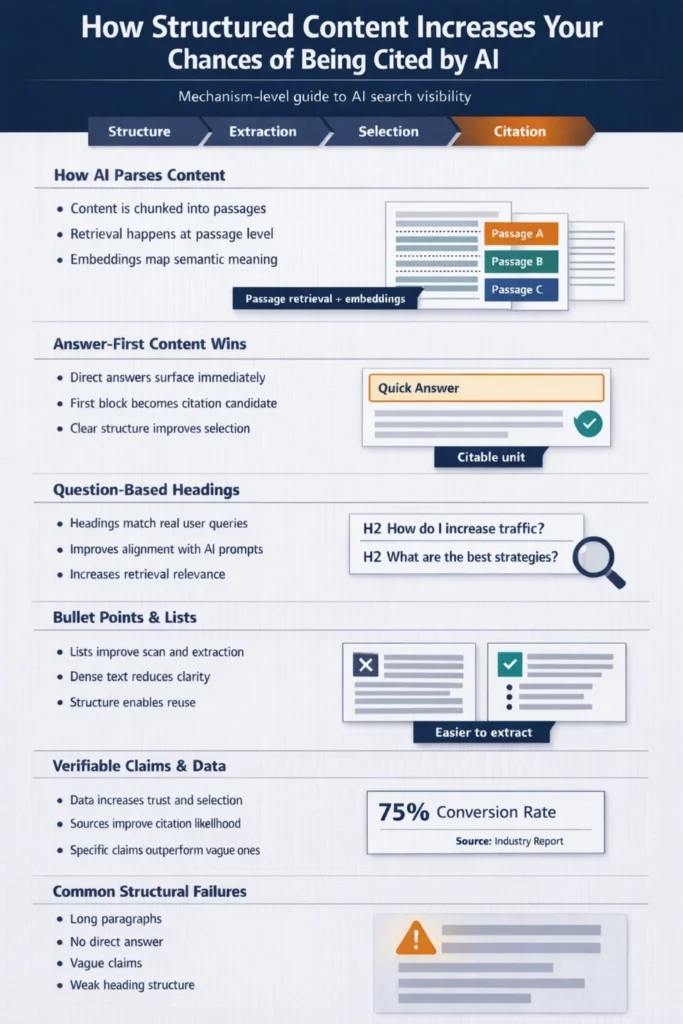
AI systems favor formats that create discrete, self-contained passages — answer-first openings, question-based headings, and bullet-heavy layouts that compress verifiable information into extractable units. This is the foundation of structured content for AI search: producing content that already resembles the output AI systems are trying to generate.
Research confirms that featured snippet paragraphs most commonly fall in the 40–60 word range, with longer answers often truncated — and the same length preference governs AI overview extraction.
Answer-First Architecture and Citable Units
A citable unit is a self-contained passage that can be quoted without requiring context from earlier in the article — typically 40–60 words that answer the question directly before supporting detail follows.
- Answer-first paragraphs fit within passage-length constraints that retrieval models prefer
- Self-contained answers don’t require the AI to reassemble fragments from multiple sentences
- Opening with the conclusion mirrors the BLUF structure that retrieval models are trained on
- Voice search answers average 29 words; AI overview paragraphs cluster around 40–60
Any answer that requires more context than that to make sense is structurally ineligible for citation — regardless of how accurate or authoritative the content is.
Question-Based Headings vs. Topic-Based Headings
Question-format H2 headings directly mirror the natural-language queries users submit to AI platforms, particularly voice and conversational search. AI systems use query fan-out — issuing multiple query variants — and question headings increase match probability across those variants.
- Question headings align content sections with query intent at the structural level
- Topic-based headings (“Benefits,” “Overview”) require semantic inference to match user questions
- QAE pattern: Question heading → direct answer in first 1–2 sentences → supporting evidence
- Each H2 functions as a mini landing page for a specific user question
H3S should address long-tail variants of that H2 question. That structure maps directly to how RAG systems target specific sections during retrieval.
Lists, Bullets, and Evidence Density
Lists and bullet points create discrete, attributable data units that AI systems can extract and cite without summarizing. Dense paragraphs require summarization, which introduces extraction error and reduces citation confidence.
- List items function as atomic facts: one claim per line, cleanly bounded
- Bullet-heavy content reduces the chance that supporting context is misread as the primary answer
- Tables and lists compress multiple data points into a small footprint — increasing evidence density per token
- Formats that map to user mental models (steps, comparisons, feature lists) require less generative transformation
A strong, structured content for AI search architecture combines answer-first openings with 40–60% bullet-heavy content in each section — the structural combination that scores highest across both featured snippet and AI overview extraction systems.
How Do You Build Content That AI Systems Reliably Extract and Cite?
Effective structured content for AI search requires three investments: organizing every section around the question-answer-evidence pattern, anchoring claims to verifiable statistics, and implementing a machine-readable structure that reduces the interpretive burden on retrieval systems. These aren’t design preferences — they’re the structural signals that determine whether your content competes in the AI citation economy.
The Question-Answer-Evidence Pattern
The QAE pattern is the most consistently cited structural recommendation across AI overview optimization research: heading mirrors the query, direct answer in the first 1–2 sentences, then evidence and supporting data.
- H2 heading mirrors the user’s question phrasing
- First 40–60 words: direct answer with primary keyword, no setup, no preamble
- Supporting H3S address sub-questions and long-tail query variants
- Each section functions as a self-contained answer unit — no earlier context required
Verifiable Claims as Citation Magnets
Research tracking 8,000+ AI citations found Wikipedia alone accounting for around 27% of ChatGPT citations — because that content is neutral in tone and rich in citations to primary sources. For multi-location operators, the path to citations lies in evidence density.
- Quantified claims anchor AI responses: exact numbers, dates, and methodology notes
- Original data and proprietary benchmarks become canonical references for AI answers needing that statistic
- Vague qualitative claims (“improve performance,” “drive growth”) score poorly on both semantic and authority dimensions
- Evidence density — the ratio of specific, verifiable claims to narrative filler — directly influences citation likelihood
Your proprietary performance data is an asset. Published operational benchmarks and location-level metrics are exactly the structured claims AI systems cite when they need concrete numbers.
Schema and Machine-Readable Structure
Pages that combine semantic HTML with structured data effectively label their own citable units, reducing the interpretive burden on retrieval systems.
- FAQPage schema makes question-answer pairs directly identifiable to retrieval systems
- Clean heading hierarchy (H1 → H2 → H3) without skipped levels enables accurate topic segmentation
- HowTo schema lets AI extract individual steps as discrete units
- Consistent H2/H3 hierarchy correlates with higher citation rates in AI-oriented SEO research
If your operation needs to produce 20–50+ articles per month without sacrificing compliance or quality, Content Ops Lab builds the infrastructure to make that possible. Contact us today to discuss your content production requirements.
What Does AI-Optimized Content Actually Deliver in Production?
A multi-location operator running a regulated healthcare organization used this content architecture across a 23-month production engagement. AI search traffic converted at 21.4% average over eight months, compared to a 3.32% site baseline — a 6.4x performance multiplier. That result came from consistent structural execution across 1,000+ citation-verified articles, built for structured content to meet AI search eligibility requirements at scale.
AI Search Conversion Performance at Scale
Across an 8-month measurement window, 537+ AI search sessions produced 95+ confirmed conversions at a 21.4% average CVR. ChatGPT alone grew from 8 sessions to 79 sessions in 7 months — 887% growth — with peak CVR reaching 40% in a single month.
- 21.4% average AI search CVR vs. 3.32% site baseline = 6.4x performance multiplier
- Peak ChatGPT CVR: 40% (January 2026) with 52 sessions
- Perplexity CVR: 25.7% during peak measurement period
- AI search represents <0.3% of total traffic, delivering a disproportionate share of conversions
The Compounding Effect of Citation Consistency
Once a source is established as a reliable citation target — across multiple queries and multiple platforms — retrieval models are more likely to continue selecting it. Citation authority compounds.
- 887% ChatGPT session growth in 7 months demonstrates early-stage compounding
- 188 question-based keywords ranking, 83% in positions 1–10
- Organic delivering 45% of all leads across a 12,487-lead, 6-month window — outperforming paid nearly 2:1
- 653% impression growth and 1,700% click growth for an emerging brand in 14 months
The operators who establish citation authority now are setting patterns that compound as AI search volume grows.
Multi-Platform Presence and Reduced Platform Dependency
Structured content that performs on ChatGPT also performs on Perplexity, Claude, and Gemini — the underlying extraction mechanics are similar across all RAG-based systems. ChatGPT accounts for approximately 80% of AI search traffic in current tracking data; multi-platform citation presence reduces that concentration risk.
- Claude, Gemini, and Qwen citations appearing in referral data alongside ChatGPT
- Platform diversification mirrors the same logic as a multi-channel organic strategy
- Structured content built for AI extraction doesn’t require platform-specific reformatting
Related: Why Generic Content Fails in AI Search Even If It Ranks in Google
What Structural Failures Are Preventing Your Content from Being Cited Today?
Most operators don’t have a content volume problem — they have a content architecture problem. Research comparing Google-ranked and ChatGPT-cited content confirmed that structure and organization — not sentence complexity — most influences AI citation. The failures preventing citation eligibility are structural: walls of text, buried answers, vague claims, and inconsistent heading hierarchies that force retrieval systems to guess at meaning rather than extract it.
Walls of Text and Over-Contextualization
Long, dense paragraphs containing multiple ideas are the most consistently cited structural failure in AI citation research. These formats bury key information, make passage boundaries ambiguous, and force AI models to summarize aggressively.
- Dense paragraphs reduce chunk confidence scores
- Over-contextualization pushes the citable unit outside the primary extraction window
- Pages where the answer is buried below paragraph four are passed over for more direct alternatives
The fix isn’t shorter articles — it’s restructured articles built around structured content for AI search principles: answer-first, evidence-supported, and section-by-section.
Vague Claims Without Evidence
Research on AI citation behavior confirms that content bloated with transition sentences and filler paragraphs dilutes information density and reduces citation likelihood. When AI systems choose among passages to support a statement, they select pages with specific, checkable details.
- Generic qualitative claims have no anchor for AI attribution
- Vague statements dilute semantic focus within a chunk, reducing similarity scores
- High-density content: front-loaded paragraphs, numbered lists, quantified claims, minimal filler
Every section that makes a claim without a number, a source, or a specific operational example is a missed citation opportunity.
Poor Heading Hierarchy and Promotional Tone
Inconsistent heading hierarchies — skipped levels, multiple H1S, styled text used as headings — make it difficult for retrieval systems to infer document structure and segment the page into coherent extraction chunks. Overtly promotional tone compounds the problem: AI citation analyses note that systems detect marketing signals and favor neutral, information-dense sources over pages that read like ads.
- Inconsistent H2/H3 hierarchy correlates with lower AI citation rates
- Promotional tone triggers down-weighting in editorial credibility frameworks
- Educational, evidence-backed, question-structured content earns citations — promotional pages earn visits from users already referred by AI
Done-For-You vs. System Build: Which Content Infrastructure Model Fits Your Operation?
Operators approaching structured content for AI search face a production decision before a strategy decision: who will build and run the system? Content Ops Lab offers two engagement models built on the same core methodology. Done—For—You managed production, and System Build with full ownership transfer.
Done-For-You for Teams Without Production Bandwidth
The Done-For-You model covers the complete production cycle: research, generation, citation verification, multi-platform optimization, and delivery. Most operators in this model publish 20–50+ articles per month without adding headcount.
- Research-first methodology: verified sources before generation, no AI writing from memory
- Citation verification on every article: line-by-line cross-check, STAT vs CLAIM labeling, audit trail
- Multi-platform optimization: Google + ChatGPT + Perplexity + Claude + Gemini in every piece
- WordPress staging delivery: meta titles, descriptions, URL slugs, internal linking — publish-ready
System Build for Organizations That Want Ownership
The System Build model transfers your team’s complete content production infrastructure over a 12-week implementation, followed by 90 days of post-launch support.
- Complete system documentation: single unified source of truth, version-controlled
- Custom templates: article generation, research workflow, citation verification, quality control
- SME interview documentation: proprietary expertise captured and integrated into production
- Training and live production: team operates the system before handoff, not after
Matching Model to Growth Stage
- Starting from near-zero organic presence: Done-For-You accelerates time-to-citation-authority
- Mature brand maintaining and expanding: System Build creates internal operational ownership
- Regulated industry with compliance requirements: both models include citation verification
- Multi-location growth stage: Done-For-You scales output per location without linear cost increases
How Content Ops Lab Builds Content Infrastructure
AI search traffic in our primary production case study converts at 21.4% average — 6.4x the site baseline — across a regulated, multi-location healthcare organization that reached 1,000+ citation-verified articles without a single compliance violation in 23 months. The structured content for AI search architecture that earns those citations is replicable, scalable, and documented.
- 23-month production test inside a regulated multi-location healthcare organization
- 1,000+ citation-verified articles and pages delivered with zero compliance violations
- 45% of all leads from organic search — outperforming paid nearly 2:1 across a 12,487-lead window
- 21.4% average AI search CVR vs. 3.32% site baseline — 6.4x performance multiplier
- 887% ChatGPT session growth in 7 months (July 2025–February 2026)
- 653% impression growth and 1,700% click growth for an emerging brand in 14 months
- 5x production scale: 10 articles/month to 50+ without adding headcount
- Dual-brand methodology: proven on mature brand maintenance and emerging brand growth simultaneously
The Content Ops Lab Production System
Every article Content Ops Lab creates moves through the same four-stage workflow — no exceptions — because citation eligibility is built at the structural level before a word is written.
- Research: Verified sources documented before AI generation begins — no writing from memory
- Verification: Every claim is cross-checked against source material, STAT vs CLAIM is labeled, and an audit trail is maintained
- Optimization: Multi-platform calibration for Google, ChatGPT, Perplexity, Claude, and Gemini in a single pass
- Delivery: WordPress staging or Google Docs — publish-ready, Grammarly-reviewed, compliance-confirmed
The system isn’t the AI tools. It’s the verification and structural infrastructure that makes AI-generated content trustworthy enough for regulated industries and citation-worthy enough for AI search platforms.
Ready to build a content infrastructure that scales without the compliance risk? Get in touch today — we’ll assess your current content operation and outline what a systematic approach would look like for your organization.
FAQs About How Structured Content Increases Your Chances of Being Cited by AI
How long does it take for structured content for AI search changes to affect citation rates?
Structural improvements can show AI citation impact within 60–90 days for pages already indexed, with compounding results accumulating over 6–12 months of consistent production. AI systems reinforce existing citation patterns — the more consistently your content earns citations, the more reliably retrieval models return to your pages.
What’s the difference between optimizing for Google featured snippets and optimizing for AI search citations?
The structural requirements overlap significantly — answer-first format, 40–60 word opening answers, question-based headings, bullet-heavy layouts. AI citation systems place a heavier weight on cross-source corroboration, verified claims, and editorial credibility signals. Content that earns featured snippets is a strong starting point; structured content for AI search adds statistical backing, schema markup, and transparent sourcing on top of that foundation.
How does Content Ops Lab verify that content meets AI extraction standards before publishing?
Every article goes through citation verification against source research (line-by-line cross-check with STAT vs CLAIM labeling), structural review for answer-first formatting and question-based H2 architecture, Grammarly review targeting a 95+ score, and readability scoring targeting Grade 8–10 — before delivery, not after.
Can structured content strategy work for industries outside healthcare?
The methodology is industry-agnostic — built for regulated healthcare, which carries stricter compliance requirements than most sectors. Legal, home services, financial services, and franchise operations face the same structural challenges: high volume requirements, compliance exposure, and the need for verifiable claims. The QAE architecture that produces AI-eligible content in healthcare translates directly to any industry where authoritative, evidence-backed content has a competitive advantage.
What content volume does a multi-location business need to compete for AI citations?
Competitive citation presence typically requires 20–50+ articles per month across a multi-location network. Citation authority is built across a content network, not a single article. Consistent structural quality, combined with sufficient production velocity, creates compounding structured content for AI search presence over time.
Key Takeaways
- AI systems parse content as discrete 150–300 word chunks, scoring each independently — content architecture determines citation eligibility before relevance is evaluated
- Approximately 44% of AI citations come from the first 30% of a page; answer-first structure is a retrieval system requirement, not a style preference
- Question-based H2 headings, 40–60 word direct answer openings, and 40–60% bullet-heavy layouts are the structural signals that most consistently correlate with AI citation selection
- Verifiable, quantified claims create citation magnets — proprietary performance data is structurally more citable than qualitative assertions available from dozens of competing pages
- AI search traffic converts at 6.4x the rate of traditional organic traffic in production data — operators capturing those citations now are building compounding advantages before the competitive window closes
- The first-mover window for AI citation authority is measured in quarters; structural content investment that begins now compounds through 2026 and beyond
Build Content Infrastructure That Compounds: How Structured Content Increases Your Chances of Being Cited by AI
AI retrieval systems select the pages that are easiest to extract, most likely to be cited, and most aligned with the question being asked. Structure and organization — not writing quality or topic depth — are the primary variables in that selection. The operators who understand this are building structured content for AI search from the start: answer-first formatting, question-based architecture, evidence-dense bullets, and verified statistical claims.
Content Ops Lab built that infrastructure inside a regulated, multi-location organization — 23 months, 1,000+ articles, and a 6.4x AI search conversion advantage that compounds with every citation earned. The structural decisions you make in the next quarter determine which side of that advantage your operation sits on.
Related: What Is Content Infrastructure for Multi-Location Brands?